Traditional Marketing vs Digital Marketing: Which One Actually Grows Your Business in 2026?
Difference between digital marketing and traditional marketing – I’ll tell you something that happened to my friend Rakesh.
He runs a sweet shop in Nagpur — three generations of family business. His grandfather built it, his father kept it alive, and now Rakesh is trying to grow it in 2026.
Two years ago, he spent ₹80,000 on a full-page Diwali newspaper ad. Beautiful design. The whole family was excited.
Results? He sold roughly the same as the previous Diwali. Maybe a little more. There was no way of knowing if the ad did anything.
Last year, his nephew convinced him to try Instagram. They shot a simple video of the mithai being made by hand — no editing, no filter. Just the sound of the kadhai, his father rolling laddoos exactly like he had for 50 years.
That video got 4 lakh views. Diwali orders went up 340%. People drove in from other cities.
Now — does that mean newspaper ads are dead and Instagram always wins?
No. That’s not the lesson.
The real lesson is that Rakesh didn’t understand why one worked and the other didn’t. And most businesses — big and small — are in exactly the same position right now.
So let’s fix that, properly.
What You’ll Learn in This Article
- What traditional marketing and digital marketing actually are (no jargon)
- The 6 real differences that matter for your business
- Which one works better — and for which type of business
- Real Indian examples from businesses that got this right
- A practical action plan based on your budget
- Honest answers to the questions people are actually Googling
What Is Traditional Marketing? (Simple Definition)
Traditional marketing is any form of promotion that reaches people through offline, physical channels — everything that existed before the internet.
Your grandfather experienced it every day. Radio jingles he still hums. Newspaper ads he’d clip and keep. The salesman who came door to door. The cinema hall slide before the movie started.
Today, it looks like this:
- The Amul hoarding you pass every morning on your commute
- The jingle on FM radio that gets stuck in your head
- The pamphlet someone slid under your windshield wiper
- The IPL jersey sponsorship you see during every match
- The brochure that arrives in your letterbox
Traditional marketing works through repetition and mass reach. You see the same brand on a billboard every day for a month. Eventually, you hear the same jingle on two different radio stations. You don’t choose to engage with it — it just gets into your head over time.
That’s the design. And it still works.
Nobody who has watched a Fevicol ad forgets it. That kind of brand memory — built slowly, over years of consistent presence — is traditional marketing doing exactly what it was built to do.
Quick Fact: Television advertising in India is still a ₹30,000+ crore industry. Traditional marketing is not dying — it’s simply no longer the only option.
What Is Digital Marketing? (And Why It’s Much More Than Instagram)
When people hear “digital marketing,” most picture Instagram posts or Google ads.
That’s like saying cricket is just batting.
Digital marketing is every way a business shows up and communicates online — across devices, platforms, and channels.
Here’s what it actually includes:
- SEO (Search Engine Optimisation) — when your website appears on Google without paying for ads
- Google Ads / PPC — paid ads that appear when someone searches for your product
- Social Media Marketing — Instagram, Facebook, LinkedIn, YouTube, Twitter/X
- Email Marketing — newsletters, offers, and follow-up sequences sent to subscribers
- Content Marketing — blogs, videos, podcasts that attract and educate your audience
- WhatsApp Marketing — direct communication at scale (massive in India)
- Influencer Marketing — partnering with creators who already have your audience’s trust
- Affiliate Marketing — paying others a commission when they send you customers
This article you’re reading right now? Content marketing. The “cake near me” result that shows your local bakery? Local SEO. The pharmacy reminder on WhatsApp? That’s digital marketing too.
It’s massive. It’s everywhere. And most businesses are barely touching the surface of what’s possible.
The One Core Difference Between Both
What separates digital from traditional at its core is one word: feedback.
With traditional marketing, you shout into a room and hope someone heard you. With digital marketing, however, the room shouts back — and you can see exactly who turned around, who walked toward you, and who left.
That single shift changes everything about how you make business decisions.
Traditional Marketing vs Digital Marketing: 6 Differences That Actually Matter
Let’s skip the boring textbook comparison. Here are the differences that will actually change how you spend your money.
1. Cost — and the Risk That Comes With It
Here’s what nobody tells you clearly enough.
Traditional marketing costs are fixed and upfront. You pay before you know if it works.
| Traditional Channel | Approximate Cost (India) |
|---|---|
| 30-sec TV ad slot (prime time, Hindi news) | ₹5 lakh – ₹40 lakh |
| Highway hoarding in Mumbai | ₹3 lakh – ₹15 lakh/month |
| Full-page national newspaper ad | ₹10 lakh – ₹25 lakh |
| FM radio spot (30 sec, metro city) | ₹80,000 – ₹3 lakh |
Once it runs, it runs. You can’t pause it or tweak it mid-campaign. It plays out and you wait.
By contrast, digital marketing works completely differently.
| Digital Channel | Starting Budget (India) |
|---|---|
| Google Ads (local business) | ₹10,000 – ₹50,000/month |
| Instagram/Facebook Ads | ₹5,000 – ₹25,000/month to test |
| Email Marketing | ₹2,000 – ₹8,000/month (tool cost) |
| SEO (with agency) | ₹15,000 – ₹60,000/month |
| WhatsApp Marketing | ₹3,000 – ₹15,000/month |
You can start a Google Ads campaign today with ₹500. See data in 24 hours. If it’s working, put more in. If it’s not, stop it and try something different. You never lose a lakh on a single bad bet.
This isn’t just a cost conversation. It’s a risk conversation. And for most businesses — especially smaller ones — managing risk is everything.
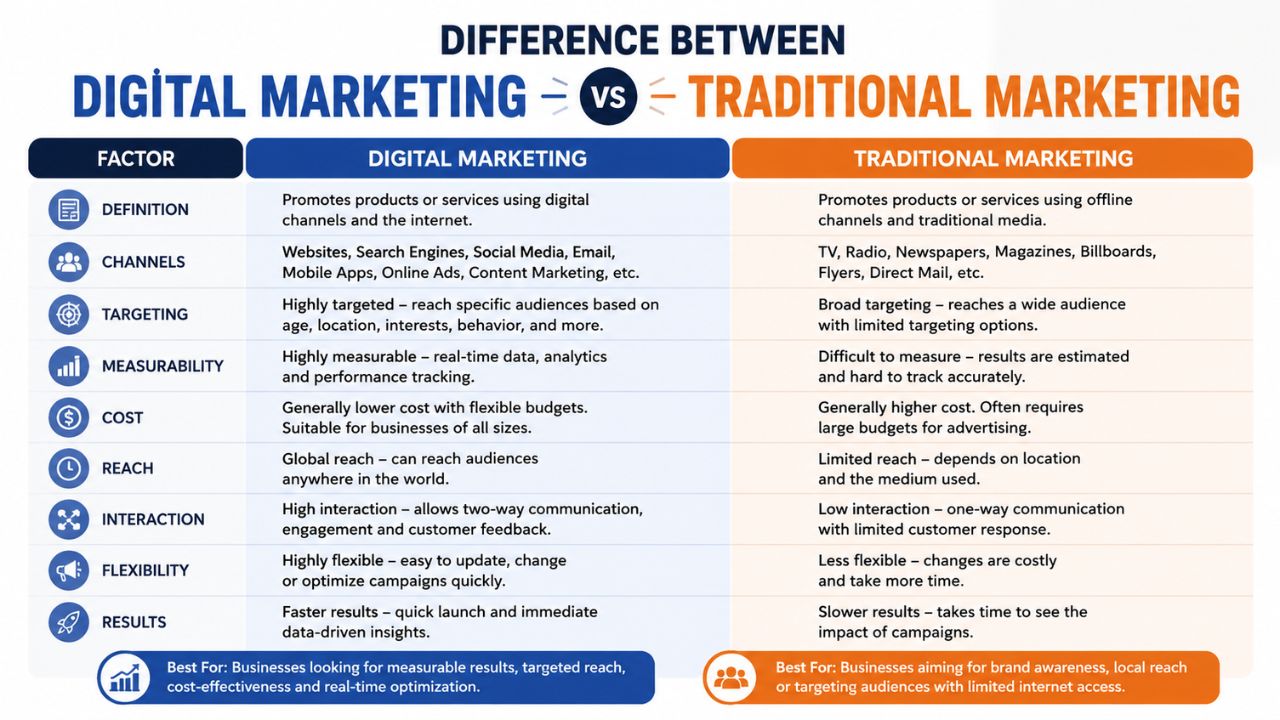
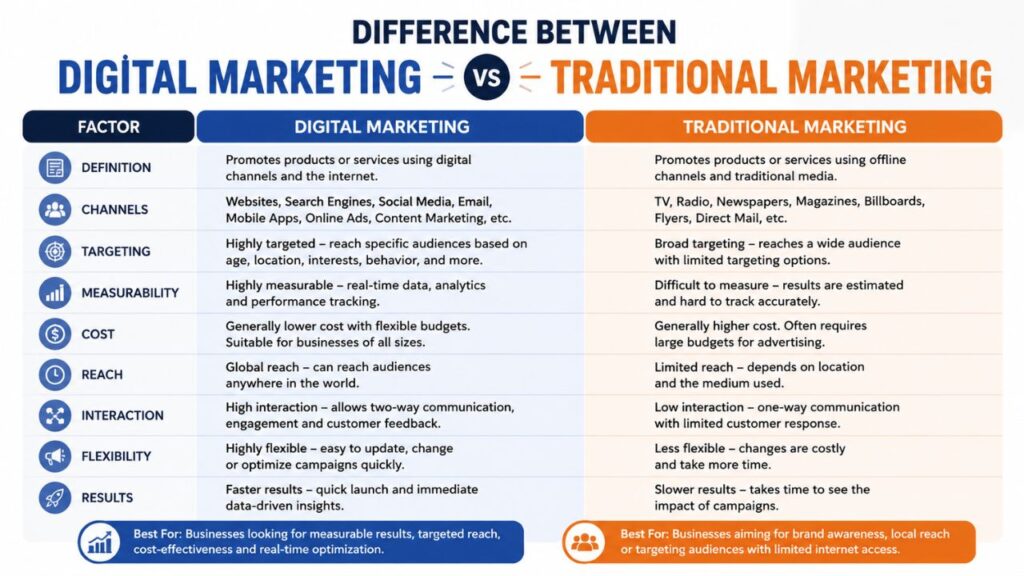
Difference between digital marketing and traditional marketing
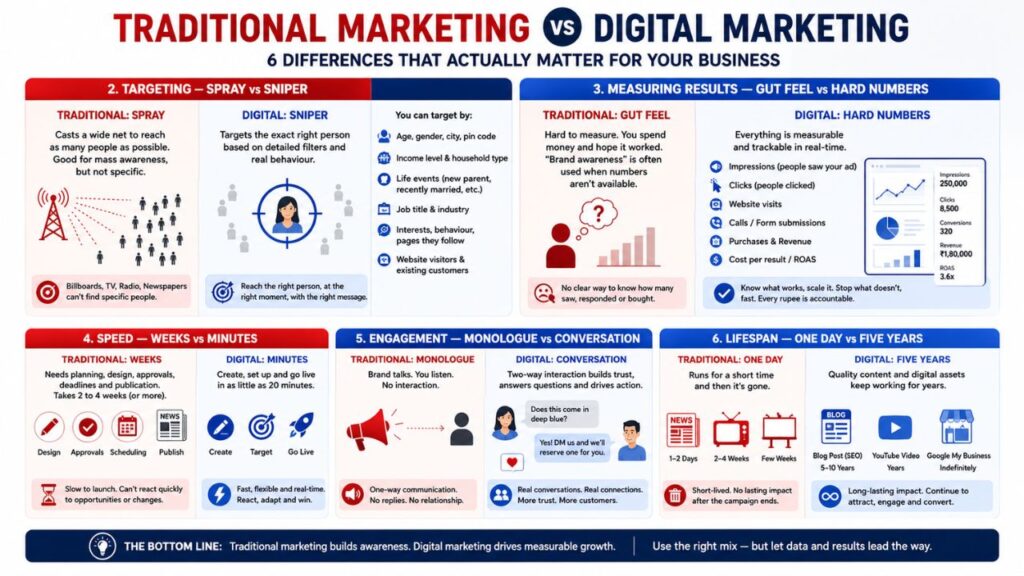
2. Targeting — Spray vs Sniper
Traditional marketing casts a wide net. Sometimes, that’s exactly what you need.
Launching a new biscuit brand and want 10 crore Indians to hear your name? TV is still one of the fastest ways to do that. Mass reach, mass awareness.
But most businesses are not launching national biscuit brands.
Most businesses want to reach a very specific person — the 32-year-old woman in Bengaluru who just had a baby and is looking for organic food, the 45-year-old Delhi business owner shopping for accounting software, or the college student in Pune who wants to learn graphic design.
No newspaper or billboard can find those people specifically. Digital marketing can.
Meta’s ad platform alone lets you target by:
- Age, gender, city, and pin code
- Income level and household type
- Recent life events (new parent, recently married, just moved)
- Job title and industry
- Interests, purchase behaviour, and pages they follow
- Whether they’ve visited your website before
In other words, you’re not spraying and praying. You’re having a focused conversation with the exact right person, at the right moment.
3. Measuring Results — Gut Feel vs Hard Numbers
Be honest with yourself here.
How many businesses have spent lakhs on traditional advertising with absolutely no way of knowing whether it made a difference? “Brand awareness” is a real thing. But it’s also sometimes what marketers say when they can’t show anyone the actual numbers.
Digital marketing, on the other hand, is built on proof.
You know exactly:
- How many people saw your ad
- How many clicked through
- How many visited your website
- How many called or filled a form
- How many bought — and what each sale cost you
When a clothing brand spends ₹50,000 on Instagram ads and gets ₹1.8 lakh in sales, they know their return was 3.6x. When a different ad doesn’t work, they find out within 3 days and stop it before wasting the full budget.
That kind of clarity changes how you grow. As a result, you stop gambling on campaigns and start making decisions based on what’s actually happening in front of you.
4. Speed — Weeks vs Minutes
A newspaper ad needs a layout, approval, a submission deadline, and a publication date. You’re looking at 2 to 4 weeks minimum from idea to someone actually reading it.
A digital ad, however, can be live in 20 minutes.
This matters more than it sounds. A restaurant can promote its lunch special at 10am and have it in front of hungry office workers by noon. Traditional marketing simply can’t do that.
Or think about what happened during COVID-19. Businesses that relied only on traditional marketing were completely stuck — their entire playbook disappeared overnight. Businesses with a digital presence — email lists, social media following, online ordering — adapted in days, not months.
Speed is competitive advantage. Digital gives you that speed.
5. Engagement — Monologue vs Conversation
A billboard doesn’t reply when you have a question. A TV ad doesn’t know your name. Traditional marketing is a monologue — the brand talks, you listen, and that’s the end of the interaction.
Digital marketing, by contrast, can be a genuine two-way conversation.
Someone sees your saree collection on Instagram and comments: “Does this come in deep blue?” You reply in 10 minutes: “Yes! DM us and we’ll reserve one for you.” They buy. That exchange — that small human moment — cost you nothing except 2 minutes of attention. And it converted someone who was just browsing into a paying customer.
People buy from brands they feel connected to. Digital gives you the tools to build that connection at scale — something traditional marketing structurally cannot offer.
6. Lifespan — One Day vs Five Years
Think about how long a newspaper ad lasts. It runs for a day, maybe two, and then it’s in the recycling bin.
Similarly, a TV ad campaign runs for a few weeks and then it’s gone — no trace.
Now consider a well-written blog post that answers a question thousands of people are Googling every month. It can bring visitors to your website every single day for five to ten years — without spending another rupee on promotion.
A YouTube video that genuinely teaches something keeps getting views long after you posted it. A strong Google My Business profile brings in local customers indefinitely.
This is precisely why content marketing and SEO have such extraordinary long-term value. You invest time and money once, and it keeps working for you on its own long after.
Difference between digital marketing and traditional marketing
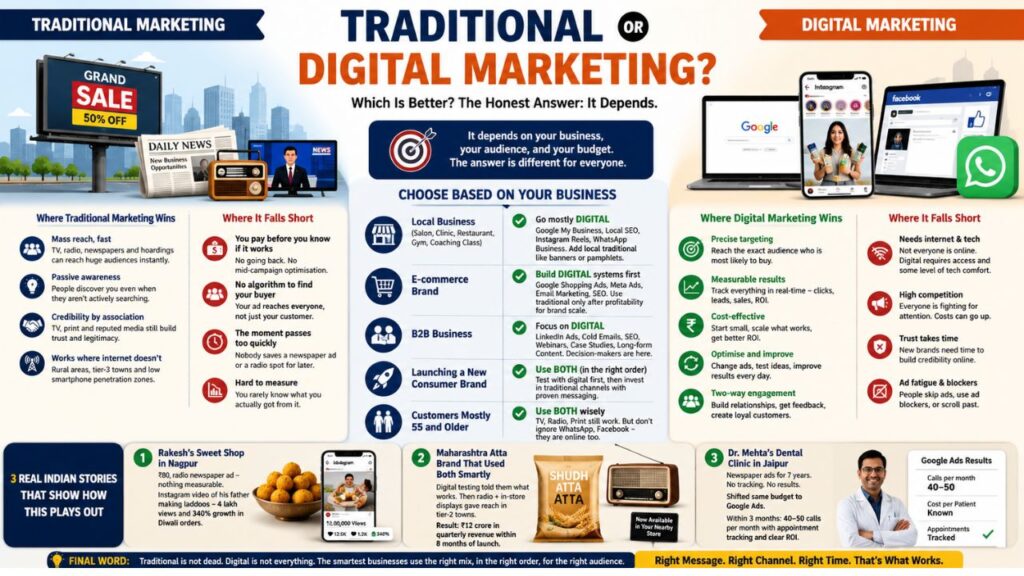
Which Is Better — Traditional or Digital Marketing?
Here’s the honest answer most articles won’t give you: it depends on your business, your audience, and your budget — and the answer is genuinely different for everyone.
Let me break it down by business type so you can actually apply this to your situation.
You Run a Local Business (Salon, Clinic, Restaurant, Gym, Coaching Class)
Go mostly digital — especially Google.
Research shows that 76% of people who search for a local business on their phone visit that business within 24 hours. Traditional marketing cannot touch that kind of purchase intent.
Start with these:
- Google My Business — free, and the most powerful local tool most owners haven’t properly set up
- Local SEO — getting your website to appear in “near me” searches
- Instagram Reels — show your work, your team, your process
- WhatsApp Business — for follow-ups, appointment reminders, offers
You can certainly add local traditional elements too — a flex banner near your location, pamphlet distribution in your colony. But digital is clearly where your growth is.
You Sell Products Online (E-commerce Brand)
Build digital systems first. Traditional comes later.
Google Shopping ads, Meta ads, email marketing for repeat buyers, and SEO for product pages — build these well and they’ll largely run your business. Consider traditional advertising only after you’re profitable and ready to accelerate brand recognition at scale.
You Sell to Other Businesses (B2B)
LinkedIn and email. That’s genuinely where your buyers are.
Business decision-makers are not swayed by hoardings. Instead, they read detailed articles, attend webinars, download case studies, and trust recommendations from peers they respect.
Therefore, invest in: LinkedIn ads, cold email marketing, SEO targeting the problems your buyers search for, and long-form content that consistently proves your expertise.
You’re Launching a New Consumer Brand
Use both — but in the right order.
Start with digital to test your messaging cheaply. Which angle resonates? Which product image converts? Which headline gets clicks? Once you know what genuinely works, invest in traditional channels — TV, radio, outdoor — with confidence, because you’ve already done your testing at low cost.
Your Customers Are Mostly 55 and Older
Don’t abandon traditional — but don’t ignore digital either.
TV, radio, and print still carry significant trust with older demographics. However, WhatsApp and Facebook have surprisingly deep penetration with the 50+ age group across India. Meet your audience where they actually are — which is increasingly online, even if they arrived there later than younger generations.
3 Real Indian Stories That Show How This Plays Out
Story 1: Rakesh’s Sweet Shop in Nagpur
You already know this one from the opening. ₹80,000 newspaper ad — nothing measurable. A simple Instagram video of his father making laddoos — 4 lakh views and 340% growth in Diwali orders.
Why did the video work where the newspaper didn’t? Because it wasn’t an ad. It was a story. It showed something real, and people didn’t feel sold to — they felt something genuine. That’s what great marketing does, regardless of the channel.
Story 2: A Maharashtra Atta Brand That Used Both Smartly
A mid-sized company launched a new wheat flour brand two years ago across Maharashtra. They started with digital — running six different Facebook and YouTube ads targeting homemakers in Pune, Nashik, and Nagpur — and tracked which message made women actually search for the product.
Once they found what worked, they took it to traditional — radio spots on local FM stations, in-store displays in kiranas. The digital testing told them exactly what to say on radio. Traditional, meanwhile, gave them reach in tier-2 towns where social media penetration was still growing.
Result: ₹12 crore in quarterly revenue within 8 months of launch.
Story 3: Dr. Mehta’s Dental Clinic in Jaipur
Dr. Mehta had been advertising in local newspapers for 7 years. ₹8,000 per ad, twice a month — ₹16,000 monthly with zero way to measure whether a single patient came because of it.
His daughter convinced him to pause the newspaper ads and shift that exact same budget to Google Ads targeting “dentist in Jaipur” and “teeth cleaning near me.”
Within 3 months, he was getting 40–50 calls per month directly from the ads, with full appointment tracking and a clear cost-per-patient number he could actually plan around.
He never went back to the newspaper.
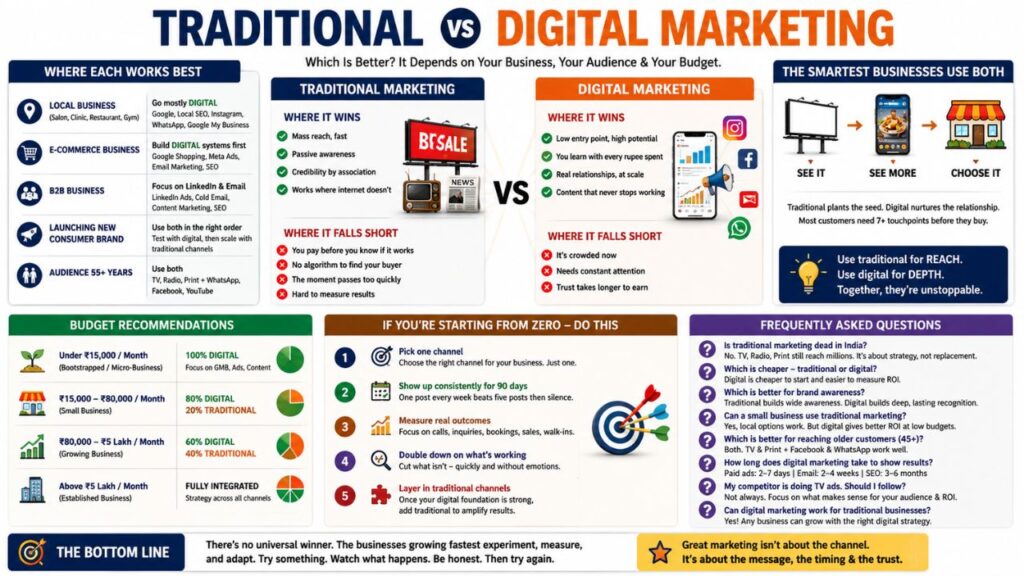
Difference between digital marketing and traditional marketing
Honest Pros and Cons — The Full Picture
Traditional Marketing: Where It Wins
Mass reach, fast. No digital campaign reaches 5 crore people in one evening the way a prime-time TV ad can.
Passive awareness. People don’t have to be actively looking for you to discover you. The billboard you pass every day plants a seed — and that seed matters when you’re finally ready to buy.
Credibility by association. Being on TV or in a respected newspaper still signals legitimacy to many people, particularly older demographics. That trust accumulates over time and is genuinely hard to replicate online.
Works where internet doesn’t. Rural India, tier-3 towns, areas with low smartphone penetration — traditional media like radio and local cable TV still reach these audiences effectively.Traditional Marketing: Where It Falls Short
You pay before you know if it works. Once the ad runs, it runs. There’s no undo button and no mid-campaign optimisation.
No algorithm to find your buyer. The distribution is entirely fixed. Your newspaper ad reaches everyone who reads that edition — whether they’re your customer or not.
The moment passes too quickly. Nobody saves a billboard in their camera roll. Nobody shares a radio ad with a friend. The interaction is one-directional and gone in seconds.
Digital Marketing: Where It Wins
Low entry point, high potential. A business of one person, with a phone and ₹5,000, can compete for attention against brands with 50x the budget — if they’re smarter and more creative about it.
You learn with every rupee spent. Every campaign teaches you something real — what headline works, what time your audience is most active, what fear or desire makes them act. Over time, this knowledge compounds and your marketing keeps getting sharper.
Real relationships, at scale. An email list of 10,000 people who genuinely want to hear from you is a business asset that no competitor can take — not a platform change, not an algorithm update.
Content that never stops working. A good SEO article, a helpful YouTube video, a well-optimised Google My Business profile — these keep delivering results long after you created them.
Digital Marketing: Where It Falls Short
It’s crowded now. Every business is online. Standing out requires genuine creativity and consistency — and most businesses start strong, then quietly fade.
It needs constant attention. SEO, social media, email — none of these are set-and-forget. Algorithms change, trends shift, and you have to keep showing up. For business owners already wearing 10 hats, that’s a real and honest challenge.
Trust takes longer to earn. Online, anyone can claim to be the best. Consumers know this and they’re naturally skeptical. Building real credibility through digital channels takes sustained honesty and patience — there are no shortcuts.
Why the Smartest Businesses Don’t Choose Between Them
The biggest mistake is treating this like an either/or question.
Imagine you’re a potential customer. You drive past a hoarding for a new restaurant and half-notice it. A week later, an Instagram Reel of that same restaurant’s chef — explaining why he uses only locally sourced vegetables — shows up on your feed. You watch the whole thing. The next time you’re choosing where to eat, that restaurant comes to mind first.
Did the hoarding do that? Did the Reel? Both. Together.
This is how the human brain actually works. Most purchases don’t happen on the first touchpoint — research consistently shows people need to encounter a brand 7 or more times before they trust it enough to spend money.
Traditional marketing plants the seed — it gets your name in front of people even before they’re looking for you. Digital marketing nurtures the relationship — it answers their questions, shows proof, and makes it easy to take the next step when they’re ready.
Use traditional for reach. Use digital for depth. Together, they’re far more powerful than either alone.
Budget Recommendations by Business Size
Not everyone has the same budget. Here’s a realistic starting point based on what you’re working with:
Under ₹15,000/Month (Bootstrapped or Micro-Business)
Go 100% digital. Set up Google My Business today — it’s free. Spend ₹8,000–10,000 on targeted ads on the platform where your customers spend time. Use whatever’s left to create one genuinely good piece of content every week. Don’t touch traditional until you have more breathing room.
₹15,000 – ₹80,000/Month (Small Business)
80% digital, 20% local traditional. A small local newspaper or FM radio spot builds area brand recognition, while the bulk of your budget goes into SEO, social ads, and WhatsApp marketing where you can measure every rupee.
₹80,000 – ₹5 Lakh/Month (Growing Business)
60% digital, 40% traditional. Invest in quality content and paid digital for performance, then layer in outdoor or print advertising for credibility and reach. Each channel should have a clear role and a way to measure its contribution.
Above ₹5 Lakh/Month (Established Business)
Fully integrated strategy. OTT platform ads, digital performance marketing, influencer partnerships, TV and radio for mass awareness — with every channel tracked, measured, and accountable. At this level, the question isn’t which channel to use. It’s how to make them all work together.
If You’re Starting From Zero — Here’s What to Actually Do
Don’t try to be on every platform at once. That’s precisely how you end up doing five things badly and burning out within 60 days.
Step 1: Pick one channel that fits your business type, based on the guide above. Just one.
Step 2: Show up consistently for 90 days. Not perfectly — consistently. One post every week, done without fail, beats five posts in one week followed by complete silence.
Step 3: Measure real outcomes. Not likes, not followers — calls, inquiries, bookings, sales, walk-ins. If you can’t connect the activity to an actual business result, it’s not working yet.
Step 4: Double down on what’s working. Cut what isn’t — quickly and without sentimentality.
Step 5: Once you have a solid digital foundation, start layering in traditional channels that complement what you’ve built. Not replace it — complement it deliberately.
This approach costs less, teaches you far more, and builds something that actually lasts beyond the first few months.
Frequently Asked Questions
Q: Is traditional marketing dead in India?
No — and anyone saying it is hasn’t looked at the data recently. TV advertising in India is a ₹30,000+ crore industry. Radio still reaches 65 crore people every week. Traditional marketing isn’t dying — it’s simply being repositioned from the only option to one option among many. The brands winning today use it strategically rather than by habit or default.
Q: Which is cheaper — traditional or digital marketing?
Digital is significantly cheaper to start, especially for small and medium businesses. You can begin with ₹5,000–10,000 a month and get real, measurable results. Traditional marketing, on the other hand, typically requires a minimum of ₹50,000 to make a meaningful impact — and often much more, depending on the channel.
Q: Which is better for building brand awareness?
Both work — but in meaningfully different ways. Traditional builds wide, fast awareness across large audiences quickly. Digital, however, builds deeper and longer-lasting recognition through consistent content and genuine engagement. For most businesses in 2026, digital content — especially video — is building brand awareness more cost-effectively than traditional channels ever could.
Q: Can a small business with a tiny budget use traditional marketing?
Yes — local options like colony-level pamphlet drops, small ads in local newspaper editions, or sponsoring a neighbourhood event can be affordable and surprisingly relevant. However, for most small businesses, digital gives dramatically better ROI at a much lower entry point. Start digital, then add traditional as your budget grows.
Q: Which is better for reaching older customers (45+ age group)?
Both work well, actually. TV and print still carry strong trust with older demographics. At the same time, Facebook has enormous penetration with the 40–60 age group in urban India, and WhatsApp is used daily across all age groups. Don’t assume older customers aren’t online — many are, they’re simply on different platforms than younger audiences.
Q: How long does digital marketing take to show results?
Paid ads (Google, Meta): results within 2–7 days. Email marketing: 2–4 weeks. SEO and content marketing: 3–6 months to build real momentum. The slower channels take longer to start, but the results compound significantly — what you build in month 4 is still actively working for you in year 4.
Q: My competitor is doing TV ads. Should I follow?
Not automatically. Your competitor’s budget, target audience, and goals may be completely different from yours. What matters is whether TV actually makes sense for your audience and your return on investment. Very often, while big competitors spend heavily on TV, smart smaller brands quietly dominate digitally — in spaces where the big players simply aren’t paying close attention.
Q: Can digital marketing work for traditional or old-school businesses?
Every time someone asks this, I think of a 40-year-old saree shop in Varanasi that started posting videos of their weavers on Instagram. Their following eventually grew to 2 lakh. Today, they ship sarees internationally. The business itself is old. The Instagram account is just 3 years old.
The age of your business doesn’t matter. Your willingness to show up honestly — and consistently — is what actually does.
The Bottom Line
Stop looking for a winner between the two.
There is no universal answer that says traditional marketing is better or digital marketing is better. There’s only what works for your specific business, your specific customers, and your specific moment in time.
What I can say with confidence, though: the businesses growing fastest right now are the ones willing to experiment, measure honestly, and change course when something isn’t working — rather than defending a decision they made two years ago.
Rakesh’s sweet shop isn’t growing because Instagram is magic. It’s growing because his nephew tried something new, it worked, and they leaned into it hard — without going back to what wasn’t working before.
Your job is the same. Try something. Watch what actually happens. Be honest about it. Then try again.
That’s not just a marketing strategy. That’s how anything worthwhile gets built.
If this helped you think more clearly about your marketing decisions, share it with someone who’s been going back and forth on whether to spend their budget on a newspaper ad or Instagram. They need to read this more than you did.