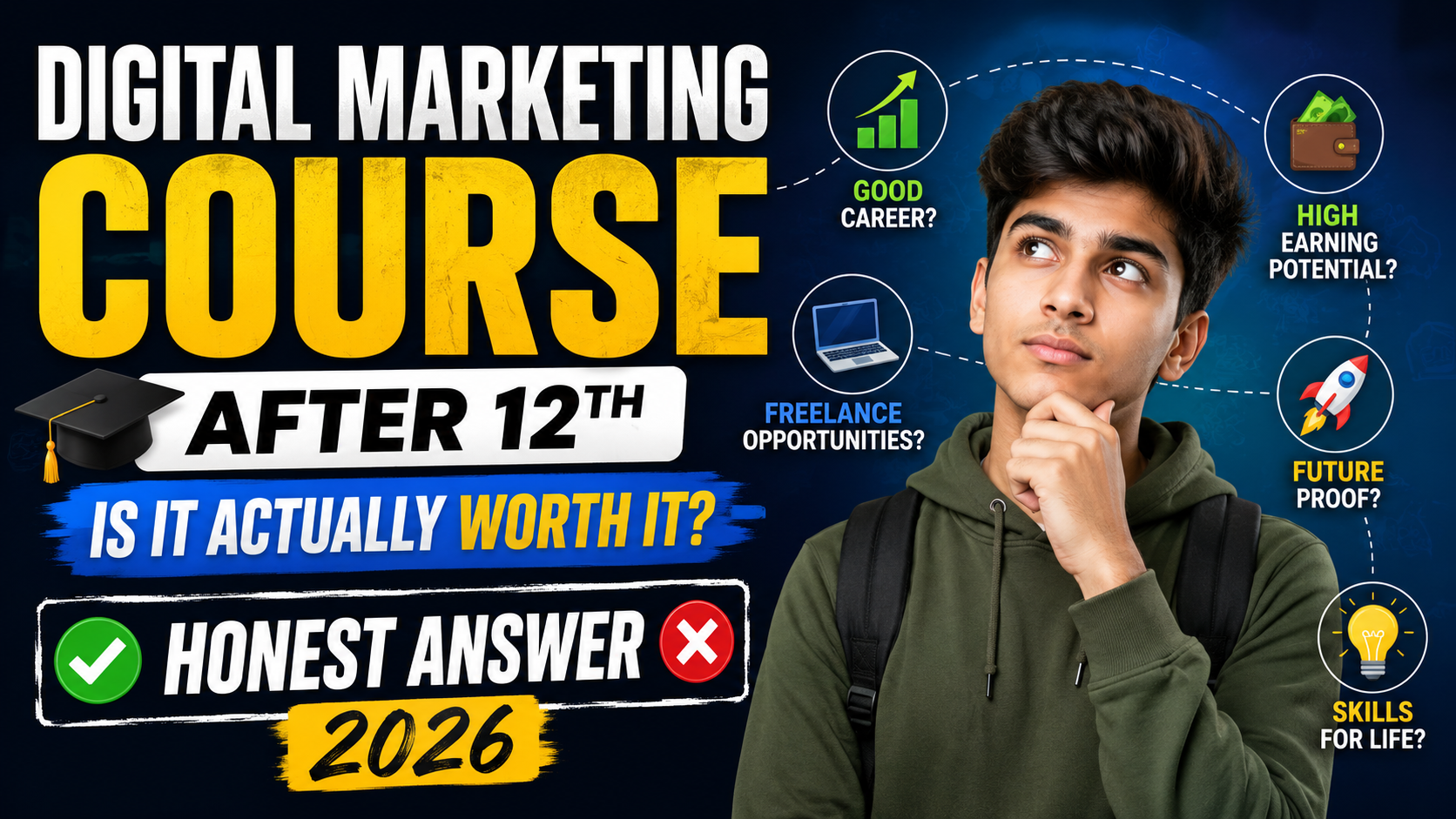
Digital Marketing Course After 12th — Is It Actually Worth It? (Honest Answer, 2026)
Reading time: 18 min | Last updated: May 2026-Digital Marketing Course After 12th
Let me guess.
You just gave your 12th boards. Everyone at home has an opinion. Relatives are pushing engineering. Your parents want a “safe” degree. And somewhere between all that chaos, someone mentioned digital marketing — and now you’re here, trying to figure out if it’s real or just another fancy-sounding thing people say.
I’ll be straight with you.
Digital marketing is real. The jobs are real. The salaries are real. But so is the noise around it — the courses that overpromise, the Instagram coaches selling dreams, the institutes that hand you a certificate and wish you luck.
This guide is going to cut through all of that.
No fluff. No “10 reasons why digital marketing is the future of India.” Just the actual stuff you need to know before making a decision.
Digital Marketing Course After 12th
Okay, But What Even Is Digital Marketing?
Here’s how I’d explain it to my younger sibling:
Every brand you see online — Swiggy, Nykaa, your favourite local café’s Instagram page, that D2C skincare brand running ads on your YouTube — someone is managing all of that. Someone decided what to post, when to post it, how much to spend on ads, which keywords to target on Google, why their last campaign flopped, and how to fix it.
That person is a digital marketer.
It’s part creative, part analytical. Some days you’re writing content that needs to sound like an actual human wrote it. Other days you’re staring at Google Analytics at 11am trying to figure out why website traffic dropped 40% last week.
It’s not glamorous every day. But it’s genuinely interesting work — and it pays well when you know what you’re doing.
The “post reels and get paid” version? That’s not it. That’s the Instagram version they sell you. The real version is more like — understand what people want, figure out where they are online, reach them with something worth their attention, and actually measure whether it worked.
Once you can do that consistently? You become valuable. Fast.
Why After 12th Specifically Makes Sense
Most people don’t think about this carefully enough.
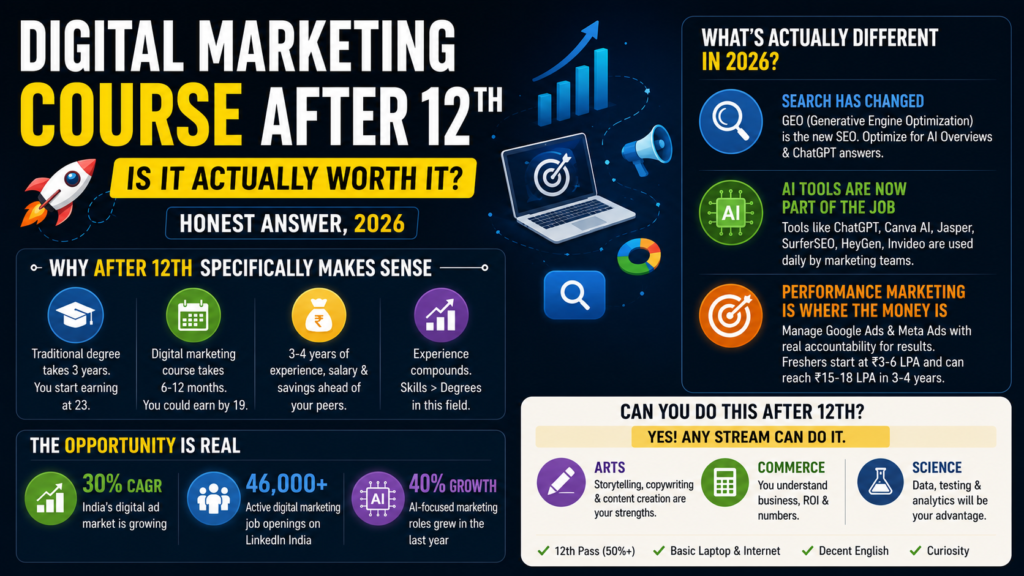
A traditional degree takes 3 years. You graduate at 21-22, with mostly theoretical knowledge and zero real work experience. Then you spend another 6-12 months job hunting. You’re 23 before you earn your first real salary.
A focused digital marketing course? You’re done in 6-12 months. You could be earning by 19.
However ,That’s not just “starting early.” That’s 3-4 years of actual work experience, salary, savings, and skill-building that your college friends haven’t started yet.
And here’s the part nobody talks about — in digital marketing, experience compounds. Someone with 3 years of actual campaign experience at 22 will out-earn and out-perform a fresh MBA graduate almost every time, because this field rewards what you’ve actually done, not what degree you hold.
The numbers back this up too. India’s digital ad market is growing at 30% CAGR. There are 46,000+ active digital marketing job openings on LinkedIn India right now. AI-focused marketing roles grew 40% just in the last year.
The demand is real. The gap between jobs available and trained people to fill them is real. That gap is your opportunity.
Can You Do This After 12th — Regardless of Your Stream?
Yes. And I mean that for all three streams.
If you’re from Arts — honestly, you might have the biggest advantage of anyone walking into this field. You know how to write. You understand storytelling. You can build a brand voice, write copy that connects, and create content that doesn’t sound like it came from a machine. Those skills take most people years to develop. You already have the foundation.
If you’re from Commerce — you understand how businesses actually work. You think in terms of ROI, budgets, margins. When a client asks “we spent ₹50,000 on ads, did it work?” — you know how to think through that question. Performance marketing is going to come naturally to you.
If you’re from Science — data is not scary to you. A/B testing, conversion rate optimization, analytics dashboards — the stuff that makes other people’s eyes glaze over is where you’ll be most comfortable. That’s valuable.
What you need to start:
- 12th pass, any stream (most places want 50%+)
- Basic comfort with a laptop and internet
- Decent written English — not perfect, just functional
- Some genuine curiosity about why people click on things
That’s it. No coding. No maths beyond basic percentages. No prior business experience.
What’s Actually Changed in 2026 (Pay Attention to This Part)
I want to spend some time here because this is where a lot of people go wrong.
Digital marketing in 2026 is not the same as digital marketing in 2022. If you enroll in a course that hasn’t updated its syllabus, you’ll learn things that employers have already moved past. That’s not me being dramatic — it’s just how fast this field moves.
Here’s what’s actually different right now:
Search has changed — and not in a small way.
Think about how you use Google. Or actually — think about how you don’t use Google sometimes. More and more people are asking ChatGPT or Perplexity a question and getting a direct answer, instead of clicking through ten blue links.
This has created something called Generative Engine Optimization (GEO) — which is basically: how do you make sure AI systems like ChatGPT and Google’s AI Overviews actually reference your content when someone asks a relevant question?
Traditional SEO still matters. But it’s not the whole game anymore. If your course doesn’t mention GEO, it’s already a year behind.
AI tools are now just part of the job.
Not optional. Not “nice to have.” They’re on the job description.
Canva AI, ChatGPT, Jasper, SurferSEO, HeyGen, Invideo — marketing teams across India use these daily. A fresher who walks in knowing how to build an AI-assisted content workflow is more useful than someone who’s done everything manually for years.
The good news is — these tools are not hard to learn. They just need practice. And a good course will have you practicing them on real campaigns, not just watching demos.
Performance marketing is where the money is right now.
If you want the fastest salary growth, this is the direction. Managing Google Ads and Meta Ads with real accountability for results — this track starts at ₹3-6 LPA for freshers and can reach ₹15-18 LPA within 3-4 years.
Digital Marketing Course After 12th
The Types of Courses — What’s Actually Worth It
Let me break this down honestly, not like a brochure.
Free Certifications (Google, HubSpot, Meta)
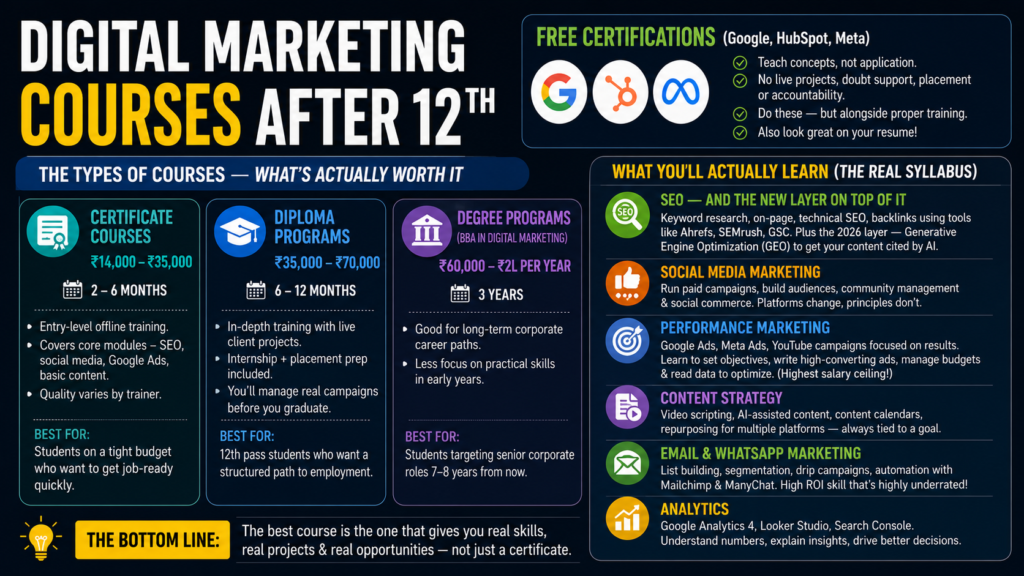
These are free for a reason — they teach concepts, not application. Google’s Digital Marketing course is genuinely solid for building a foundation. HubSpot’s content and email certifications are worth your time. Meta Blueprint covers ads clearly.
But here’s what they don’t give you: live projects, someone to answer your questions at 10pm when you’re stuck, placement support, or accountability to actually finish.
Most people who start free courses don’t complete them. Of those who do, most can’t translate what they learned into actual work without guidance.
Do these — but alongside proper training, not instead of it. They also look good on a resume as supporting credentials.
Certificate Courses (₹14,000 – ₹35,000 | 2-6 months)
Entry-level offline training. You’ll cover the core modules — SEO, social media, Google Ads, basic content. Quality varies a lot depending on the trainer. The institute name matters less than whether the trainer has actually worked in the industry.
Best for: students who need to get job-ready quickly on a tight budget, and who plan to build depth through real work experience after.
Diploma Programs (₹35,000 – ₹70,000 | 6-12 months)
This is where serious training happens. Live client projects, internship, placement prep — the works. A good diploma program means you’ll have managed actual campaigns before you graduate, not just simulated ones. When you walk into an interview, you’ll have something real to talk about.
Best for: 12th pass students who want a structured path to employment and don’t want to figure it all out alone.
Degree Programs — BBA in Digital Marketing (₹60,000–₹2L per year | 3 years)
If you’re targeting a senior corporate role or brand management position 7-8 years from now, this makes sense. If you want to enter the workforce and start building real skills quickly — it doesn’t.
Best for: students who have a specific long-term corporate trajectory in mind and aren’t in a rush.
What You’ll Actually Learn (The Real Syllabus)
SEO — And the New Layer on Top of It
Keyword research, on-page optimization, technical audits, backlink strategy. You’ll use tools like Ahrefs, SEMrush, Google Search Console.
But you’ll also learn the 2026 layer — how to structure content so AI systems cite and reference you. How to write in a way that answers questions directly, because that’s what gets featured in AI-generated summaries.
Social Media Marketing
Not just posting. Running paid campaigns, building audiences from scratch, community management, social commerce — setting up actual purchases through Instagram and Facebook. Platforms change, but the principles of audience psychology don’t. Good courses teach you both.
Performance Marketing
Google Ads, Meta Ads, YouTube campaigns — all focused on measurable outcomes. You learn to set objectives, write ad copy that converts, manage budgets, and most importantly read what the data is telling you and adjust.
This is the skill set with the highest salary ceiling in the field.
Content Strategy
Video scripting, AI-assisted content creation, content calendars, repurposing for different platforms. In 2026 this is multi-format and always tied to a goal — not just “create and post and hope.”
Email and WhatsApp Marketing
List building, segmentation, drip campaigns, automation flows through Mailchimp and ManyChat. Automated sequences that nurture leads without manual effort — this is one of the highest-ROI skills in the entire field, and it’s underrated by most freshers.
Analytics
Google Analytics 4, Looker Studio, Search Console. You need to be able to walk into a room and explain the numbers — what worked, what didn’t, what you’re going to do differently. This is what separates good marketers from great ones.
Digital Marketing Course After 12th
How Much Does It Cost? (Honest Breakdown)
| Type | Approx. Fee |
|---|---|
| Google / HubSpot Certifications | Free |
| Online programs (Coursera, Simplilearn) | ₹30,000 – ₹70,000 |
| Offline certificate course | ₹14,000 – ₹35,000 |
| Offline diploma program | ₹35,000 – ₹70,000 |
| Intensive full-time programs | ₹1,30,000+ |
| PGP with placement guarantee | ₹3,00,000 – ₹4,50,000 |
| BBA Digital Marketing (per year) | ₹60,000 – ₹2,00,000 |
One thing I want to say clearly: a higher fee doesn’t automatically mean better training.
A ₹40,000 diploma at a well-connected institute with experienced trainers can do more for your career than a ₹1,20,000 program at a bigger brand with an outdated curriculum and no real placement follow-through.
The question to always ask before enrolling: “Can I talk to 2-3 students who graduated in the last 6 months?”
If they hesitate or can’t make it happen — that tells you something.
What Kind of Jobs Can You Get?
Digital Marketing Executive
The most common entry role. You’ll manage campaigns across a few channels — SEO, social, email, ads — or focus on one depending on company size. Agencies hire the most freshers here.
Starting salary: ₹2.5 – 4.5 LPA
SEO Executive
Keyword research, technical audits, content planning, performance tracking. In 2026 this increasingly includes GEO work — structuring content to appear in AI-generated answers.
Starting salary: ₹2.5 – 3.5 LPA
Social Media Manager
Running brand accounts, paid campaigns, community engagement, influencer coordination. Needs AI scheduling tools and social commerce experience now.
Starting salary: ₹2.5 – 3.5 LPA → ₹5 – 8 LPA after 2-3 years
Performance Marketer
Google Ads, Meta Ads, programmatic, OTT. Direct accountability for ROAS. Fastest-growing role category in the field right now.
Starting salary: ₹3 – 6 LPA → ₹8 – 18 LPA after 3-4 years
Content Marketer
Strategy, SEO writing, video scripting, AI workflow design. Growing 30% year-on-year as brands invest more in organic.
Starting salary: ₹2.5 – 4 LPA
Freelance Digital Marketer
Work with multiple clients independently. Starting income is usually ₹15,000 – ₹25,000/month. With a strong portfolio and 2-3 solid client relationships, ₹80,000 – ₹1,00,000+/month is genuinely achievable.
Salary Table — What to Realistically Expect
| Role | Experience | Salary |
|---|---|---|
| Digital Marketing Executive | 0-2 years | ₹2.5 – 5 LPA |
| SEO / Social Media Executive | 1-3 years | ₹4 – 8 LPA |
| Performance Marketing Manager | 2-5 years | ₹5 – 18 LPA |
| Digital Marketing Manager | 3-5 years | ₹8 – 15 LPA |
| Head of Digital / CMO | 5+ years | ₹15 – 50+ LPA |
Salaries in this field grew 30% in India in 2025 alone. The reason is simple — demand is growing faster than supply. That math works in your favour if you get trained properly.
How to Pick the Right Course Without Getting Played
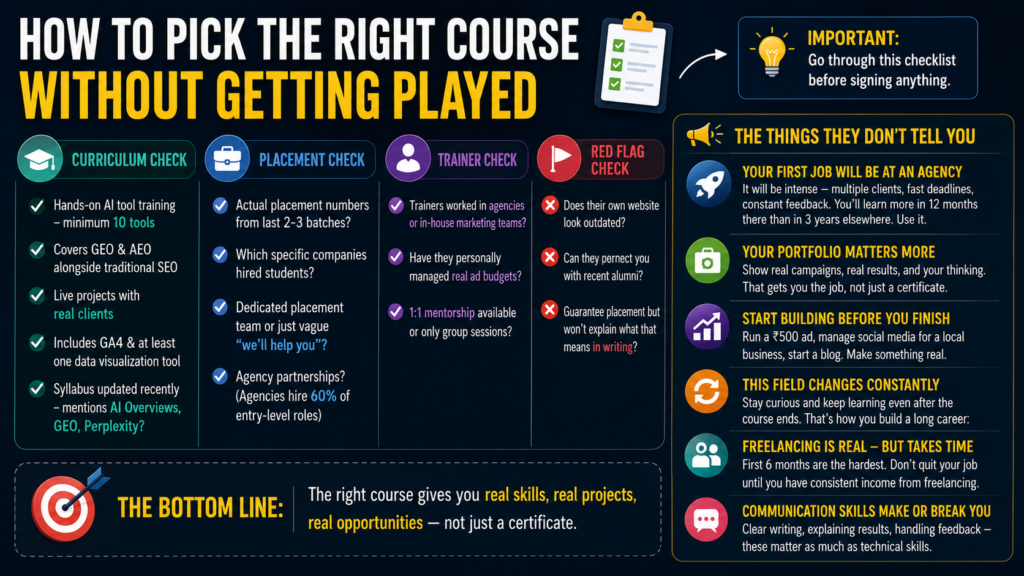
Here’s a checklist. Go through it before signing anything.
Curriculum check:
- Does it include hands-on AI tool training — minimum 10 tools actually used, not just shown?
- Does it cover GEO and AEO alongside traditional SEO?
- Are there live projects with real clients, or just case studies?
- Does it include GA4 and at least one data visualization tool?
- When was the syllabus last updated — does it mention AI Overviews, GEO, Perplexity?
Placement check:
- What are the actual placement numbers from the last 2-3 batches?
- Which specific companies hired students — not “top MNCs,” actual names?
- Is there a dedicated placement team or just a vague “we’ll help you”?
- Do they have agency partnerships? Agencies hire 60% of entry-level roles.
Trainer check:
- Have the trainers actually worked in agencies or in-house marketing teams?
- Have they personally managed real ad budgets?
- Is 1:1 mentorship available or only group sessions?
Red flag check:
- Does their own website look outdated? (A digital marketing institute with a weak online presence should make you nervous.)
- Can they connect you with recent alumni before you enroll?
- Do they guarantee placement but won’t explain what that actually means in writing?
The Things They Don’t Tell You Before You Enroll
Your first job will probably be at an agency — and it will be intense.
Multiple clients, fast deadlines, constant feedback. You’ll also learn more in 12 months there than you would in 3 years at a slower-paced company. Don’t run from it. Use it.
Your portfolio matters more than your certificate.
Two freshers walk into an interview. One has a certificate from a well-known institute. The other has a certificate from a smaller institute but can show you a campaign they ran, what the results were, and what they’d do differently. The second one gets the job. Every time.
Start building before you finish the course. Run a ₹500 ad campaign. Manage social media for a local business for free. Start a blog. Make something real.
This field changes constantly.
What was best practice in 2022 is sometimes outdated in 2026. The marketers who build long careers here are the ones who stay curious after the course ends — not just during it.
Freelancing is real — but it takes time to build.
The first 6 months of freelancing are usually the hardest. You’re finding clients, building trust, learning to price yourself. Don’t quit a full-time job to freelance until you already have consistent income from it on the side.
Communication skills will make or break you.
Being able to write clearly, explain campaign results to a non-technical client, handle feedback without getting defensive — these matter as much as any technical skill. Invest in them.
Digital Marketing Course After 12th
Start Here for Free (Before You Spend a Rupee)
Spend 2-3 weeks with these. If you find yourself curious and wanting to go deeper — you’ve found your field. Digital Marketing Course After 12th
Free courses:
- Google Digital Garage — Fundamentals of Digital Marketing
- HubSpot Academy — Content Marketing, Email Marketing, Inbound
- Meta Blueprint — Facebook and Instagram Ads basics
- Google Analytics Academy — GA4 fundamentals
YouTube channels worth your time:
- Neil Patel — SEO and content strategy, explained simply
- Ahrefs — Deep SEO tutorials
- Surfside PPC — Google Ads, step by step
- Social Media Examiner — Platform strategy and paid social
Free tools to practice with:
- Google Search Console — connect any website, see real search data
- Ubersuggest — keyword research, free tier
- Canva — design, free tier is genuinely useful
- Mailchimp — email marketing, free up to 500 contacts
Frequently Asked Questions
Can I do this straight after 12th with zero experience?
Yes. No marketing experience needed, no coding, no specific stream. The course is designed to build from scratch. What helps is being curious and not scared of learning tools.
Is digital marketing good for Arts students?
Genuinely yes — and I’d argue Arts students have an edge in the creative side that takes others years to develop. The analytical part is learnable. The instinct for language and storytelling is harder to teach.
How long before I get a job after the course?
With a diploma that includes live projects and placement support, most students land something within 1-3 months of finishing. Students who build a portfolio during the course tend to get placed faster than those who wait until after.
What’s the starting salary?
₹2.5 – 4.5 LPA across most roles. Performance marketing starts higher — ₹3 – 6 LPA. Metro cities typically offer the upper end of these ranges.
Can I freelance after 12th?
Yes. Many students start taking small freelance projects during the course itself. Your first goal should be ₹10,000 – ₹15,000/month on the side before you think about going full freelance.
What about AI replacing digital marketers?
AI is changing the tools, not replacing the people. If anything, it’s creating more demand for people who can think strategically and use AI tools to work faster. The risk is for marketers who don’t adapt. For those who do — this is a genuinely good time to be in the field.
The Bottom Line
Hence ,You don’t need a three-year degree to build a real career in digital marketing. You need the right training, actual hands-on experience with campaigns and tools, and the willingness to keep learning after the course ends.
Digital Marketing Course After 12th field is growing faster than it’s producing trained people. That gap is your opportunity — if you take it seriously.
Pick a course that makes you do real work, not just watch lectures. Build something during the course, not after. Stay curious when the course is over.
That’s the whole game, honestly.
If this helped, share it with someone figuring out their path after 12th. And if you’ve got questions this didn’t answer — drop them in the comments.