
How to Find Clients for Digital Marketing in 2026 (Even If You’re Starting from Zero)
Let me be honest with you. How to Find Clients for Digital Marketing
When I first started in digital marketing, I was confident about one thing — I knew my craft. SEO, paid ads, social media strategy, content marketing. I had the skills. What I didn’t have? A single paying client.
And that’s the part nobody talks about enough.
You can be the most talented marketer in the room and still struggle to find clients if you don’t know where to look or how to approach it. Finding clients is its own skill — separate from marketing itself — and it takes time to figure out.
This guide is everything I wish I had when I was starting out. Whether you’re fresh out of a course, transitioning from a full-time job, or trying to grow your agency beyond referrals, these strategies work. Not overnight. But they work.
Let’s get into it. How to Find Clients for Digital Marketing
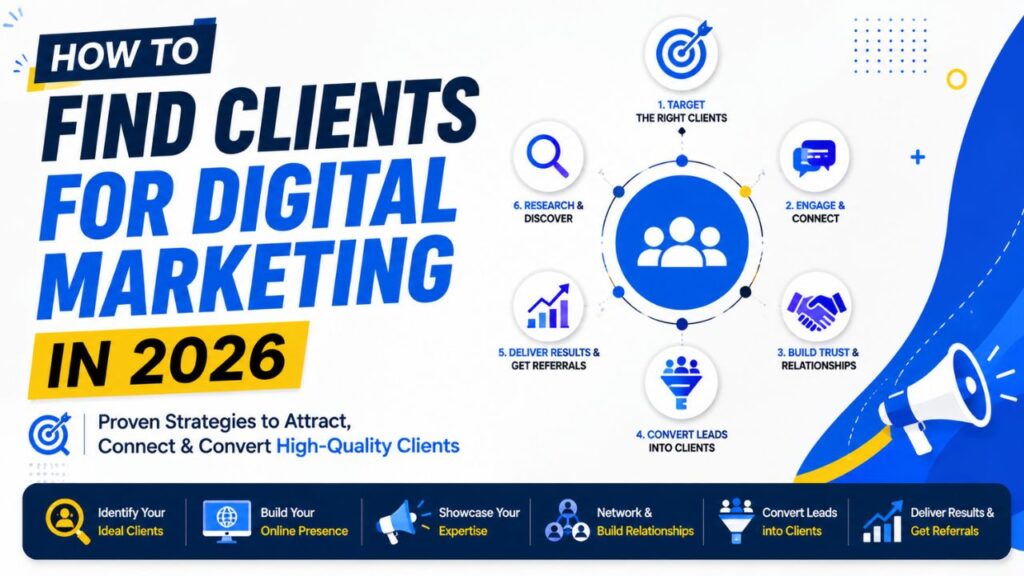
Why Finding Digital Marketing Clients Feels So Hard (At First)
Here’s something that trips up almost every beginner: they treat client acquisition like it’s a math problem. Post enough content, send enough cold emails, run enough ads — and eventually someone will say yes.
That thinking isn’t wrong, but it’s incomplete.
The real challenge is trust. When a business owner hands over their marketing budget to someone, they’re not just buying a service. They’re betting on a person. They want to know: Can this person actually deliver? Have they done this before? Will they disappear after taking my money?
Your job, especially at the start, isn’t to prove you’re the best marketer in the world. It’s to reduce that fear enough for someone to give you a shot. Once you understand that, everything about client acquisition starts to make more sense.
Step 1: Get Ruthlessly Specific About Who You Want to Help
The biggest mistake new digital marketers make is trying to help everyone. “I do SEO, social media, email marketing, PPC, content strategy, web design…”
Cool. But who is it for?
When you speak to everyone, you connect with no one. And in a crowded market full of agencies offering the same laundry list of services, generalists get skipped over. Specialists get hired.
Pick a niche. Not forever — just for now, to get traction.
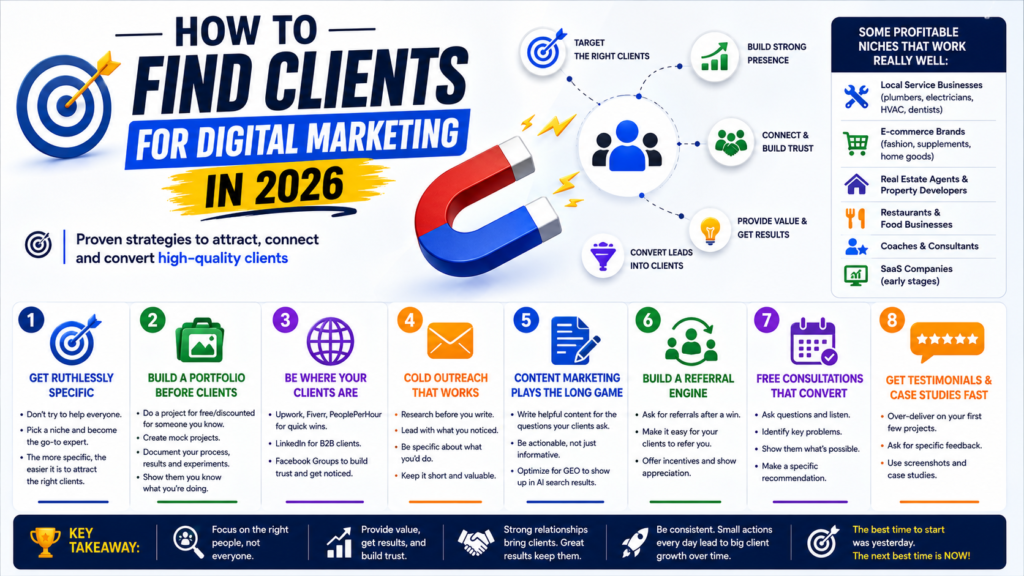
Some examples of niches that work really well:
- Local service businesses — plumbers, electricians, HVAC companies, dentists
- E-commerce brands in a specific category (fashion, supplements, home goods)
- Real estate agents and property developers
- Restaurants and food businesses
- Coaches and consultants
- SaaS companies at early stages
The more specific, the better. “I help local plumbers get more calls through Google” is 10x more compelling than “I do digital marketing for small businesses.”
Once you pick a niche, everything else gets easier. Your outreach becomes more targeted. Your content becomes more relevant. Your portfolio makes more sense to the people reading it.
Step 2: Build a Portfolio Before You Have Paying Clients
“But I have no clients yet — what do I put in a portfolio?”
This is the chicken-and-egg problem everyone faces, and there are a few solid ways around it.
Do a free or heavily discounted project for someone you know. A friend’s bakery, a family member’s service business, a local nonprofit. It doesn’t have to be glamorous. You just need something real to show. A before-and-after. A result. A process.
Create a mock project. Pick a fictional or real local business and build out what their marketing strategy would look like. Show your thinking, your recommendations, your sample ad creatives or keyword research. Presented well, this demonstrates your skills just as effectively as a paid project.
Write detailed case studies from personal experiments. Started a blog and grew it? Ran a small ad campaign with your own money? Document it. Show what you tested, what worked, what didn’t, and what you learned. That kind of transparency builds more trust than a polished success story.
The goal is to give potential clients something to look at that shows you know what you’re doing. Even one or two solid examples will move you past the “I have nothing to show” stage.
Step 3: The Platforms Where Your First Clients Are Waiting
When you’re starting out, you don’t need to build a massive audience or wait for inbound traffic. Your first clients are already out there — you just need to go find them.
Freelance Platforms (The Fastest Starting Point)
Upwork, Fiverr, and People/Hour are genuinely good places to land your first few clients, despite what some people say about them being too competitive or low-paying.
Yes, there’s competition. But most profiles on these platforms are poorly written and generic. If you show up with a specific niche, a clear offer, and a couple of portfolio samples, you’ll stand out immediately.
A few tips for these platforms:
- Specialize your profile. Don’t list 15 services. Pick one or two and build your entire profile around them.
- Respond fast. Speed matters. The freelancers who get hired are often the ones who respond within the first hour.
- Start with a competitive rate, then increase it. Getting your first 3–5 reviews is the hardest part. Once you have them, you can raise prices.
LinkedIn (The Best Platform for B2B Clients)
If your target clients are businesses rather than consumers, LinkedIn is where you should be spending your time.
The approach that works isn’t cold pitching in DMs (although done right, that can work too). It’s showing up consistently with useful content.
Post about marketing mistakes businesses make. Share quick tips for local businesses trying to improve their Google rankings. Comment thoughtfully on posts from business owners in your niche. Over time, people start to see you as someone who knows their stuff — and when they need help, you’re the first person they think of.
The key is consistency. Three posts a week for six months will do more for your business than any quick tactic.
Facebook Groups (Underrated and Underused)
There are thousands of Facebook groups full of business owners actively asking for help with their marketing. Groups for local entrepreneurs, niche industries, specific platforms like Shopify or Etsy — they’re everywhere.
Join 5–10 groups that match your niche. Don’t pitch your services. Just answer questions genuinely and helpfully. When someone asks “how do I get more Instagram followers for my bakery?” — give them a real, useful answer. No fluff.
People notice who shows up consistently with good advice. They’ll check your profile, visit your website, and often reach out directly.
Local Business Communities
Don’t overlook what’s right in front of you. Local business networking groups, Chamber of Commerce meetings, BNI chapters, even local Facebook community groups — these are full of small business owners who need exactly what you offer.
In-person trust is built faster than online trust. If someone has met you, shaken your hand, and heard you speak knowledgeably about marketing, they’re far more likely to hire you or refer you than someone who only knows you from a website.
Step 4: Cold Outreach That Doesn’t Feel Creepy
Cold outreach has a bad reputation because most of it is terrible. Generic, copy-pasted, clearly mass-sent emails that start with “Hi [First Name], I came across your business and I think I can help you…”
Nobody wants to respond to that.
But personalized, thoughtful outreach? That’s a different story entirely.
Here’s the framework that actually works:
1. Research before you write. Visit their website. Check their social media. Look at their Google reviews. Find something specific — a problem, an opportunity, something you genuinely noticed.
2. Lead with what you noticed, not who you are. Your first line should be about them, not you.
3. Be specific about what you’d do. Vague offers (“I can help with your marketing”) get ignored. Specific observations (“Your Google Business Profile is missing several service categories that your competitors are using to rank higher”) get responses.
4. Keep it short. Five sentences max. Respect their time.
Here’s an example of what this looks like in practice:
Subject: Quick thought on your Google rankings
Hi Sarah,
I was searching for [your type of business] in [city] and noticed your website shows up on page 2, while two of your competitors — who appear to offer fewer services — are ranking above you.
I took a quick look and there are a few specific things that are likely holding you back (your page titles, some missing local citations, and a thin homepage).
I work with [niche] businesses to fix exactly this kind of thing. Would you be open to a 15-minute call this week to talk through it?
[Your name]
That’s it. No lengthy pitch. No “I’ve helped hundreds of clients.” Just a specific observation and a low-commitment ask.
Not everyone will respond. But the ones who do are genuinely interested — which makes those conversations much easier to convert. How to Find Clients for Digital Marketing
Step 5: Content Marketing — Playing the Long Game
Cold outreach gets you clients now. Content marketing gets you clients six months from now, and then keeps getting them without extra effort.
If you’re building a marketing blog (which it sounds like you are), this is your biggest long-term leverage point.
Write for the Questions Your Clients Are Already Asking
The best content isn’t the content you want to write. It’s the content your potential clients are already searching for.
What does a local restaurant owner type into Google when they’re frustrated with their marketing? What does an e-commerce founder search for at midnight when their ad costs keep going up? Those are your article topics.
Some examples:
- “Why is my Google Business Profile not showing up?”
- “How much should I spend on Facebook ads for my small business?”
- “Is SEO worth it for a local business in 2026?”
- “How to get more reviews on Google without asking awkwardly”
These aren’t glamorous topics. But they’re what real people search for, and if you answer them well, those people will find you.
Be Actually Helpful, Not Just Informative
There’s a difference between an article that contains information and an article that genuinely helps someone. The first gives you facts. The second gives you understanding.
Don’t just explain what SEO is. Walk someone through exactly what they should do this week to improve their local rankings. Don’t just say “email marketing has a high ROI.” Show them how to write their first welcome email sequence, step by step.
The more specific and actionable your content, the more it gets shared, bookmarked, and linked to.
GEO: The New Frontier That Most Bloggers Are Ignoring
Here’s something most content creators haven’t caught on to yet: a huge and growing chunk of search is happening inside AI tools like ChatGPT, Perplexity, and Google’s AI Overviews. People are asking these tools “who should I hire for digital marketing?” and getting specific recommendations.
To show up in those recommendations, you need to optimize for Generative Engine Optimization (GEO) — not just traditional SEO.
What that looks like practically: How to Find Clients for Digital Marketing
- Write in clear, direct language that AI tools can easily understand and summarize
- Include your location and specialty explicitly and frequently
- Get mentioned on other websites — AI tools treat citations and mentions as credibility signals
- Build a complete, consistent online presence across your website, Google Business Profile, LinkedIn, and directories
- Answer questions directly — AI tools love content structured around a question and a clear answer
This is still an emerging area, which means the competition is low. Get ahead of it now while most of your competitors are still focused only on traditional SEO.
Step 6: The Referral Engine Nobody Builds Until It’s Too Late
Here’s a stat worth sitting with: referred clients close faster, pay more, and stay longer than clients from any other source.
And yet most freelancers and agencies leave referrals entirely to chance. They do good work, hope their clients mention them to friends, and wonder why the phone isn’t ringing more.
A referral system doesn’t have to be complicated. It just needs to be intentional.
Ask at the right moment. The best time to ask for a referral is right after a win — when a client tells you they’re happy with the results. Don’t wait until the project ends. Ask in the moment: “That’s great to hear! If you know anyone else who could use help with this, I’d really appreciate an introduction.”
Make it easy for them. Most clients would happily refer you but don’t know who to think of. Help them. “If you know any other [type of business] owners who are frustrated with their marketing, I’d love to help them too.” Specificity helps them visualize a real person.
Consider a formal referral incentive. A discount on their next month, a small gift card, or even just a genuine thank-you note goes a long way. It signals that you value the referral and makes people more likely to send more.
Step 7: Free Consultations — How to Structure Them So They Convert
Offering free consultations is common advice. But most people do them wrong.
A free consultation isn’t a sales call. It’s not where you pitch your services and hope the client says yes. Done right, it’s where the client convinces themselves they need to hire you.
Here’s how to structure a consultation that converts:
Start with questions, not a presentation. Ask them about their business, their goals, what’s not working, what they’ve tried before. Listen more than you talk.
Identify one or two specific problems you can solve. Not everything. Not a full audit. Just the most pressing issues that, if fixed, would make a real difference.
Show them what good looks like. Pull up a competitor who’s doing well. Show them a before-and-after from a past project. Give them a glimpse of what’s possible.
Make a specific recommendation. Not “I can help with your marketing.” Something like: “Based on what you’ve told me, I think the biggest opportunity right now is improving your Google Business Profile and getting a consistent review strategy in place. That alone could meaningfully increase your inbound calls within 60 days.”
Then stop talking. Let them respond. Don’t oversell. If they’re a fit, the conversation will naturally move toward next steps.
The goal isn’t to close everyone. It’s to have real conversations with real business owners and let the right ones self-select.
Step 8: Testimonials and Case Studies — Getting Them Fast as a Beginner
Social proof is one of the most powerful tools you have. But when you’re new, you don’t have much of it yet.
Here’s how to build it quickly:
Do exceptional work on your first few projects, even if they’re free or heavily discounted. Treat them like they’re your most important clients. Over-deliver. Then ask for a specific, detailed testimonial.
Don’t just ask “can you leave me a review?” Ask them specific questions: How to Find Clients for Digital Marketing
“What was your situation before we worked together?” “What results did you see?” “Who would you recommend me to?”
Their answers to those questions will give you testimonials that are far more compelling than generic “Great to work with!” praise.
Write a mini case study for every project. Even a simple one-page document that covers the challenge, what you did, and the outcome can be enormously persuasive. Share it on your website, on LinkedIn, and in sales conversations.
Screenshots are gold. A screenshot of a client’s Google Analytics showing traffic growth, or their Google Business Profile showing increased calls, is worth more than any written testimonial.
Step 9: The Mistakes That Kill New Digital Marketers Before They Get Started
A few things to watch out for — because these are genuinely common:
Undercharging to the point of burnout. Charging too little doesn’t just hurt your income. It attracts clients who don’t value your work and creates a dynamic where you’re always scrambling. Charge what the work is actually worth, even at the start.
Trying to be everywhere at once. LinkedIn, Instagram, TikTok, YouTube, a podcast, a newsletter, a blog — you don’t need all of these. Pick one or two and do them consistently. Half-hearted presence everywhere beats no presence, but focused presence somewhere beats both.
Taking on clients who aren’t a good fit. The client who haggles over price, asks endless questions before signing, and wants daily updates will drain you far more than they pay you. It’s okay to say no to someone who isn’t the right fit.
Confusing activity with progress. Busy and productive are not the same thing. Sending 100 cold emails a week is busy. Sending 20 highly personalized, well-researched emails is productive.
Waiting until everything is perfect. Your website doesn’t need to be perfect. Your portfolio doesn’t need to be extensive. Your LinkedIn profile doesn’t need to be polished. Start with what you have and improve as you go.
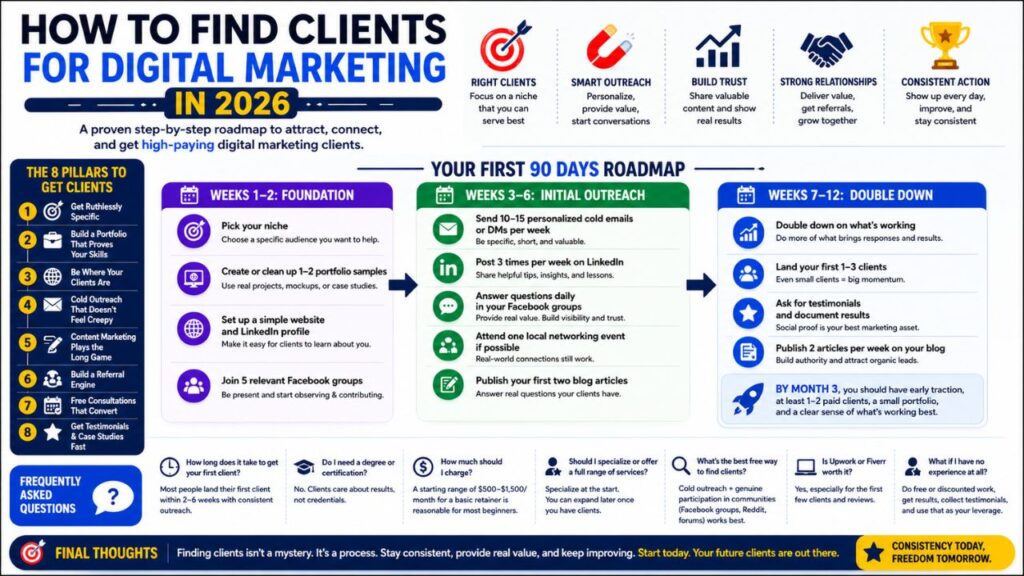
Putting It All Together: What Your First 90 Days Should Look Like
Weeks 1–2: Foundation
- Pick your niche
- Create or clean up 1–2 portfolio samples
- Set up a simple website and LinkedIn profile
- Join 5 relevant Facebook groups
Weeks 3–6: Initial Outreach
- Send 10–15 personalized cold emails or DMs per week
- Post 3 times per week on LinkedIn
- Answer questions daily in your Facebook groups
- Attend one local networking event if possible
- Publish your first two blog articles
Weeks 7–12: Double Down on What’s Working
- If cold email is getting responses, do more of it
- If LinkedIn is generating interest, increase your posting
- Land your first 1–3 clients (even small ones)
- Ask for testimonials and document results
- Publish 2 articles per week on your blog
By month 3, you should have some early traction, at least one or two paid clients, a small portfolio, and a clearer sense of which channels are working best for you.
Final Thoughts
Finding clients for digital marketing isn’t a mystery. It’s a process — one that gets easier the more you work at it. How to Find Clients for Digital Marketing
The agencies and freelancers who succeed long-term aren’t necessarily the most talented. They’re the ones who stayed consistent when it was slow, kept improving when it wasn’t working, and built systems instead of relying on luck.
You don’t need a massive audience. You don’t need a fancy website. You don’t need to go viral.
You just need a clear offer, a genuine willingness to help, and the discipline to show up every day.
Start with one strategy from this guide. Do it seriously for 30 days. Then add another. That’s how momentum builds.
Frequently Asked Questions
How long does it take to get your first digital marketing client? It varies, but most people land their first client within 2–6 weeks if they’re actively doing outreach. If you’re relying solely on inbound content, expect 3–6 months before it starts generating consistent leads.
Do I need a degree or certification to find digital marketing clients? No. Clients care about results, not credentials. A strong portfolio and clear communication of what you can do for them will always matter more than certifications.
How much should I charge as a beginner? It depends on your niche and the scope of work, but a starting range of $500–$1,500/month for a basic retainer is reasonable for most beginners. Avoid hourly pricing if you can — it limits your income and makes it harder to scale.
Should I specialize or offer a full range of services? Specialize, especially at the start. You can expand later once you have clients and systems in place. Specialists get hired faster and can charge more than generalists.
What’s the best free way to find digital marketing clients? Cold outreach via email or LinkedIn DMs, combined with genuine participation in online communities (Facebook groups, Reddit, forums), is the most effective free strategy. It takes time but has a very high return.
Is it worth using platforms like Upwork to find clients? Yes, especially for your first few clients. The platform fees are worth the access to active buyers. Once you build a reputation and referral network, you can reduce your dependence on them.
How do I find clients if I have no experience at all? Start by offering free or heavily discounted work to 1–2 businesses you know personally. Document everything. Get a testimonial. Then use that as your foundation to approach paying clients.