WhatsApp Marketing for Indian D2C Brands: The Honest, No-Fluff Guide (2026)
By [Ranker Boost] · Updated May 2026 · 18 min read-How to do marketing through whatsapp
Let me be upfront with you.
Most “WhatsApp marketing guides” you’ll find online were written by SaaS companies trying to sell you their tool. So naturally, every section conveniently ends with “…and that’s why you need our platform.” You already know GoKwik wrote one. Interakt wrote one. AiSensy wrote one.
This isn’t that.
I’m going to tell you what actually works, what the real costs look like (in rupees, not vague “per conversation” nonsense), which tools are worth your money, and where most D2C brands quietly waste their WhatsApp budget without realising it.
Let’s get into it.
First, Let’s Talk About Why This Channel Actually Works
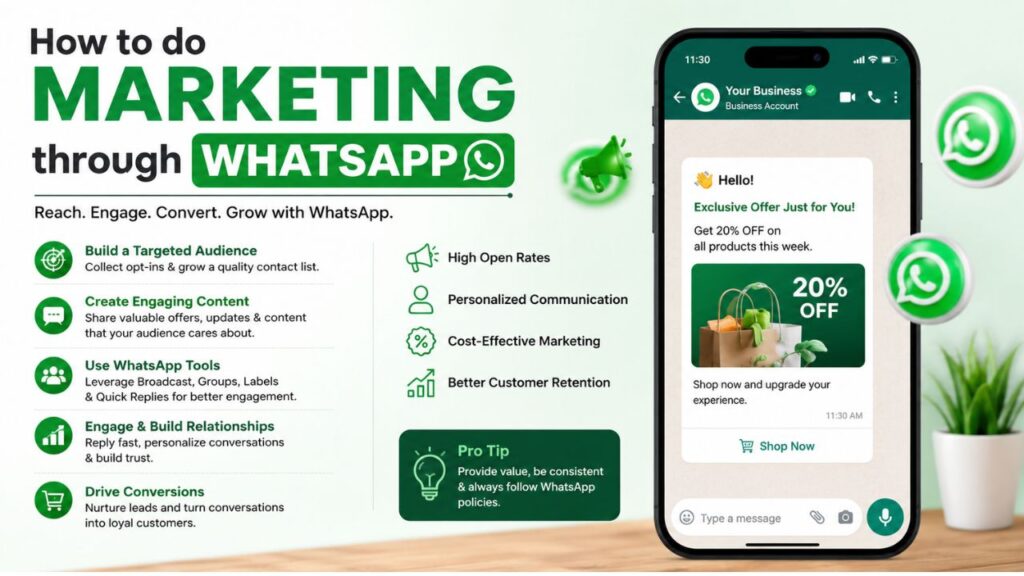
India has 535 million active WhatsApp users. That’s not a stat you throw in a slide deck — that’s your entire addressable market sitting on one app, checking it 23 times a day.
Here’s what’s different about WhatsApp compared to every other channel you’re running:
Your customer’s inbox on WhatsApp has messages from their mom, their college group, their spouse. When your brand message lands there, it doesn’t feel like marketing — it feels like a conversation. That proximity is worth more than any ad spend you can throw at Meta.
The numbers back this up hard. Email open rates in Indian ecommerce hover around 17–20%. WhatsApp? Consistently 85–98%. And 80% of those messages get read within the first 5 minutes of delivery.
Think about what that means for a flash sale, a restock alert, or an abandoned cart reminder. You’re not competing with 47 other promotional emails. You’re the buzz in someone’s pocket.
Indian D2C brands that have properly set up WhatsApp automation report that the channel now drives 20–35% of their total digital revenue. That number keeps growing.
WhatsApp Marketing vs Email vs SMS — Here’s the Real Comparison
Nobody wants to read another “WhatsApp wins!” article without seeing the actual numbers side by side. So here it is, specific to the Indian D2C market:
| What you care about | SMS | ||
| Open rate (India) | 85–98% | 17–22% | 28–35% |
| Read within 5 minutes | ~80% | ~12% | ~45% |
| Click-through rate | 15–35% | 2–5% | 4–7% |
| Abandoned cart recovery | Up to 60% | 8–15% | 10–18% |
| Cost per message (INR) | ₹0.30–₹1.20 | ₹0.02–₹0.10 | ₹0.15–₹0.50 |
| Two-way conversation | Yes | Limited | No |
| In-chat checkout | Yes (via API) | No | No |
WhatsApp is more expensive per message than email. I want you to know that upfront. But when your recovery rate on abandoned carts is 4x better, the ROI math works out very differently.
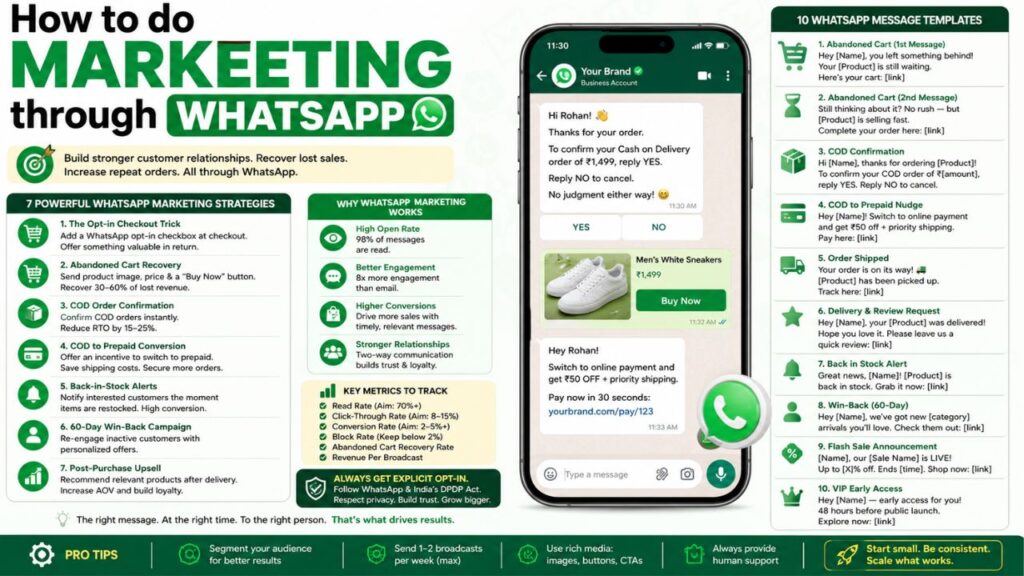
The Two WhatsApp Products — and Which One You Actually Need
This is where a lot of small brands get confused, so let’s keep it simple.
The WhatsApp Business App (the free one)
You’ve probably already used this. Download it, add your business name, set up a catalogue, reply to customers. It works fine if you’re managing 20–50 conversations a week manually.
The ceiling is real though. You can only broadcast to 256 contacts at a time. One device, one person managing it. No automation. No integration with Shopify or WooCommerce. No proper analytics.
If you’re doing more than ₹10 lakh/month in revenue, you’ve probably already hit this ceiling and felt the frustration.
The WhatsApp Business API (the one that scales)
This is what serious D2C brands use. It’s not an app — it’s a technical integration that connects WhatsApp to your ecommerce stack through a third-party platform called a BSP (Business Solution Provider).
With the API, you can:
- Send unlimited broadcasts (within Meta’s quality limits)
- Automate abandoned cart messages, COD confirmations, delivery updates
- Let customers complete checkout inside WhatsApp
- Run multiple agents on the same number
- Get the blue tick verification
The trade-off: it’s not free. You pay Meta a per-conversation fee, plus a monthly platform fee to your BSP. More on the actual costs in a moment — because nobody talks about this clearly.
What Does WhatsApp Marketing Actually Cost in India?
This is the section nobody writes. Let me fix that.
Meta charges per conversation, not per message. A “conversation” is a 24-hour window of messaging between you and one customer. There are four types:
Marketing conversations — your promotional broadcasts, sale announcements, win-back campaigns. These are the most expensive because you’re initiating them.
Utility conversations — order confirmations, shipping updates, OTP messages. Cheaper than marketing.
Authentication conversations — login OTPs, verification codes. Cheapest category.
Service conversations — when a customer messages you first, you get a 24-hour free window to respond. Actually free.
Here’s the approximate INR pricing as of 2026 (these shift slightly, always verify with your BSP):
| Conversation type | Approx. cost per conversation (INR) |
| Marketing | ₹0.78 – ₹1.10 |
| Utility | ₹0.28 – ₹0.40 |
| Authentication | ₹0.18 – ₹0.25 |
| Service (customer-initiated) | Free |
Then add your BSP platform fee. Most platforms charge ₹2,500–₹12,000/month depending on volume and features.
Real example: If you send a marketing broadcast to 10,000 customers, that’s roughly ₹7,800–₹11,000 in Meta fees alone. If 3% convert and your average order value is ₹1,500, that’s ₹4.5 lakh in revenue from ₹10,000 spent. You can do that math.
The Best WhatsApp Marketing Tools in India — Honest Comparison
Since I have no product to sell you, here’s a straightforward look at the main BSP options available to Indian D2C brands. I’ve used or evaluated most of these.
AiSensy
Good for mid-size brands. Clean interface, solid broadcast features, decent analytics dashboard. Their pricing is transparent and they have good documentation. If you’re just getting started with the API and want something you can figure out without a 2-hour onboarding call, AiSensy is a solid starting point.
Best for: Brands doing ₹10L–₹1Cr/month, wanting simple setup.
Interakt
Built specifically for Indian D2C and has strong Shopify integration. Their abandoned cart automation is genuinely good and works out of the box. They also have a shared team inbox which is useful if you have a customer support team. Slightly pricier than AiSensy but the Shopify plugin saves significant development time.
Best for: Shopify-first brands who want tight ecommerce integration without custom development.
Wati
One of the more established players globally. Good chatbot builder, supports multiple agents well, and has decent CRM-like features for tagging and segmenting contacts. Their UI can feel a bit dense but the feature set is comprehensive.
Best for: Brands with a dedicated customer support team and complex conversation flows.
Gallabox
Best for: Brands prioritising team collaboration and support ticketing alongside marketing.
DoubleTick
More focused on sales teams — if you have a WhatsApp sales team (not just broadcasts), DoubleTick has good CRM-style features for tracking conversations and deals. Less suited for pure broadcast marketing.
Underrated option. Strong team inbox features, good automation, and their pricing is competitive. Less brand recognition than Wati or Interakt but genuinely solid product. Worth evaluating if you’re comparing options.
Best for: Brands with high-touch sales via WhatsApp (fashion, jewellery, high-AOV categories).
Quick comparison:
| Platform | Starting price/month | Shopify plugin | Chatbot builder | Best for |
| AiSensy | ~₹2,499 | Yes | Yes | Getting started |
| Interakt | ~₹2,787 | Excellent | Yes | Shopify D2C |
| Wati | ~₹2,999 | Yes | Strong | Support teams |
| Gallabox | ~₹2,999 | Yes | Yes | Team inbox |
| DoubleTick | ~₹2,500 | Basic | Basic | Sales teams |
Pricing changes frequently — always check the current pricing page before deciding.
How to Set Up WhatsApp Marketing: The Actual Process
Here’s what nobody tells you — the setup takes longer than you expect. Plan for 1–2 weeks, not 2 hours.
Step 1: Get a clean phone number
This has to be a number not currently active on any WhatsApp account. Can’t be your personal number, can’t be your existing Business App number. Get a fresh SIM. Sounds annoying, but it’s non-negotiable.
Step 2: Sort your Meta Business Manager
You need an active Facebook Business Manager account with admin access, your GST certificate, company PAN, and a live website. Meta uses these to verify you’re a real business. If your Meta Business account has issues (like it’s been flagged before), fix that first — it’ll slow everything else down.
Step 3: Pick your BSP and start onboarding
Once you sign up with a BSP, they guide you through connecting your phone number to the WhatsApp Business Platform. This is where your BSP actually matters — a good one makes this painless, a bad one disappears after you pay.
Step 4: Apply for the blue tick (optional but worth it)
The blue verified badge builds trust. Meta grants it to businesses with notable brand presence — press coverage, verified social profiles, clear brand identity. Apply through your BSP dashboard. Not guaranteed, but worth trying.
Step 5: Connect your store
Most BSPs have Shopify and WooCommerce plugins. Install, connect, and sync your product catalogue. This is what enables automated messages like “You left something in your cart” and “Your order #12345 has shipped.”
Step 6: Start small
Do not blast your entire customer list on day one. WhatsApp tracks your quality rating — if too many people report your messages as spam, your sending limits drop and your account can get suspended. Start with your 500 most engaged customers. See what your open rates and block rates look like. Then scale.
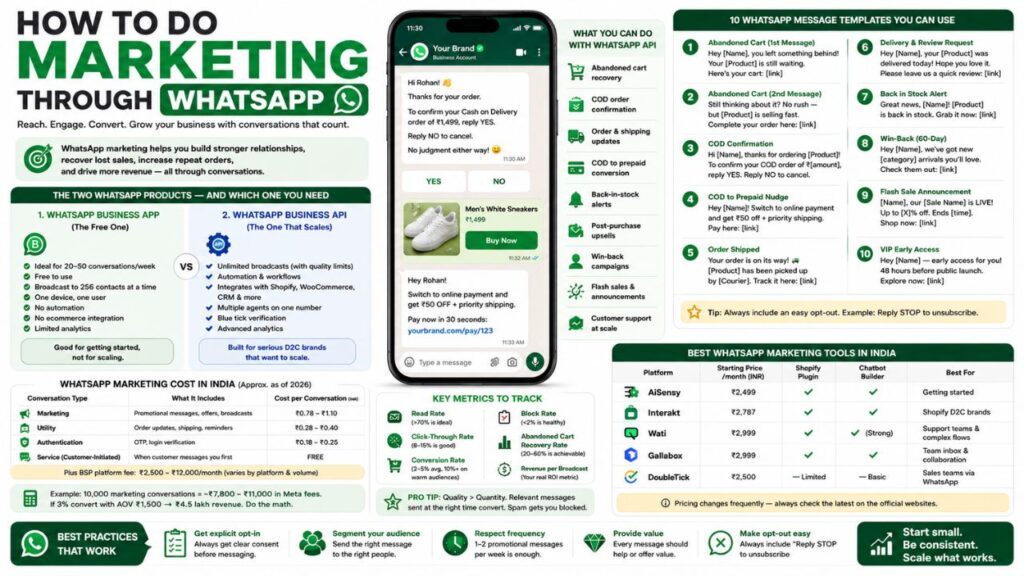
7 WhatsApp Marketing Strategies That Actually Drive Revenue
Let’s get specific. These aren’t concepts — these are things Indian D2C brands are doing right now.
1. The opt-in checkout trick
The best time to get a customer’s WhatsApp opt-in is when they’re already engaged — which is exactly at checkout. Add a simple checkbox: “Get order updates and exclusive offers on WhatsApp.” Most customers check it without thinking twice because they actually want order updates.
The nudge that converts even better: offer something for it. “Get 10% off your next order — delivered via WhatsApp.” You’re building your list and giving value simultaneously.
2. Abandoned cart recovery — done right
The standard approach is to send a link back to the cart. The better approach is to send the product image, the price, and a “Buy Now” button that completes the purchase without making them log in again.
Timing matters more than most brands realise:
- First message: 30–60 minutes after abandonment (while they’re still thinking about it)
- Second message: 24 hours later if no action (different angle — “Still thinking it over?” with a social proof line)
- Third message: 48–72 hours later with a small incentive if it makes sense for your margins
Brands doing this sequence well are recovering 30–60% of abandoned carts. That’s revenue you were leaving on the table.
3. COD order confirmation (the RTO killer)
Return-to-origin is the silent profit killer for Indian ecommerce. A customer places a COD order impulsively at 11pm, forgets about it, and rejects delivery three days later. You’ve paid for shipping both ways and got nothing.
Simple fix: send a WhatsApp message immediately after a COD order is placed. “Hi [name], confirming your order for [product]. Reply YES to confirm or NO to cancel.” Fake and impulsive orders fall away. Serious customers confirm. Your RTO drops meaningfully.
Some brands see 15–25% RTO reduction from this one automation alone.
4. COD to prepaid conversion
Right after someone places a COD order, send them a WhatsApp message offering a small incentive to switch to prepaid. Something like: “Hey! Switch to online payment and get ₹50 off + priority dispatch. Pay here: [link]”
This works because the customer is still in buying mode. They just placed the order — they want the product. A ₹50 incentive to secure the order for you is almost always worth it, given what RTO costs you.
5. Back-in-stock alerts
Your most interested customers are the ones who wanted something when it was out of stock. “Notify me when available” on your website, then a WhatsApp ping the moment you restock. These are your hottest leads — they’ve already told you they want to buy. Conversion rates on back-in-stock WhatsApp alerts regularly hit 20–35%.
6. The 60-day win-back
Customers who haven’t bought in 60 days aren’t gone — they’re just distracted. Set up an automated flow: check purchase history, send a personalised message featuring products similar to what they bought before, maybe with a small offer.
“Hey [name], we got new arrivals in [category you like]. Thought you’d want to see these first.” It doesn’t need to be aggressive. Just relevant and timely.
7. Post-purchase upsell sequence
After delivery is confirmed, you have a warm customer who just received something they (presumably) like. This is the best time to introduce a complementary product. Not immediately — wait 2–3 days. “Hope you’re loving your [product]! Quick question — have you tried [related product]? A lot of our customers who buy X also love Y.”
This feels like a personal recommendation, not a blast. And it works.
10 WhatsApp Message Templates You Can Actually Use
Here are real templates. Adapt them to your brand voice.
Abandoned cart (message 1 — within 1 hour):
Hey [Name] , You left something behind! Your [Product Name] is still waiting. Here’s your cart: [link] Need help deciding? Just reply and we’ll sort it out.
Abandoned cart (message 2 — 24 hours later):
Still thinking about it? No rush — but [Product Name] is selling fast and we can’t guarantee stock. Complete your order here: [link]
COD confirmation:
Hi [Name], thanks for ordering [Product]! To confirm your Cash on Delivery order of ₹[amount], reply YES. Reply NO to cancel. No judgment either way!
COD to prepaid nudge:
Hey [Name]! Switch to online payment for your order and get ₹50 off + priority shipping. Takes 30 seconds: [payment link] Your order ships faster, you save money. Win-win!
Order shipped:
Your order is on its way! [Product Name] has been picked up by [courier]. Track it here: [link] Estimated delivery: [date]
Delivery confirmed + review request:
Hey [Name], your [Product] was delivered today! Hope you love it. Would mean a lot if you left us a quick review: [link] (Takes 30 seconds, genuinely helps us improve )
Back in stock alert:
Great news, [Name]! [Product] is back in stock. You showed interest earlier — grab it before it sells out again: [link]
Win-back (60-day lapsed customer):
Hey [Name], it’s been a while! We’ve got some new [category] arrivals that we think you’ll love based on what you bought before. No pressure — just thought you’d want to see these first: [link]
Flash sale announcement:
[Name], our [Sale Name] starts NOW Up to [X]% off on [categories]. Sale ends [time]. Shop here: [link] (Reply STOP to unsubscribe anytime)
Loyalty/VIP early access:
Hey [Name] — before we announce it publicly, you get early access to our new collection. 48 hours before anyone else. Take a look: [link]
Metrics That Tell You If Your WhatsApp Marketing Is Actually Working
Don’t just look at opens. Here’s what matters:
Read rate — ideally above 70%. If it’s lower, your audience isn’t resonating with your messaging or you’re messaging too frequently.
Click-through rate — the percentage who click after reading. Good benchmark for promotional broadcasts: 8–15%. Below 5% means your message content or CTA needs work.
Conversion rate — of those who clicked, how many bought? Benchmark varies by category, but 2–5% on a cold broadcast is solid. 10%+ on warm audiences (post-purchase, back-in-stock) is achievable.
Block rate — this is your warning signal. If more than 2% of recipients are blocking you, stop and reassess. High block rates tank your WhatsApp quality rating, which limits how many people you can message.
Abandoned cart recovery rate — track this separately. How much lost revenue are you recovering via WhatsApp? If it’s below 20%, your timing or message sequence needs work.
Revenue per broadcast — total revenue from a campaign divided by the number of messages sent. This is your real ROI metric. Track it per campaign and you’ll quickly see which types of messages actually make you money.
WhatsApp Marketing and India’s Privacy Laws — What You Need to Know
This section exists because it’s genuinely important and almost nobody writes about it for Indian brands.
India’s Digital Personal Data Protection (DPDP) Act, 2023 has implications for how you collect and use customer phone numbers for marketing. The core principle: you need clear, informed consent before sending marketing messages.
In practice for WhatsApp marketing, this means:
Opt-ins need to be explicit. A pre-checked checkbox that says “I agree to receive marketing messages” doesn’t cut it. Customers need to actively choose to opt in.
You need to offer an easy way to opt out in every marketing message. A “Reply STOP” instruction or an unsubscribe button. Not optional.
Keep records of when and how customers opted in. If there’s ever a dispute, you need to show that you had consent.
Don’t buy or rent phone number lists and blast them on WhatsApp. This is both against Meta’s policies and increasingly problematic under Indian data protection law.
The practical upside: brands that do this right build a list of people who genuinely want to hear from them. Your metrics will be dramatically better than brands that take shortcuts.
Common WhatsApp Marketing Mistakes That Quietly Kill Your Results
A few things I see Indian D2C brands do wrong regularly:
Messaging too often. One to two promotional broadcasts per week is the maximum for most audiences. More than that and your block rate climbs, your quality rating drops, and eventually your sending limits get restricted. The channel stops working not because WhatsApp marketing is bad — but because you burned your audience.
No segmentation. Sending the same message to your entire customer list is lazy and shows. A customer who bought from you three times doesn’t need the same “here’s why you should try us” message as someone who signed up but never purchased. Segment by purchase history, category preference, location, and recency.
Chatbots with no escape hatch. Automation is great until a customer has a complex problem and gets stuck in a loop answering bot questions. Always give them a clear path to a human agent. And when the human takes over, they should see the full chat history so the customer doesn’t have to repeat themselves from scratch.
Ignoring the golden window. When a customer messages you first, you get a free 24-hour service conversation window. Most brands use this only for support. Smart brands use it to gently introduce relevant products or offers at the end of a support resolution — when the customer is feeling good about the brand.
Starting with a mass blast. New WhatsApp accounts have low sending limits by default. Meta increases these gradually as it sees your quality rating hold steady. If you blast 50,000 people on day one and get a spike in blocks, you might find your account restricted. Build slowly, earn trust, scale.
A Note on AI Search and Why It Matters for Your Blog Strategy
One thing GoKwik quietly figured out — they added direct sharing buttons to ChatGPT, Gemini, Claude, and Perplexity at the bottom of their blog. That’s not decoration. They’re trying to get AI models to cite their content when people ask about WhatsApp marketing.
It’s a smart move and worth doing for your blog too. When someone asks an AI assistant “how do I set up WhatsApp marketing for my Shopify store in India,” you want your content to be what the AI references.
The way to earn that: write with genuine specificity. Real numbers. Real examples. Clear, factual answers to the exact questions people ask. AI models surface content that directly and accurately answers questions — not content that talks around them with vague strategy language.
This guide does that intentionally. You should too.
So, Where Do You Start?
If you’re reading this and you haven’t set up WhatsApp marketing yet, here’s the honest starting point:
If you’re under ₹5L/month revenue — start with the free Business App. Get comfortable managing conversations, understand what your customers actually ask about, build your list organically.
If you’re between ₹5L–₹50L/month — get the API. Start with Interakt or AiSensy, set up the three core automations (abandoned cart, COD confirmation, order updates), and measure the impact before adding complexity.
If you’re above ₹50L/month — you’re probably already on the API. The focus now is segmentation, personalisation, and finding the right message frequency for your audience. Your biggest lever is probably the COD-to-prepaid conversion and the 60-day win-back flow if you haven’t built those yet.
WhatsApp isn’t magic. It works because it’s where your customers already are, already paying attention. You’re not fighting for inbox space — you’re joining a conversation that’s already happening. Do that respectfully, with genuine value, and it compounds faster than almost any other channel you’re running.
Frequently Asked Questions
Is WhatsApp marketing legal in India?
Yes, as long as you have explicit opt-in consent from customers, include a clear opt-out option in every promotional message, and comply with the Digital Personal Data Protection Act, 2023. Never message people who haven’t opted in.
How much does WhatsApp marketing cost for a small Indian brand?
At minimum, expect ₹2,500–₹3,000/month for a BSP platform, plus Meta’s conversation fees (roughly ₹0.78–₹1.10 per marketing conversation). A brand sending 5,000 marketing messages/month is looking at approximately ₹6,000–₹9,000 total per month to get started.
Can I use WhatsApp for marketing without the API?
Yes, the Business App is free and works for small volumes. But you’re limited to 256 contacts per broadcast, no automation, and no integration with your store. For serious ecommerce marketing, you eventually need the API.
Which WhatsApp BSP is best for Shopify brands in India? Interakt has the strongest native Shopify integration. AiSensy is a close second and easier to set up. The best choice depends on your budget and how much custom automation you need.
Is WhatsApp marketing better than email for Indian D2C brands?
For open rates and immediacy — yes, significantly. WhatsApp gets 85–98% open rates vs 17–22% for email in India. But email is far cheaper per contact and better for long-form content. Smart brands use both: WhatsApp for time-sensitive messages and high-value automations, email for newsletters, detailed product stories, and nurturing.
How do I get customers to opt into WhatsApp marketing?
The most effective methods: a checkbox at checkout (“Get order updates on WhatsApp”), a click-to-WhatsApp button on your website, an incentive offer (discount delivered only via WhatsApp), and social media ads that open a WhatsApp conversation.
What is a WhatsApp broadcast and how does it work?
A WhatsApp broadcast is a message sent to multiple opted-in contacts simultaneously. Each recipient receives it as an individual message (not a group chat). Through the Business API, you can send unlimited broadcasts to your full opted-in list, unlike the 256-contact limit on the Business App.
How do I avoid getting my WhatsApp account banned?
Keep your block rate below 2%. Don’t message people who haven’t opted in. Don’t send more than 1–2 promotional broadcasts per week. Always include an opt-out option. Start with small sends on a new account and scale gradually as your quality rating stays high.
What types of messages get the highest conversion on WhatsApp?
Back-in-stock alerts (customers who already want the product), post-purchase upsells, and personalised win-back messages consistently outperform generic sale broadcasts. The more relevant the message, the better it converts.
Can customers complete a purchase inside WhatsApp?
Yes — through a feature called headless checkout, supported by some BSPs. A customer can browse products, add to cart, and pay without leaving WhatsApp. This is still relatively new in India but adoption is growing, particularly for brands with simpler catalogues.
Found this useful? Share it with your team. If you have questions about anything covered here, leave a comment below — I read everything.