
Google AI Overviews in 2026: The Honest Guide Nobody’s Writing Yet
Google AI Overviews in 2026| By [Saksham Verma] | Updated June 2026
Okay, I’m going to start with something that might sting a little.
Some of the websites that lost 40–50% of their organic traffic in the last 18 months did everything right. Good content, solid backlinks, clean technical SEO, all of it. They didn’t get penalized. They didn’t make mistakes. They just woke up one day and discovered that Google had placed a machine-generated summary directly above their result — one that answered the user’s question well enough that clicking through became optional.
That’s the world we’re in now. And the frustrating thing is that most articles about Google AI Overviews either catastrophize (“SEO is dead!”) or brush it off (“just optimize for E-E-A-T and you’ll be fine”). Neither is actually useful if you’re sitting there watching your Search Console numbers slide.
So here’s what I want to do instead: tell you what’s actually happening, show you the real numbers, and give you a clear picture of what separates sites that are getting cited in these AI results from the ones getting buried under them.
Google AI Overviews in 2026
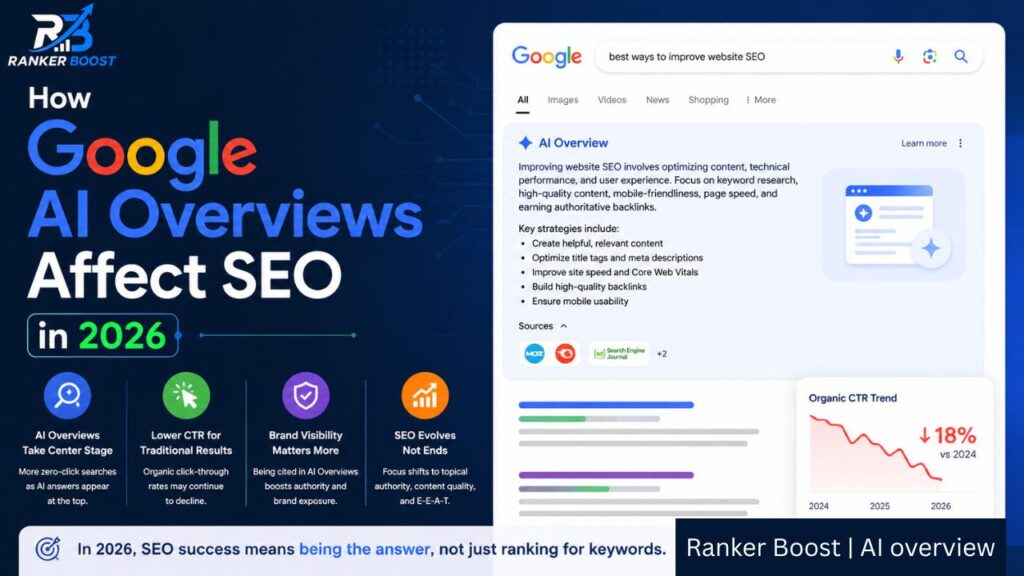
First — What Even Is an AI Overview, Really?
Most people describe AI Overviews as “a summary at the top of search results” and leave it there. That description is technically accurate and practically useless.
Here’s what’s actually happening under the hood. When you search for something like “how to reduce churn for SaaS products,” Google isn’t picking one page and summarizing it. It’s running its large language model across multiple pages simultaneously — pulling a statistic from one, a framework from another, a clarifying nuance from a third — and stitching them into a synthesized response. Then it attributes that response to the sources it drew from, with inline links.
What this means for you is genuinely strange to wrap your head around at first. The page that gets cited in the AI Overview isn’t necessarily the one that ranks #1 organically. It’s the one whose content was clearest, most directly structured, and most easily extracted. A page sitting at position four can be cited while the page at position one gets nothing — because the position-one page buried its answer inside three paragraphs of preamble before getting to the point.
And yes, Google is now deciding which of your sentences are worth surfacing. Which is either exciting or alarming depending on how you look at it.
The Traffic Numbers Are Real. But So Is the Recovery.
Let me show you the actual data, because this is where it gets interesting.
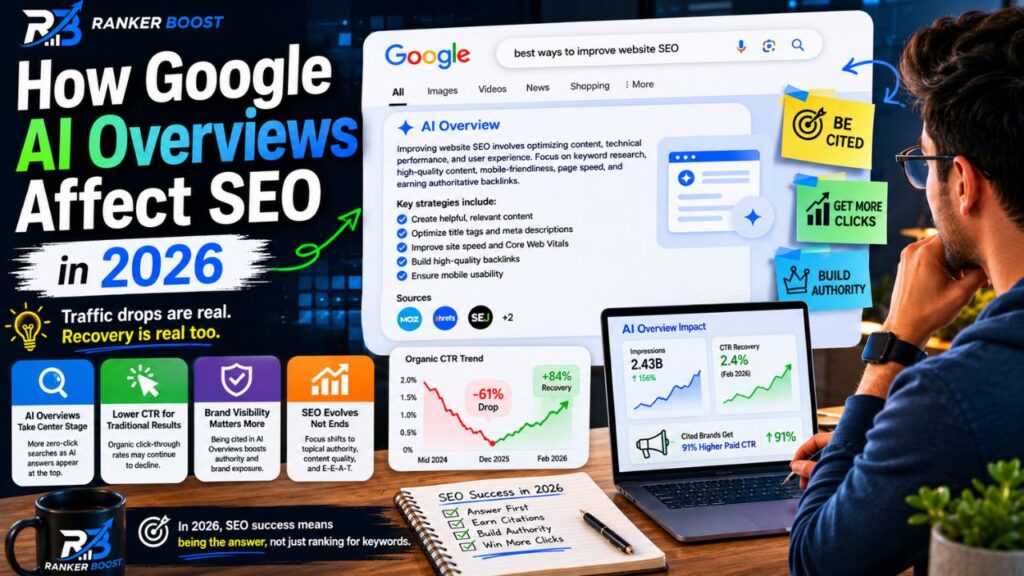
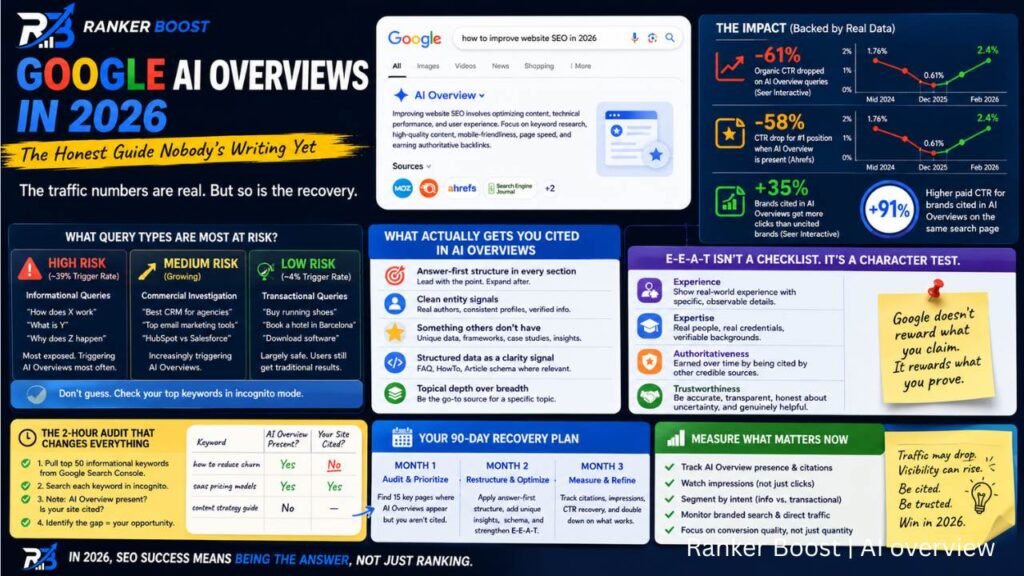
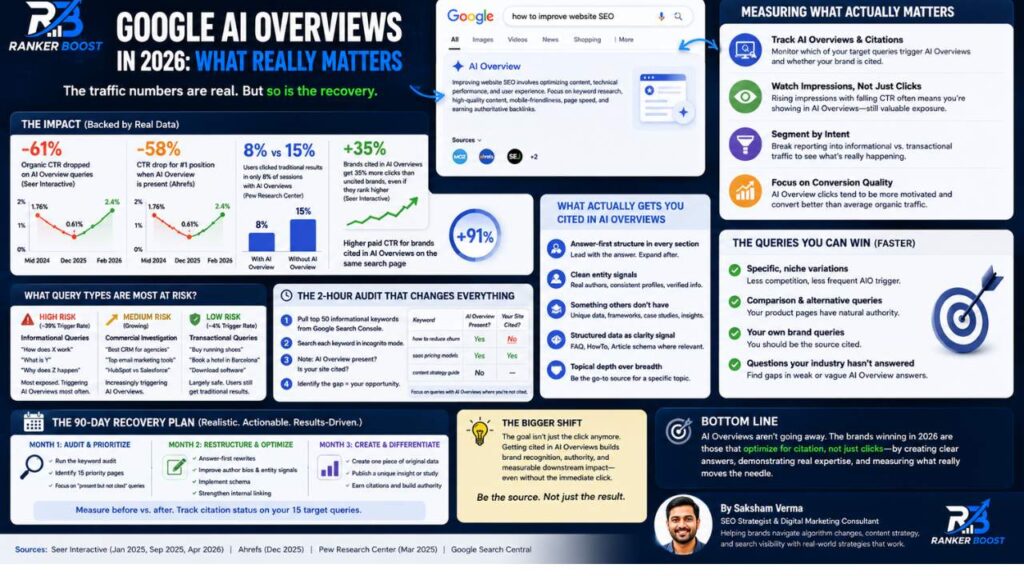
Seer Interactive ran one of the most rigorous studies on this — 3,119 informational queries, 42 organizations, 25.1 million organic impressions tracked from mid-2024 through late 2025. What they found: organic CTR on queries where AI Overviews appeared dropped 61%. Not 10%. Not 20%. Sixty-one percent, from roughly 1.76% down to 0.61%. Paid CTR on those same queries fell even harder — 68%.
Ahrefs looked at 300,000 keywords and found the #1 organic position saw a 58% CTR drop when an AI Overview was present. The Pew Research Center found that users clicked a traditional result in only 8% of sessions where AI Overviews appeared, compared to 15% without them.
Those numbers are bad. I’m not going to pretend they aren’t.
But here’s the part that barely got covered: by February 2026, organic CTR on AI Overview queries had climbed back from its floor of 1.3% (December 2025) to 2.4%. Same Seer Interactive team, now tracking 53 brands and 2.43 billion impressions. The freefall stopped. Users appear to be adapting to AI Overviews in ways that are partially restoring click behavior, at least for now.
The even bigger finding — and this is the one I’d put on a sticky note on your monitor — is this: brands that are cited inside AI Overviews get 35% more clicks than uncited brands, even uncited brands that rank higher. Being cited has become worth more than ranking. That’s a complete inversion of how SEO has worked for the past 20 years.
There’s also a downstream effect nobody expected: brands cited in AI Overviews see 91% higher paid CTR on the same search page. Ninety-one percent. Being selected as a trusted source by Google’s AI apparently triggers something in users that makes them more likely to click your ad too. The authority halo is real.
Why Being a Good Writer Isn’t Enough Anymore
Here’s something that genuinely bothers me about how AI Overviews select sources, because it creates a weird incentive.
Well-written, nuanced content often loses to clearly structured, answer-first content. A beautifully written 3,000-word essay that builds to its conclusion might rank fine organically but never get cited in an AI Overview — because the AI can’t easily extract a clean, standalone answer from it.
The content that gets cited tends to follow a specific pattern whether intentionally or not: heading that matches a user question, then the actual answer in the first two sentences of that section, then supporting detail, examples, and caveats. Every major section is almost self-contained. The AI can lift the answer without needing the surrounding context.
This doesn’t mean you should write like a robot to beat robots — that’s counterproductive and it won’t work anyway. But it does mean that burying your insights inside paragraphs of context, or saving your conclusion for the end of a section, actively works against you in the AI Overview era. Lead with the point. Expand after.
What Query Types Are Most at Risk — and Which Ones Google Is Leaving Alone
Not every keyword you care about is equally threatened. This is important because a lot of people are rebuilding their entire content strategy when only part of their portfolio actually needs rethinking.
Informational queries are the most exposed. “How does X work,” “what is Y,” “why does Z happen” — these trigger AI Overviews around 39% of the time as of early 2026, and that number is growing. If your business runs on informational content — think blogs, guides, educational resources — you’re dealing with the highest-impact scenario.
Transactional queries are largely safe. “Buy running shoes,” “book a hotel in Barcelona,” “download project management software” — these trigger AI Overviews in maybe 4% of cases. People searching to buy or book something still get traditional results.
The middle ground is where it gets complicated. Commercial investigation queries — “best CRM for agencies,” “top email marketing tools,” “HubSpot vs Salesforce” — are increasingly triggering AI Overviews, and that’s genuinely painful for B2B marketers who spent years ranking for those terms.
The practical takeaway is to actually go check your keywords. Don’t assume. Open a browser in incognito mode, search your top 20 most valuable informational keywords, and see what appears. For the ones where AI Overviews are showing up and you’re not cited, those are your priority targets. For the ones where AI Overviews aren’t showing, your traditional SEO approach is still working fine — don’t mess with it.
The Audit That Takes Two Hours and Tells You Everything
I’m going to walk you through exactly what I’d do if I inherited your site today.
Pull your top 50 informational keywords from Google Search Console — the ones driving the most impressions. Export them. Then, one by one, search each one and note: does an AI Overview appear? If yes, is your site cited within it? You’re building a simple three-column spreadsheet: keyword, AI Overview present (yes/no), your site cited (yes/no/not ranking).
Most sites end up with something like this: AI Overviews present on 15–20 of their top 50 queries, cited on maybe 3–5 of those. The gap between “present but not cited” is your opportunity. Those are pages you already rank for, where you’re already being crawled, where Google already trusts you enough to show you — but where your content structure isn’t giving the AI what it needs to pull from you.
Those pages are your next 60 days of work. Everything else can stay as-is.
What Actually Gets You Into an AI Overview (Not the Vague Advice — The Specific Stuff)
I’ve read a lot of articles that say “create high-quality content and optimize for E-E-A-T” and then stop there. That’s like telling someone “eat well and exercise” when they ask how to run a marathon. True, but not actionable.
Here’s what the evidence actually points to: Google AI Overviews in 2026
Answer-first structure, every section. I already mentioned this but it’s worth repeating because it’s probably the highest-leverage single change you can make. If you’re writing a section about how AI Overviews affect click-through rates, the first sentence of that section should contain the answer to that question. Not in paragraph three. Sentence one or two.
Clean entity signals. Google’s AI is working within an entity-based understanding of the world — brands, people, organizations, topics are all entities that Google recognizes and trusts to varying degrees. Your site’s entity profile matters. This means named authors with consistent biographies and professional profile links. It means your organization is described consistently across your site, your Google Business profile, your social accounts, and third-party references. It means your author pages have actual information on them — not just “The Editorial Team” with no names.
Something the other sources don’t have. AI Overviews typically pull from three to five sources per response. You don’t have to be the single best source on the topic. You have to offer something one of the other sources doesn’t. A statistic from your own research. A framework you developed and named. A case study from your actual client work. A counterintuitive finding. If everything you publish could have been written by any of your competitors, there’s nothing to compel the AI to reach for you specifically.
Structured data as a clarity signal. FAQ schema, HowTo schema, and Article schema don’t directly cause citation — but they make your content’s structure legible to Google’s systems, which removes friction in the extraction process. Add them where they’re semantically appropriate. Don’t spam them across pages where they don’t fit.
Topical depth over breadth. A site that has published 30 deeply useful, specific articles on a narrow topic is easier for Google’s AI to recognize as authoritative on that topic than a site that has 200 articles touching loosely on 50 different subjects. Depth signals coherent expertise. Breadth without depth signals content volume strategy.
Google AI Overviews in 2026
E-E-A-T Isn’t a Checklist. It’s a Character Test.
Google introduced the E-E-A-T framework — Experience, Expertise, Authoritativeness, Trustworthiness — and then the internet turned it into a checklist of things to add to your website. Author bio? Check. About page? Check. Citations? Check.
That’s not how it works, and I think people who treat it that way are going to be increasingly disappointed.
What E-E-A-T is actually evaluating — especially in an AI Overview context — is whether your content could only have been written by someone who actually knows this subject. Experience means specific, observable details that come from doing, not just reading. If you’re writing about how AI Overviews affected your traffic, the post should contain your actual Search Console numbers, your actual observations about which queries got hit and which didn’t, your actual experiments with restructuring content and what happened.
Expertise means your authors are real people with real backgrounds that can be verified. Not “our team of expert writers.” Actual humans with names, credentials, and professional histories that can be checked.
Authoritativeness is built over time by being cited by other credible sources — not by calling yourself authoritative in your About page copy. It’s an external signal, not a self-declared one.
Trustworthiness is the one people underestimate most. It includes accuracy, yes. But it also includes being honest about uncertainty, being transparent about who you are and what you’re trying to do, not making overconfident claims you can’t back up, and not using manipulative framing. Google’s systems are increasingly good at detecting the difference between content written to genuinely help someone and content written to rank.
Measuring in a World Where Traffic Isn’t the Whole Picture
If you report to someone who looks at organic traffic and nothing else, you’re going to have a hard time over the next few years. Not because your site will necessarily fail, but because the relationship between content performance and clicks has fundamentally changed for certain query types.
Being cited in a high-visibility AI Overview delivers brand exposure to people who will search for you directly later, engage with your ads, or refer you through word of mouth. None of that shows up in your organic traffic report. It shows up in branded search volume, direct traffic trends, and conversion quality — if you’re looking for it.
What to add to your measurement stack right now: Google AI Overviews in 2026
Track which of your target queries display AI Overviews, and whether you’re cited. Several platforms now offer this — Semrush, Ahrefs, and dedicated answer engine optimization tools have built monitoring for this. If you can’t afford a tool, manual spot-checking against your top 20 queries monthly is better than nothing.
Watch impressions separately from clicks. A rise in impressions with falling CTR often means you’re appearing in AI Overview contexts — which has real value even without the click.
Break your traffic reporting by intent segment. Your informational traffic and your transactional traffic need to be reported separately. Lumping them together right now means you can’t actually see what’s happening in either category.
Pay attention to conversion quality for AI Overview traffic. The users who do click through from an AI-Overview SERP tend to be more motivated — they saw the summary, decided they wanted more, and came to you intentionally. These sessions often have better engagement and conversion metrics than average organic traffic.
The Honest Bit About Queries You Probably Can’t Win
I want to be straight with you on this. Some queries are effectively locked up by publishers with enormous authority and years of citation history. Trying to earn an AI Overview citation for “what is content marketing” when HubSpot, Neil Patel, and Semrush are already there is going to take a very long time and a lot of resources. That time might be better spent elsewhere.
The queries where you have a genuine path to citation faster:
Specific, niche variations. “Content marketing for independent financial advisors” is exponentially less contested than “content marketing.” It probably triggers AI Overviews less frequently too, which means your traditional ranking still matters and your citation competition is thin.
Comparison and alternative queries tied to your product. “Your product vs [competitor]” is a query where your site has natural standing to be the authoritative source. Optimize those pages hard for citation structure.
Your own brand name queries. If someone searches your brand name and an AI Overview appears, it should be citing you. Check this. You might be surprised.
Questions your industry hasn’t answered clearly. Do a search for important questions in your niche and look at whether the AI Overview response is actually good. If it’s vague or incomplete, that’s a gap you can fill with a genuinely better answer.
A Realistic 90-Day Plan
Because “build better content” is not a plan: Google AI Overviews in 2026
Month one. Run the keyword audit. Identify 15 pages that target queries where AI Overviews appear and you’re not currently cited. That’s your priority list. Don’t expand it beyond that — focused effort beats scattered effort every time.
Google AI Overviews in 2026: The Honest Guide Nobody’s Writing Yet
By Saksham Verma | Updated June 2026
Okay, I’m going to start with something that might sting a little.
Some of the websites that lost 40–50% of their organic traffic in the last 18 months did everything right. Good content, solid backlinks, clean technical SEO, all of it. They didn’t get penalized. They didn’t make mistakes. They just woke up one day and discovered that Google had placed a machine-generated summary directly above their result — one that answered the user’s question well enough that clicking through became optional.
That’s the world we’re in now. And the frustrating thing is that most articles about Google AI Overviews either catastrophize (“SEO is dead!”) or brush it off (“just optimize for E-E-A-T and you’ll be fine”). Neither is actually useful if you’re sitting there watching your Search Console numbers slide.
So here’s what I want to do instead: tell you what’s actually happening, show you the real numbers, and give you a clear picture of what separates sites that are getting cited in these AI results from the ones getting buried under them.
First — What Even Is an AI Overview, Really?
Most people describe AI Overviews as “a summary at the top of search results” and leave it there. That description is technically accurate and practically useless.
Here’s what’s actually happening under the hood. When you search for something like “how to reduce churn for SaaS products,” Google isn’t picking one page and summarizing it. It’s running its large language model across multiple pages simultaneously — pulling a statistic from one, a framework from another, a clarifying nuance from a third — and stitching them into a synthesized response. Then it attributes that response to the sources it drew from, with inline links.
What this means for you is genuinely strange to wrap your head around at first. The page that gets cited in the AI Overview isn’t necessarily the one that ranks #1 organically. It’s the one whose content was clearest, most directly structured, and most easily extracted. A page sitting at position four can be cited while the page at position one gets nothing — because the position-one page buried its answer inside three paragraphs of preamble before getting to the point.
And yes, Google is now deciding which of your sentences are worth surfacing. Which is either exciting or alarming depending on how you look at it.
Google AI Overviews in 2026
The Traffic Numbers Are Real. But So Is the Recovery.
Google AI Overviews in 2026 |Let me show you the actual data, because this is where it gets interesting.
Seer Interactive ran one of the most rigorous studies on this — 3,119 informational queries, 42 organizations, 25.1 million organic impressions tracked from mid-2024 through late 2025. What they found: organic CTR on queries where AI Overviews appeared dropped 61%. Not 10%. Not 20%. Sixty-one percent, from roughly 1.76% down to 0.61%. Paid CTR on those same queries fell even harder — 68%.
Ahrefs looked at 300,000 keywords and found the #1 organic position saw a 58% CTR drop when an AI Overview was present. The Pew Research Center found that users clicked a traditional result in only 8% of sessions where AI Overviews appeared, compared to 15% without them.
Those numbers are bad. I’m not going to pretend they aren’t.
But here’s the part that barely got covered: by February 2026, organic CTR on AI Overview queries had climbed back from its floor of 1.3% (December 2025) to 2.4%. Same Seer Interactive team, now tracking 53 brands and 2.43 billion impressions. The freefall stopped. Users appear to be adapting to AI Overviews in ways that are partially restoring click behavior, at least for now.
The even bigger finding — and this is the one I’d put on a sticky note on your monitor — is this: brands that are cited inside AI Overviews get 35% more clicks than uncited brands, even uncited brands that rank higher. Being cited has become worth more than ranking. That’s a complete inversion of how SEO has worked for the past 20 years.
There’s also a downstream effect nobody expected: brands cited in AI Overviews see 91% higher paid CTR on the same search page. Ninety-one percent. Being selected as a trusted source by Google’s AI apparently triggers something in users that makes them more likely to click your ad too. The authority halo is real.
Why Being a Good Writer Isn’t Enough Anymore
Google AI Overviews in 2026 -Here’s something that genuinely bothers me about how AI Overviews select sources, because it creates a weird incentive.
Well-written, nuanced content often loses to clearly structured, answer-first content. A beautifully written 3,000-word essay that builds to its conclusion might rank fine organically but never get cited in an AI Overview — because the AI can’t easily extract a clean, standalone answer from it.
The content that gets cited tends to follow a specific pattern whether intentionally or not: heading that matches a user question, then the actual answer in the first two sentences of that section, then supporting detail, examples, and caveats. Every major section is almost self-contained. The AI can lift the answer without needing the surrounding context.
This doesn’t mean you should write like a robot to beat robots — that’s counterproductive and it won’t work anyway. But it does mean that burying your insights inside paragraphs of context, or saving your conclusion for the end of a section, actively works against you in the AI Overview era. Lead with the point. Expand after.
What Query Types Are Most at Risk — and Which Ones Google Is Leaving Alone
Not every keyword you care about is equally threatened. This is important because a lot of people are rebuilding their entire content strategy when only part of their portfolio actually needs rethinking.
Informational queries are the most exposed. “How does X work,” “what is Y,” “why does Z happen” — these trigger AI Overviews around 39% of the time as of early 2026, and that number is growing. If your business runs on informational content — think blogs, guides, educational resources — you’re dealing with the highest-impact scenario.
Transactional queries are largely safe. “Buy running shoes,” “book a hotel in Barcelona,” “download project management software” — these trigger AI Overviews in maybe 4% of cases. People searching to buy or book something still get traditional results.
The middle ground is where it gets complicated. Commercial investigation queries — “best CRM for agencies,” “top email marketing tools,” “HubSpot vs Salesforce” — are increasingly triggering AI Overviews, and that’s genuinely painful for B2B marketers who spent years ranking for those terms.
The practical takeaway is to actually go check your keywords. Don’t assume. Open a browser in incognito mode, search your top 20 most valuable informational keywords, and see what appears. For the ones where AI Overviews are showing up and you’re not cited, those are your priority targets. For the ones where AI Overviews aren’t showing, your traditional SEO approach is still working fine — don’t mess with it.
The Audit That Takes Two Hours and Tells You Everything
Google AI Overviews in 2026- I’m going to walk you through exactly what I’d do if I inherited your site today.
Pull your top 50 informational keywords from Google Search Console — the ones driving the most impressions. Export them. Then, one by one, search each one and note: does an AI Overview appear? If yes, is your site cited within it? You’re building a simple three-column spreadsheet: keyword, AI Overview present (yes/no), your site cited (yes/no/not ranking).
Most sites end up with something like this: AI Overviews present on 15–20 of their top 50 queries, cited on maybe 3–5 of those. The gap between “present but not cited” is your opportunity. Those are pages you already rank for, where you’re already being crawled, where Google already trusts you enough to show you — but where your content structure isn’t giving the AI what it needs to pull from you.
Those pages are your next 60 days of work. Everything else can stay as-is.
What Actually Gets You Into an AI Overview (Not the Vague Advice — The Specific Stuff)
I’ve read a lot of articles that say “create high-quality content and optimize for E-E-A-T” and then stop there. That’s like telling someone “eat well and exercise” when they ask how to run a marathon. True, but not actionable.
Here’s what the evidence actually points to:
Answer-first structure, every section. I already mentioned this but it’s worth repeating because it’s probably the highest-leverage single change you can make. If you’re writing a section about how AI Overviews affect click-through rates, the first sentence of that section should contain the answer to that question. Not in paragraph three. Sentence one or two.
Clean entity signals. Google’s AI is working within an entity-based understanding of the world — brands, people, organizations, topics are all entities that Google recognizes and trusts to varying degrees. Your site’s entity profile matters. This means named authors with consistent biographies and professional profile links. It means your organization is described consistently across your site, your Google Business profile, your social accounts, and third-party references. It means your author pages have actual information on them — not just “The Editorial Team” with no names.
Something the other sources don’t have. AI Overviews typically pull from three to five sources per response. You don’t have to be the single best source on the topic. You have to offer something one of the other sources doesn’t. A statistic from your own research. A framework you developed and named. A case study from your actual client work. A counterintuitive finding. If everything you publish could have been written by any of your competitors, there’s nothing to compel the AI to reach for you specifically.
Structured data as a clarity signal. FAQ schema, HowTo schema, and Article schema don’t directly cause citation — but they make your content’s structure legible to Google’s systems, which removes friction in the extraction process. Add them where they’re semantically appropriate. Don’t spam them across pages where they don’t fit.
Topical depth over breadth. A site that has published 30 deeply useful, specific articles on a narrow topic is easier for Google’s AI to recognize as authoritative on that topic than a site that has 200 articles touching loosely on 50 different subjects. Depth signals coherent expertise. Breadth without depth signals content volume strategy.
E-E-A-T Isn’t a Checklist. It’s a Character Test.
Google introduced the E-E-A-T framework — Experience, Expertise, Authoritativeness, Trustworthiness — and then the internet turned it into a checklist of things to add to your website. Author bio? Check. About page? Check. Citations? Check.
That’s not how it works, and I think people who treat it that way are going to be increasingly disappointed. Google AI Overviews in 2026
What E-E-A-T is actually evaluating — especially in an AI Overview context — is whether your content could only have been written by someone who actually knows this subject. Experience means specific, observable details that come from doing, not just reading. If you’re writing about how AI Overviews affected your traffic, the post should contain your actual Search Console numbers, your actual observations about which queries got hit and which didn’t, your actual experiments with restructuring content and what happened.
Expertise means your authors are real people with real backgrounds that can be verified. Not “our team of expert writers.” Actual humans with names, credentials, and professional histories that can be checked.
Authoritativeness is built over time by being cited by other credible sources — not by calling yourself authoritative in your About page copy. It’s an external signal, not a self-declared one.
Trustworthiness is the one people underestimate most. It includes accuracy, yes. But it also includes being honest about uncertainty, being transparent about who you are and what you’re trying to do, not making overconfident claims you can’t back up, and not using manipulative framing. Google’s systems are increasingly good at detecting the difference between content written to genuinely help someone and content written to rank.
Measuring in a World Where Traffic Isn’t the Whole Picture
If you report to someone who looks at organic traffic and nothing else, you’re going to have a hard time over the next few years. Not because your site will necessarily fail, but because the relationship between content performance and clicks has fundamentally changed for certain query types.
Being cited in a high-visibility AI Overview delivers brand exposure to people who will search for you directly later, engage with your ads, or refer you through word of mouth. None of that shows up in your organic traffic report. It shows up in branded search volume, direct traffic trends, and conversion quality — if you’re looking for it.
What to add to your measurement stack right now: Google AI Overviews in 2026
Track which of your target queries display AI Overviews, and whether you’re cited. Several platforms now offer this — Semrush, Ahrefs, and dedicated answer engine optimization tools have built monitoring for this. If you can’t afford a tool, manual spot-checking against your top 20 queries monthly is better than nothing.
Watch impressions separately from clicks. A rise in impressions with falling CTR often means you’re appearing in AI Overview contexts — which has real value even without the click.
Break your traffic reporting by intent segment. Your informational traffic and your transactional traffic need to be reported separately. Lumping them together right now means you can’t actually see what’s happening in either category.
Pay attention to conversion quality for AI Overview traffic. The users who do click through from an AI-Overview SERP tend to be more motivated — they saw the summary, decided they wanted more, and came to you intentionally. These sessions often have better engagement and conversion metrics than average organic traffic.
The Honest Bit About Queries You Probably Can’t Win
I want to be straight with you on this. Some queries are effectively locked up by publishers with enormous authority and years of citation history. Trying to earn an AI Overview citation for “what is content marketing” when HubSpot, Neil Patel, and Semrush are already there is going to take a very long time and a lot of resources. That time might be better spent elsewhere.
The queries where you have a genuine path to citation faster:
Specific, niche variations. “Content marketing for independent financial advisors” is exponentially less contested than “content marketing.” It probably triggers AI Overviews less frequently too, which means your traditional ranking still matters and your citation competition is thin.
Comparison and alternative queries tied to your product. “Your product vs [competitor]” is a query where your site has natural standing to be the authoritative source. Optimize those pages hard for citation structure.
Your own brand name queries. If someone searches your brand name and an AI Overview appears, it should be citing you. Check this. You might be surprised.
Questions your industry hasn’t answered clearly. Do a search for important questions in your niche and look at whether the AI Overview response is actually good. If it’s vague or incomplete, that’s a gap you can fill with a genuinely better answer.
A Realistic 90-Day Plan
Because “build better content” is not a plan:
Month one. Run the keyword audit. Identify 15 pages that target queries where AI Overviews appear and you’re not currently cited. That’s your priority list. Don’t expand it beyond that — focused effort beats scattered effort every time.
Month two. Restructure those 15 pages. Rewrite the opening of each major section to lead with the answer, not the context. Add or significantly improve author bios — real names, real credentials, links to professional profiles. Implement Article schema and FAQ schema where appropriate. Add internal links from your highest-authority pages to each target page.
Month three. Create one piece of original data. Survey your customers, analyze your own internal data, run a study — something that produces a finding that isn’t published elsewhere. Even a small, methodologically sound study creates a unique citable claim that sets you apart from the five other pages Google is choosing between.
Then measure. Compare your citation status on your 15 target queries before and after. That’s the most direct signal you have that any of this is working.
The Bigger Shift That All of This Points To
For most of the history of search engine optimization, the goal was the click. Everything — rankings, traffic, impressions — was a proxy for getting someone onto your page. The better you ranked, the more they clicked, the more you won.
Google AI Overviews in 2026 have introduced a different layer. Getting your content into the answer — whether or not it produces a click — is now a meaningful outcome in its own right. Citation builds brand recognition in people who may never have found you otherwise. It signals authority to users who do click through later. It has measurable downstream effects on paid performance.
This doesn’t mean clicks don’t matter. They do. But the brands that are adapting well right now are the ones that stopped treating citation as a bonus outcome and started treating it as a primary goal — and restructured their content and measurement accordingly.
The ones still fighting to get their old traffic numbers back, using the same strategies that worked in 2022, are going to keep being frustrated. The landscape has moved. The question is just whether your strategy has moved with it.
Bottom Line
Google AI Overviews in 2026 aren’t going away. Coverage is expanding, not contracting. The CTR declines for informational queries are real, though the worst of the freefall appears to have stabilized in early 2026.
The path forward isn’t to panic or to declare SEO dead. It’s to understand that a new competitive layer has appeared above the traditional organic results — one that selects sources based on answer clarity, entity authority, and content uniqueness rather than just domain authority and backlinks.
Win at that layer, and you don’t just preserve your visibility. You build a kind of presence in search results that’s arguably more valuable than a #1 ranking — because you’re the source Google is vouching for, not just the page it’s sending people to.
That’s a different game than the one most of us learned. But it’s the one we’re playing now.
Sources: Seer Interactive AIO CTR Studies (January 2025, September 2025, April 2026); Ahrefs CTR Analysis (December 2025); Pew Research Center Search Behavior Study (March 2025); Google Search Central documentation.
Saksham Verma is an SEO strategist and digital marketing consultant who has spent years helping brands navigate algorithm changes, content strategy, and search visibility. He writes about what actually works in SEO — not the theory, but the stuff that shows up in Search Console.
Google AI Overviews in 2026
Frequently Asked Questions About Google AI Overviews
People ask a lot of questions about this topic — some practical, some almost philosophical. Here are the ones I see come up the most, answered as plainly as I can.
AI Overviews are the AI-generated summaries Google places above traditional search results for many queries. When you search something like “how does compound interest work,” instead of showing you ten blue links straight away, Google shows a synthesized answer it built by pulling information from multiple web pages simultaneously — then cites those pages with links.
The key thing to understand is Google isn’t summarizing one page. It’s reading several, extracting relevant claims, and weaving them together. The pages it cites aren’t always the ones ranking #1. They’re the ones whose content was structured clearly enough to extract from.
Yes — but the picture is more complicated than a simple yes. For informational queries where AI Overviews appear, organic CTR has dropped significantly. Seer Interactive’s data from September 2025 showed a 61% CTR drop on queries with AI Overviews. Ahrefs found position-one rankings saw 58% less clicks when an AI Overview was sitting above them.
However — and this matters — by February 2026, CTR had partially recovered from its lowest point. And sites that are actually cited inside AI Overviews earn 35% more clicks than uncited sites, even uncited sites ranking higher. So “AI Overviews hurt traffic” is only the full story for sites not appearing in the citations. If you’re getting cited, it can actually help.
There’s no guaranteed method, but the patterns are clear enough to act on. The sites getting cited tend to: structure their content so the answer comes in the first two sentences of each section (not buried at the end), use headings that match the actual question a user would type, have named authors with real credentials, publish something genuinely unique that other sources don’t have, and implement structured data like FAQ schema and Article schema.
The single highest-leverage change most sites can make is answer-first writing. If every major section of your page leads with the direct answer before the context and caveats, you’ve made it dramatically easier for Google’s AI to extract and cite you.
Yes. Google allows publishers to use the nosnippet meta tag to prevent their content from being used in AI Overviews. You can also use max-snippet directives to limit how much text Google can pull. Whether opting out makes sense depends on your situation — if you’re getting cited and it’s driving visibility, opting out removes that. If you’re losing traffic without being cited, opting out doesn’t help much either since it just removes you from consideration entirely.
Most publishers are better off optimizing to be cited rather than opting out.
Informational queries are by far the most common trigger — “how to,” “what is,” “why does,” “explain X” style questions. As of early 2026, these trigger AI Overviews roughly 39% of the time. Question-based keywords make up about 25% of all AIO-triggering searches.
Transactional queries (“buy X,” “book Y”) almost never trigger them — around 4% of the time. Navigational queries (“YouTube login”) rarely do. The grey area is commercial investigation queries — “best CRM software,” “HubSpot vs Salesforce” — which are increasingly triggering AI Overviews and causing real pain for B2B content marketers.
More than people expected. Research found that paid CTR dropped 68% on queries where AI Overviews appeared — actually a steeper drop than organic. That seems counterintuitive at first, but it makes sense when you think about it: if the AI Overview answers the question completely, users who would have clicked an ad to learn more just… don’t need to anymore.
The interesting flip side: brands that are cited in AI Overviews see 91% higher paid CTR on the same page. The trust signal from being cited by Google’s AI spills over into how users interact with that brand’s ads. So the answer to “should I still run Google Ads on AI Overview queries” is mostly yes, but focus your paid budget on queries where you’re also earning citations or where AI Overviews don’t appear.
No. That question gets asked every time something big changes in search, and the answer is always the same: the game changed, but it didn’t end.
What’s true is that the ranking-equals-traffic equation is broken for informational query categories. A #1 ranking no longer reliably delivers the clicks it used to when an AI Overview sits above it and fully answers the question. But transactional and navigational search is largely unaffected. Brand-building through organic search still works. Citation in AI Overviews is a new form of visibility that SEO work can earn.
The people declaring SEO dead are usually looking at one metric — informational traffic clicks — and extrapolating. The full picture is more nuanced. Traditional SEO fundamentals (technical health, backlinks, content quality, topical authority) are still the foundation. They’re just not sufficient on their own anymore for the informational query layer.
Almost certainly yes. Google I/O in May 2026 confirmed continued investment in AI search features. AI Mode — the conversational version of AI search — crossed one billion monthly users with queries more than doubling every quarter. Google’s own revenue data shows search ad revenues grew 17% even as CTRs dropped, because CPC inflation is compensating. Google has every financial incentive to keep expanding this.
The honest answer is nobody knows the exact trajectory. What we can say is that the smart move is to build your content strategy around a world where AI Overviews are present on most informational queries, because that’s where things are clearly heading — and being prepared early is better than scrambling to adapt later.
Google Search Console now includes AI Overview data, though it doesn’t cleanly separate AI Overview clicks from regular organic clicks yet — as of June 2025, AI Mode clicks count under the “Web” search type. That’s a real gap in measurement right now.
For dedicated tracking, Semrush, Ahrefs, and tools like SERP Trends and AI Overview trackers from platforms like Authoritas and SE Ranking have built monitoring for citation presence. If budget is tight, the manual approach — searching your top 20 keywords in incognito mode monthly and logging what you see — is slow but free and gives you real-world data on your actual exposure.
The Bigger Shift That All of This Points To
For most of the history of search engine optimization, the goal was the click. Everything — rankings, traffic, impressions — was a proxy for getting someone onto your page. The better you ranked, the more they clicked, the more you won.
AI Overviews have introduced a different layer. Getting your content into the answer — whether or not it produces a click — is now a meaningful outcome in its own right. Citation builds brand recognition in people who may never have found you otherwise. It signals authority to users who do click through later. It has measurable downstream effects on paid performance.
This doesn’t mean clicks don’t matter. They do. But the brands that are adapting well right now are the ones that stopped treating citation as a bonus outcome and started treating it as a primary goal — and restructured their content and measurement accordingly.
The ones still fighting to get their old traffic numbers back, using the same strategies that worked in 2022, are going to keep being frustrated. The landscape has moved. The question is just whether your strategy has moved with it.
Bottom Line
Google AI Overviews in 2026 -AI Overviews aren’t going away. Coverage is expanding, not contracting. The CTR declines for informational queries are real, though the worst of the freefall appears to have stabilized in early 2026.
The path forward isn’t to panic or to declare SEO dead. It’s to understand that a new competitive layer has appeared above the traditional organic results — one that selects sources based on answer clarity, entity authority, and content uniqueness rather than just domain authority and backlinks.
Win at that layer, and you don’t just preserve your visibility. You build a kind of presence in search results that’s arguably more valuable than a #1 ranking — because you’re the source Google is vouching for, not just the page it’s sending people to.
That’s a different game than the one most of us learned. But it’s the one we’re playing now.
I have spent five years working in digital marketing. It covers SEO and content marketing along with some website growth strategies. There were multiple client projects across different industries. Those helped improve Google rankings and organic traffic for the businesses involved.
Online visibility was part of it too. Right now blogging takes most of my attention. The content stays focused on SEO and comes from what actually worked in practice. It feels like that approach makes sense but I am not totally sure how much more there is to add. Some parts of the strategy still seem unclear even after using them.
How to improve google ranking – Click Here