
How to Make AI Content Sound Human: The No-Fluff Guide That Actually Works (2026)
Target Keywords integrated naturally: How to Make AI Content Sound Human
- humanize AI content (secondary)
- AI writing detection (secondary)
- AI content SEO (supporting)
You prompted. The AI delivered 800 words in eight seconds. The facts check out. The structure is clean. But the moment you hit the second paragraph, something feels wrong — like you’re reading an internal memo written by someone who’s never had a bad day.
That’s the real problem nobody wants to say plainly: AI doesn’t write badly. It writes blandly. It produces the shape of a good article without the soul of one. Publish it as-is, and readers disappear. Google quietly shuffles it down the rankings. And no amount of “humanizer” tools will fix what’s broken at the root.
I’ve spent a lot of time figuring out how to make AI content sound human — not by running it through a spinner and crossing my fingers, but by understanding what actually makes writing feel like a person wrote it. Every technique in this guide is something you can apply today, to your next draft, without any special tools.
How to Make AI Content Sound Human
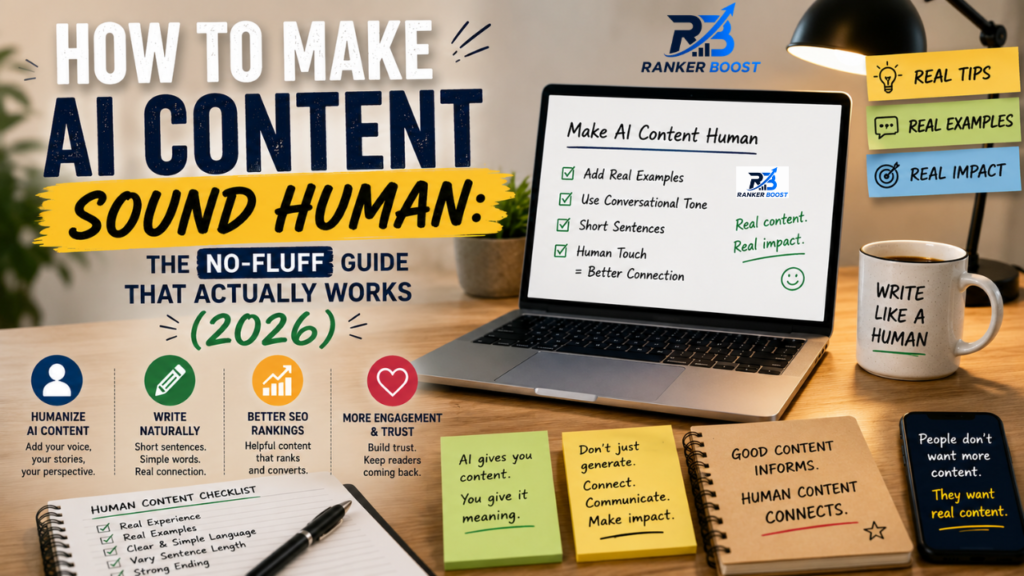
Why AI Writing Sounds the Way It Does
Most people blame word choice. Cut “utilize,” kill “delve,” done. Nope.
Word choice is a symptom. The root cause is deeper: every AI model is trained to produce the most statistically average response to any prompt. It’s learned from millions of human texts and outputs something that looks like what a “typical” article on that topic looks like. That’s powerful — and it’s also why everything it generates feels vaguely familiar. Because in a way, you’ve read it before.
Human writing isn’t optimized for average. It goes somewhere specific. It has a point of view baked in from sentence one. It takes a side, calls something out, or explains a concept in a way that only makes sense if you’ve actually spent time close to the subject.
That’s the gap. Here’s how you close it — step by step.
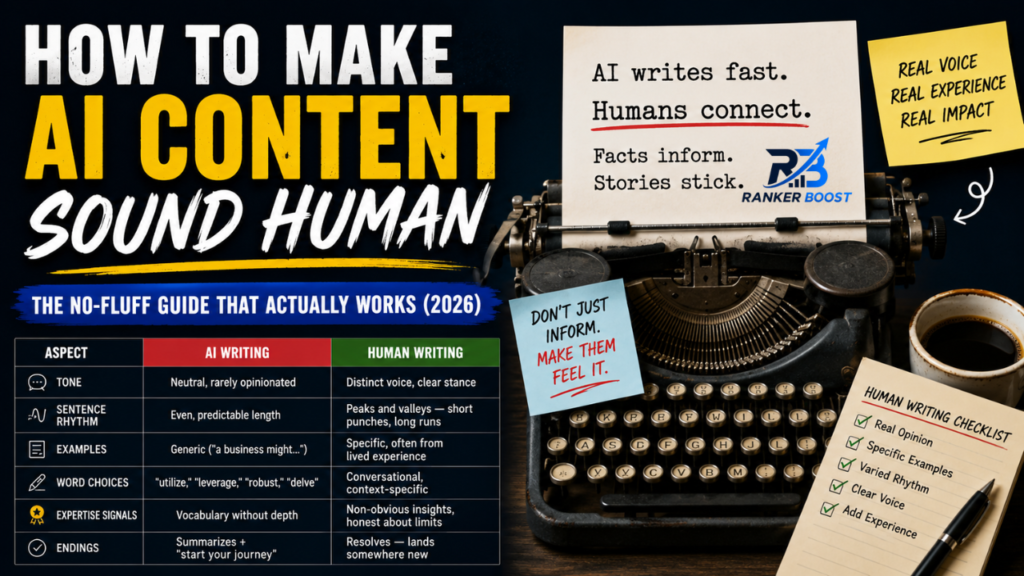
At a Glance: AI Writing vs. Human Writing
| Quality | AI Writing | Human Writing |
|---|---|---|
| Tone | Neutral, rarely opinionated | Distinct voice, clear stance |
| Sentence rhythm | Even, predictable length | Peaks and valleys — short punches, long runs |
| Examples | Generic (“a business might…”) | Specific, often from lived experience |
| Word choices | “utilize,” “leverage,” “robust,” “delve” | Conversational, context-specific |
| Expertise signals | Vocabulary without depth | Non-obvious insights, honest about limits |
| Endings | Summarizes + “start your journey” | Resolves — lands somewhere new |
Once you see these patterns, you’ll spot them in any AI draft within two paragraphs.
Step 1: Read It Out Loud — Every Word
Before you change anything, read the whole draft out loud. Not in your head — actually out loud.
Your brain autocorrects when you read silently. It smooths over stiff phrasing, fills in missing rhythm, and lets you believe the writing is better than it is. Your voice can’t do that. It will stumble on every sentence that’s too formal, too long, or assembled in a way no real person would speak.
Mark every stumble. Those are your rewrites.
Before: “Implementing a strategy that incorporates both human insight and artificial intelligence capabilities can yield significant improvements in engagement metrics and brand perception.”
After: “Using AI for content is smart — but only if a real person shapes what it produces. Otherwise you’re publishing at scale without actually saying anything.”
Same idea. Half the length. An actual point of view. You can hear someone saying it.
Step 2: Cut This Word List Without Mercy
AI models have verbal tics — phrases they reach for constantly because they appear constantly in formal writing. These words don’t signal expertise. They signal that nobody with skin in the game touched the draft.
| AI Word | Replace With |
|---|---|
| Utilize | Use |
| Leverage | Use, apply, build on |
| Delve | Look at, dig into, explore |
| Robust | Strong, solid, reliable |
| Seamlessly | Easily, smoothly — or just cut it |
| Comprehensive | Full, complete, thorough |
| Elevate | Improve, lift, strengthen |
| Facilitate | Help, allow, make possible |
| Cutting-edge | New, recent, advanced |
| Empower | Help, give people the tools to |
| In today’s fast-paced world | Delete. Start your actual sentence. |
| It’s important to note that | Delete. Say the thing directly. |
| Now more than ever | Delete every time. |
| At the end of the day | Delete every time. |
Research from GPTZero found that certain phrase combinations appear hundreds of times more often in AI text than human text. “Provide a valuable insight” shows up nearly 470 times more frequently in AI writing. “Left an indelible mark” — 317 times more. These aren’t stylistic choices. They’re fingerprints. And AI writing detection tools are built to find them.
Step 3: Put a Real Opinion In the Article
This is the step that matters most. It’s also the one people skip, because it requires actually thinking rather than editing.
AI content is rigorously neutral. It acknowledges trade-offs, presents multiple perspectives, and lands without committing to anything. That’s not balance — that’s a refusal to be useful. Your reader has access to every balanced overview on the internet. They came to you because they want to know what someone who actually lives near this subject believes.
So decide what you believe. What would you tell a sharp colleague who asked about this over lunch? What does the standard advice get wrong? What have you seen work that most guides don’t mention?
Write that. Put it in.
Without opinion: “There are various approaches to making AI content sound more human, and the best method depends on your specific goals and audience.”
With opinion: “Most advice about how to make AI content sound human focuses on surface fixes — different words, shorter sentences, fewer passive verbs. That stuff matters. But it’s downstream of the real problem: the thinking is still coming from a machine. Until you put your actual perspective in the piece, it doesn’t matter how many words you swap.”
One of those paragraphs has someone in it. The other doesn’t. The difference is the whole game when it comes to AI content SEO — Google’s E-E-A-T framework rewards the one that clearly reflects real expertise.
Step 4: Replace Every Generic Example
AI illustrates points with examples that could apply to anyone — which means they connect with no one.
“For example, a business might use this to improve their social media presence.”
Nobody nods at that. Nobody thinks “yes, that’s my situation exactly.”
The examples that make people stop and re-read are oddly specific. They name a real detail. They place you in a moment. They feel like something that actually happened.
| Type | Example |
|---|---|
| AI generic | “For example, a marketer could use AI to write blog posts faster.” |
| Specific human | “I once got an AI draft for a product page that used the phrase ‘best-in-class solution’ four times in six sentences. We rewrote it in plain language, and that page outperformed its previous version by a significant margin the following month.” |
| AI generic | “Users may find AI-generated emails feel impersonal.” |
| Specific human | “I asked an AI to write a birthday note for a colleague and it opened with ‘Wishing you continued success in your professional endeavors.’ She would have thought I’d lost my mind.” |
Specific details are proof that you know something. Vague people don’t notice specific things. And specific things are exactly what makes humanize AI content efforts actually work — they’re the part no tool can replicate.
Step 5: Break the Rhythm on Purpose
Here’s something AI almost never does: write two sentences of wildly different lengths back to back.
Everything comes out roughly the same weight. The same pace. It reads like a metronome — technically regular and completely lifeless.
Human writing has peaks and valleys. Short sentences land hard. They signal that you mean it. Longer sentences carry a reader through a more complicated thought — one that needs a bit of runway before the point actually arrives — and used well, they create a sense of movement through an idea.
The contrast is what does the work.
Find any stretch of three consecutive sentences running about the same length. Break them. Make one brutally short. Let another run long. The rhythm will start to feel like something a person wrote.
How to Make AI Content Sound Human
Step 6: Ground Every Abstraction in a Real Moment
AI exists nowhere. It has no location, no moment, no context. Every piece of content it produces could have been written anywhere, at any time, about any industry.
Human writing puts you somewhere.
Abstract AI version: “Understanding your audience is essential for creating effective content.”
Grounded human version: “The most useful reader research I ever did was spending a few hours going through customer support emails — not to collect data, but just to hear how people described the problem they were trying to solve. Every piece of content I wrote after that was different.”
Same lesson. Completely different effect. The second version makes you trust the writer, because it sounds like someone who actually did the work.
Step 7: Ask One Question That Makes People Actually Think
AI content broadcasts. It talks at you. A well-placed question flips that — suddenly reading feels like a conversation.
But there’s a difference between rhetorical filler and a real question.
| Type | Example |
|---|---|
| Filler | So, are you ready to take your content to the next level? |
| Real | How much of what you’ve published this month would you stand behind if your name weren’t attached to it? |
The second one stops people. They sit with it. That pause — that moment of genuine reflection — is something AI writing almost never creates on its own.
Use one or two real questions per article. Place them where you want the reader to slow down before moving on.
Step 8: Add a Story with Stakes at the Center
“Use stories” has become such standard content advice that it’s almost meaningless. AI tries to do this too, and the results are flat — because AI stories have no center of gravity.
A story without a specific moment of uncertainty is just a sequence of events. What makes a story feel like one is the second where someone had to decide something without knowing how it would turn out.
Not this: “A content team faced challenges with their AI workflow and found a solution.”
This: “We’re three hours from deadline. The draft is in front of me. It’s technically fine — every fact checks out. But it reads like it was written by someone who has never been frustrated about anything in their life. And I had to decide: fix it fast and publish mediocre work, or delay and explain why.”
That version has stakes. It has a moment. You can feel the pressure of it.
When you add a story to an AI draft, don’t add a case study. Find the moment of uncertainty. That’s where the story lives.
Step 9: Replace Empty Authority with Real Specificity
AI states things with total confidence that are technically defensible but don’t actually mean anything.
“Research has shown that personalized content performs significantly better.”
Which research? How much better? Under what conditions?
That’s empty authority. It sounds credible while giving you nothing to hold onto. When you spot it, replace it with something specific — a real number, a named study — or replace it with honest uncertainty:
“Most email data I’ve seen suggests subject line personalization outperforms body content personalization, though the gap varies a lot by industry.”
That’s less confident. It’s also more credible, because it sounds like someone who knows what the data says — and what it doesn’t.
Step 10: End Somewhere New, Not Where You Started
AI conclusions are reliably the weakest part of any draft. They summarize, remind you the topic is important, and tell you to “start your journey today.”
A real ending doesn’t recap. It lands somewhere.
| Ending type | What it does |
|---|---|
| Circles back to the opening | Returns to a specific image or question from the intro — now carrying everything you just read |
| Challenges the reader | Leaves something uncomfortable to sit with |
| Gives one final specific thing | Not three takeaways. One sentence worth remembering. |
| Tells you exactly what to do | Not “start your content journey.” The specific first move. |
Pick one. Do not summarize. The reader just read the article. They don’t need a recap.
The Tools That Actually Help (And What They Can’t Do)
| Tool | What it’s good for | What it can’t do |
|---|---|---|
| Hemingway Editor | Flagging sentences that are too long or passive | Adding opinion, specificity, or story |
| Grammarly | Grammar issues, clearer phrasing | Replacing generic examples with real ones |
| GPTZero / Originality.ai | Showing which passages read most like AI | Making the content actually interesting |
| Reading aloud (free) | Catching every rhythm and flow problem | Nothing — this is the most reliable method there is |
Tools fix surface patterns. They can’t do the human work. Use them after you’ve added your opinion, your examples, your voice. Not before, and never instead.
The AI tool that I personally used to humanize content — you can also use it to make the content more “Humanize.ai“-free.
How to Make AI Content Sound Human
The Full Workflow: Start to Finish
| Stage | What You’re Doing | Time |
|---|---|---|
| 1. Generate | Use AI to produce a full rough draft | 5–10 min |
| 2. Reader pass | Read the whole thing once, mark where attention drifts | 5 min |
| 3. Restructure | Rearrange sections — lead with the most interesting thing | 10 min |
| 4. Human layer | Add your opinion, specific examples, story moments | 20–30 min |
| 5. Word edit | Cut verbal tics, vary sentence length, kill filler | 10 min |
| 6. Read aloud | Final pass — fix every stumble | 5–10 min |
Roughly an hour for a piece that reads like a person wrote it. Faster than writing from scratch. Fundamentally different from publishing the raw AI draft.
What Google Is Actually Measuring
A lot of guides frame this as “how to beat AI writing detection.” Wrong goal.
Google has said publicly it doesn’t penalize content for being AI-generated. What it penalizes is content that’s unhelpful, unoriginal, or low-quality. What it rewards — through E-E-A-T (Experience, Expertise, Authoritativeness, Trustworthiness) — is evidence that a real, knowledgeable person engaged with the topic.
That shows up in things like: a non-obvious insight only someone close to the subject would know; an honest acknowledgment of what the data doesn’t show; a specific example that couldn’t have been made up; a perspective some readers will disagree with.
None of those get added by a tool. They all require a human. The AI writing detection question becomes irrelevant when you write content that’s genuinely worth reading. That’s the actual bar for AI content SEO that holds up long-term.
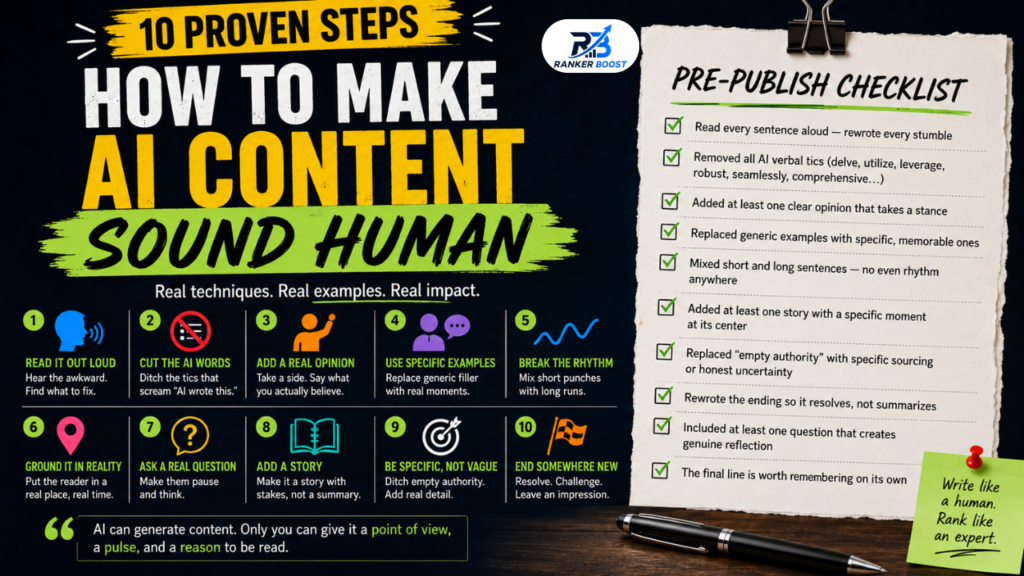
Pre-Publish Checklist
Before you hit publish on any AI-assisted piece:
- [ ] Read every sentence aloud — rewrote every stumble
- [ ] Removed all AI verbal tics (delve, utilize, leverage, robust, seamlessly, comprehensive…)
- [ ] Added at least one clear opinion that takes a real stance
- [ ] Replaced generic examples with specific, memorable ones
- [ ] Mixed short and long sentences — no even rhythm anywhere
- [ ] Added at least one story with a specific moment at its center
- [ ] Replaced “empty authority” with specific sourcing or honest uncertainty
- [ ] Rewrote the ending so it resolves rather than summarizes
- [ ] Included at least one question that creates genuine reflection
- [ ] The final line is worth remembering on its own
F.A.Q
Not really — not if “sound human” means more than passing a detection scan. You can swap words and tighten sentences without rewriting everything, but the sections that still read flat are the ones where AI expressed a generic opinion or used a vague example. Those need real replacement, not just rewording. Figure on 20–30 minutes of genuine editing on top of any surface fixes.
Usually yes, if you’ve done real editing — not just word swaps. But this is the wrong goal. AI detectors have high false-positive rates and Google doesn’t use them as ranking signals. Focus on whether the content is genuinely useful and clearly reflects real expertise. That’s what actually matters.
Read it out loud. Seriously — this single step catches more problems faster than any tool. Your voice stumbles on every unnatural sentence, and stumbles are your edit list. After that, add one specific example from real experience and one opinion you’d actually defend. Those three things alone transform a flat draft.
Sentences that all run roughly the same length. Overuse of words like “robust,” “leverage,” “delve,” and “seamlessly.” Claims made with authority but no specific source. Examples that could apply to anyone. Endings that summarize instead of landing. And an absence of any perspective you could disagree with.
Yes — if the final product is accurate, useful, and reflects your real perspective. Using AI as a drafting tool while adding your own expertise and voice is no different from using any other writing tool. The ethical line is publishing raw AI output as if it represents your knowledge when it doesn’t.
Publishing unedited AI content is like handing someone a map you’ve never used yourself. It might be technically accurate. But you can’t tell them what the road actually feels like — and that’s the part they came to you for.
Top AI content Writers tools :- Click here