
The 10 AI Tools Actually Changing Digital Marketing in 2026
Top 10 AI tools for Digital Marketing in 2026 | An honest guide for Indian marketers — no hype, no fluff, just what works
Reading time: 14 minutes · Updated May 2026 · All costs shown in INR
Let me be upfront with you about something.
I’ve read a lot of “top AI tools for digital marketing” articles over the past year. Most of them are genuinely useless. They list the same 10 tools in the same order, copy each other’s descriptions, and never once tell you whether any of it actually works for someone running a marketing campaign in India on a real budget.
This article is my attempt to fix that.
Everything here is based on what marketers — from solo freelancers in Coimbatore to agency teams in Pune and Bangalore — are actually using right now in 2026. I’ll tell you what each tool is genuinely good at, where it falls short, whether the free plan is good enough to start, and roughly what you’ll pay if you decide to upgrade.
I’ll also be honest when a tool that gets a lot of hype isn’t worth your money yet.
Let’s get into it. Top 10 AI tools for Digital Marketing in 2026
First — a quick reality check on AI and marketing
Top 10 AI tools for Digital Marketing in 2026-There was a period in 2024 where everyone was either panicking about AI replacing marketing jobs or treating it like a magic button that would solve everything. Neither of those things happened.
What actually happened is more interesting and, honestly, more useful: AI became the great equalizer.
A freelance content writer in Nagpur can now produce the same volume of work as a five-person team did three years ago. A two-person digital agency in Surat can pitch — and win — clients that would have previously gone to a larger Mumbai agency, because their work quality and turnaround time look the same from the outside.
The marketers winning in 2026 didn’t replace themselves with AI. They used it to do more of what they were already good at — faster, with less friction, and at a scale that simply wasn’t possible before.
That’s the framing to hold as you read through this list. These are not tools that think for you. They’re tools that remove the boring, repetitive parts of the job so you can spend more time on the parts that actually require a human — strategy, relationships, judgment, creativity.
With that said — here’s what’s actually worth your time.
Not sure where to start? Read this first.
If you only have five minutes and need a fast answer, here it is:
If you’re completely new to AI tools:
- Open ChatGPT (free) and spend 30 minutes experimenting with it. Ask it to write something you’d normally write yourself. See how close it gets.
- Then open Canva (free), click on “Magic Design,” type a description of a post you need to make, and see what comes out.
- Those two tools alone will change your week.
If you’re already using some AI tools:
- For SEO: Surfer SEO is the one that actually moves rankings.
- For content volume: Jasper AI is worth it if you’re writing for multiple clients.
- For research: Perplexity AI is the most underrated tool on this list. Seriously.
If you’re running paid ads:
- AdCreative.ai was built specifically for you. Start there.
Now let’s go through each one properly.
The Full Comparison — All 10 Tools at a Glance
| Tool | What it’s best for | Who it suits | Free? | Approx. Cost | Worth it? |
| ChatGPT | Writing, brainstorming, copy | Everyone | Yes | ~₹1,650/mo | Absolutely. Start here. |
| Canva AI | Social graphics, design | Beginners | Yes | ~₹1,000/mo | Yes — daily use tool |
| Jasper AI | Long articles, agency work | Intermediate | No | ~₹3,200/mo | Yes, if you do volume |
| Surfer SEO | Ranking on Google | SEO focus | No | ~₹4,100/mo | Best ROI for SEO teams |
| Semrush AI | Full SEO + research | Intermediate | Limited | ~₹8,500/mo | Yes, for agencies |
| HubSpot AI | Lead scoring, CRM | B2B / Advanced | Limited | ~₹0–30k+/mo | Only if you need CRM |
| Pictory AI | Blog-to-video, Reels | Beginners | Trial only | ~₹1,500/mo | Yes, for video teams |
| AdCreative.ai | Ad creatives, paid ads | Beginners | Trial only | ~₹1,500/mo | Yes, for ad managers |
| Perplexity AI | Research, trend hunting | Everyone | Yes | ~₹1,700/mo | Underrated. Try free. |
| Gamma.app | Decks, presentations | Everyone | Yes | ~₹1,200/mo | Yes — surprisingly good |
The Detailed Breakdown
Here’s where we go deep. For each tool, I’ll give you the real picture — not just what the marketing page says. Top 10 AI tools for Digital Marketing in 2026
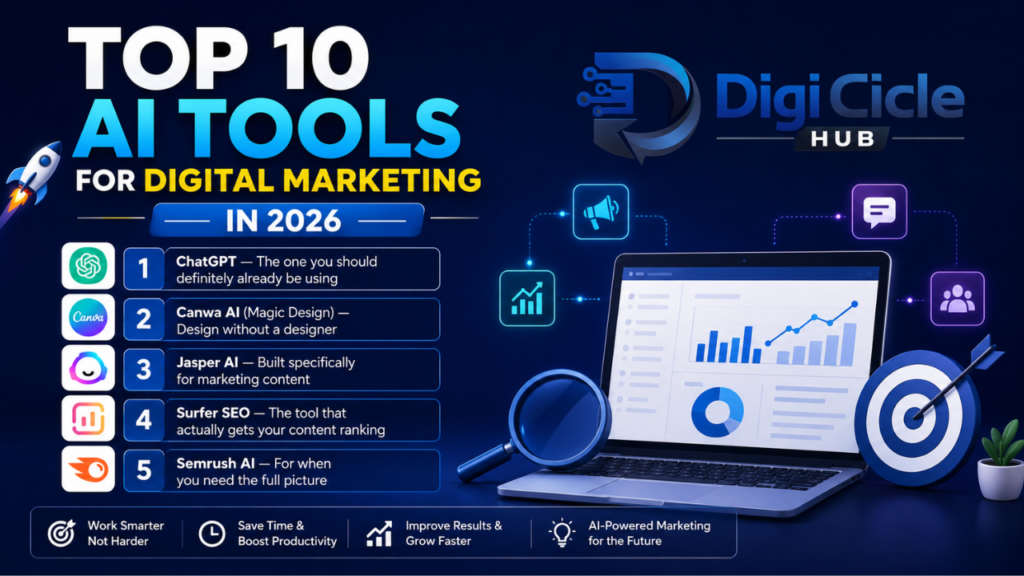
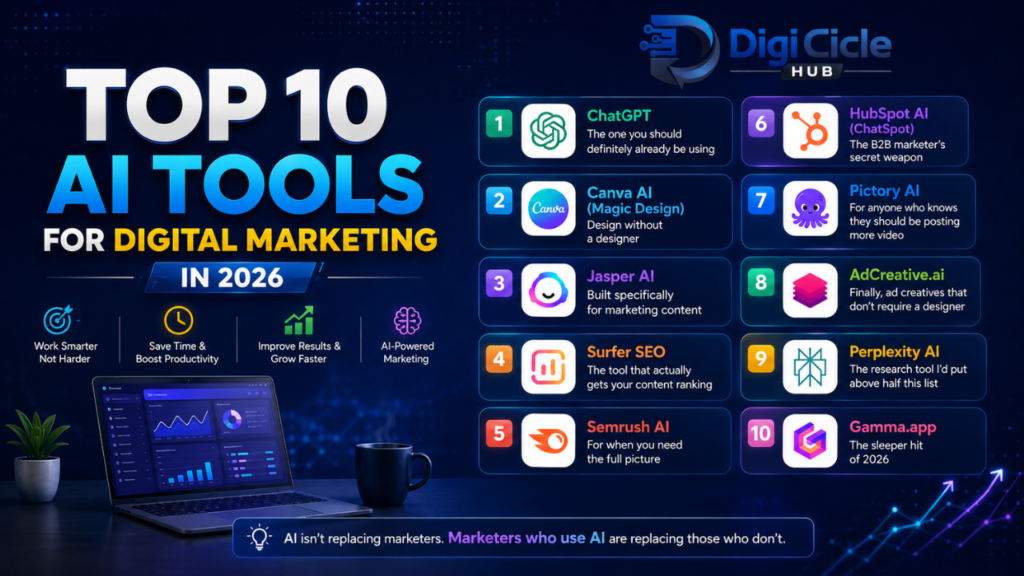
1. ChatGPT — The one you should definitely already be using
Perfect for beginners | Free plan: Yes | Cost: Free / GPT-4o ~₹1,650/month
If you haven’t used ChatGPT yet, this is your sign to stop what you’re doing and open it today. Not tomorrow. Today.
I know it sounds basic to say that in 2026. But you’d be surprised how many marketers have “tried it once” and moved on without actually building it into their workflow. There’s a big difference between trying it and using it.
Here’s what using it actually looks like:
Say you manage social media for three clients. Every month you need roughly 90 captions — 30 per client, across different tones and topics. Before ChatGPT, that was a week’s worth of work woven into your schedule. Now it’s a Tuesday afternoon. You write a prompt that describes each client’s brand voice, product, and audience. You give ChatGPT the topics for the month. You ask for 30 captions per client. You review them, throw out the weak ones, rewrite the ones that are close but not quite right, and you’re done.
The output isn’t perfect. It never is on the first try. But it gives you a starting point that’s 70% of the way there, which means you spend your energy editing and sharpening instead of staring at a blank document.
Beyond social media, people are using ChatGPT for email campaign drafts, blog post outlines, ad copy variations, product descriptions, customer service response templates, and even brainstorming campaign ideas when they’re stuck. The free plan is good enough to get started. The paid plan (GPT-4o) is noticeably better for longer, more nuanced content and is worth the money once you’re using it daily.
One thing I’d encourage you to do: don’t use ChatGPT’s output as-is. Read it, change what doesn’t sound like you, add a specific example or local reference, and then publish. That’s what makes the difference between content that feels human and content that feels like a machine made it.
2. Canva AI (Magic Design) — Design without a designer
Perfect for beginners | Free plan: Yes | Cost: Free / Canva Pro ~₹1,000/month
Canva was already one of the most used tools in digital marketing before they added AI features. Now it’s genuinely in a different category.
The feature most people find immediately useful is Magic Design. You type a description — something like “festive Instagram post for a bakery, warm colors, Eid sale” — and Canva generates several complete design options in about ten seconds. They’re not always perfect. Sometimes the font choice is wrong or the layout is too busy. But more often than not, one of the options is close enough that you can customize it in a few minutes and have something ready to post.
Background removal used to require either Photoshop or a separate paid tool. Canva AI does it in one click, and it does it well. Text-to-image generation is built in. If you need to resize a post from Instagram square to Instagram Story to LinkedIn, there’s a magic resize button that handles it automatically.
For Indian marketers dealing with multilingual content — which is most of you — Canva also has solid support for Hindi, Tamil, Kannada, Telugu, and Bengali scripts, which makes creating regional content significantly less painful.
The free plan is genuinely useful, but the Pro plan is worth it the moment you’re working with multiple brands and need their specific fonts, color palettes, and logo kits saved and accessible. At roughly ₹1,000 a month, it’s one of the easiest ROI calculations in marketing.
3. Jasper AI — Built specifically for marketing content
Mid-level | Free plan: No | Cost: Starts ~₹3,200/month
Here’s my honest take on Jasper: it’s excellent, but it’s not for everyone, and I’d be doing you a disservice if I didn’t say that upfront.
If you’re a solo content marketer writing for one brand, ChatGPT will probably serve you just as well for a fraction of the price. Where Jasper genuinely earns its cost is when you’re managing content for multiple clients — say, an agency running blogs and email campaigns for five to ten different brands simultaneously.
The feature that changes things for agency teams is brand voice profiles. You spend some time teaching Jasper what each client sounds like — their tone, their typical sentence length, their industry vocabulary, the things they’d never say. Once you’ve set that up, Jasper writes in that voice consistently. Not perfectly, but consistently. And in an agency context, “close and consistent” is hugely valuable because it reduces the back-and-forth with clients who keep saying “this doesn’t sound like us.”
Jasper is also noticeably better than raw ChatGPT at holding structure across a long piece. If you need a 1,500-word article that doesn’t lose its thread halfway through, Jasper handles it more reliably.
The price is the main barrier. At ₹3,200+ per month, it only makes sense if you’re billing clients for content work or if you’re producing enough volume that the time saved clearly outweighs the cost. If you’re not there yet, start with ChatGPT and revisit Jasper when you are.
4. Surfer SEO — The tool that actually gets your content ranking
Mid-level | Free plan: No | Cost: Starts ~₹4,100/month
I want to share something with you that took me a while to properly understand about SEO.
Writing a well-researched, well-written article about a topic is not enough to rank on Google anymore. It hasn’t been enough for a few years. Google doesn’t just look at your content in isolation — it compares it to every other page already ranking for that keyword and asks: does this page cover the topic as thoroughly, or more thoroughly, than what’s already ranking?
Surfer SEO answers that question before you start writing.
You type in your target keyword, and Surfer analyzes the top 20 pages currently ranking for it. It tells you the ideal word count, which specific terms appear in the top-ranking pages and how often, what heading structure works best, which related topics you need to cover, and what questions people are asking that you should answer. It’s like having someone read every competitor article for you and hand you a clear brief.
When you write with Surfer open, there’s a real-time content score that goes up as you incorporate the recommended elements. It’s not about stuffing keywords — it’s about making sure your content is genuinely comprehensive relative to what’s already ranking.
Teams using Surfer consistently in India are seeing real results — moving from page 3 to page 1 within two to three months for competitive keywords. That’s not magic; it’s just writing better-structured content with a clearer brief. Surfer gives you the brief.
It’s not cheap at ₹4,100/month, but for an SEO-focused team or agency, the ROI is measurable. You can literally track which articles you optimized with Surfer and watch their positions improve.
5. Semrush AI — For when you need the full picture
Mid-level | Free plan: Limited | Cost: Full access ~₹8,500/month
Semrush has been the professional SEO tool of choice for years, and the AI features they’ve layered on top of it in the last two years make it significantly more useful for content teams specifically.
But before I go further — the price point matters here. At ₹8,500 a month, this is a tool for agencies and serious in-house marketing teams, not for individuals just getting started. If you’re in that category, consider Semrush as two things simultaneously: the AI writing assistant (which checks your content for keywords, readability, and tone in real time) and the broader competitive intelligence platform underneath it.
That second part is where Semrush pays for itself.
Here’s a practical example: the blog you’re reading right now exists because someone wanted to outrank a competitor. With Semrush, you can look at any competitor’s domain and see exactly which keywords are driving their traffic, where their backlinks are coming from, which of their pages are growing and which are declining, and — most importantly — what topics their audience is searching for that they haven’t covered yet.
Those uncovered topics become your content calendar. You write the articles they haven’t written, on the keywords their audience is already searching, and you systematically take traffic from them. It sounds aggressive but it’s just smart content strategy.
If the monthly cost is a barrier, Semrush does offer limited free access, and for pure AI writing assistance, a combination of free tools can get you most of the way there.
Top 10 AI tools for Digital Marketing in 2026
6. HubSpot AI (ChatSpot) — The B2B marketer’s secret weapon
Advanced | Free plan: Limited | Cost: Free CRM / Paid plans ~₹0–30,000+/month
I’ll be honest with you: HubSpot AI is not for everyone. If you’re running social media campaigns for consumer brands or you’re a content creator, you can skip this one for now. It’s most valuable in a specific context — B2B marketing, where you’re managing leads, nurturing relationships over weeks or months, and trying to figure out which prospects to prioritize.
In that context, it’s remarkable.
HubSpot AI’s lead scoring model looks at everything a prospect has done — which pages they visited, which emails they opened and when, whether they visited your pricing page, how long they spent on your case studies — and gives each lead a score that reflects how ready they are to buy. On a Monday morning, instead of staring at a list of 200 leads and guessing where to start, your CRM tells you: these 12 people showed buying signals in the last 48 hours. Start here.
The email personalization features are also genuinely useful. The AI can draft personalized follow-up messages based on what a specific contact has engaged with — not just inserting their name into a template, but actually referencing their behavior. For a small B2B sales-marketing team in India managing a pipeline of enterprise prospects, this is the kind of capability that used to require a much larger team.
The free CRM is worth trying for any B2B team. Just be aware that the AI features kick in at the paid tiers, and the pricing scales up quickly as you add contacts and features.
7. Pictory AI — For anyone who knows they should be posting more video
Perfect for beginners | Free plan: Trial only | Cost: Starts ~₹1,500/month
Here’s something most digital marketers know but don’t act on enough: video content gets dramatically more reach than static posts. On Instagram, Reels consistently outperform carousels and images. On YouTube, short-form video is still growing. On LinkedIn, native video gets significantly more organic reach than link posts.
The reason most marketers aren’t posting more video isn’t laziness — it’s time. Creating a decent video takes equipment, editing skills, and hours of work. Pictory removes most of those barriers.
The core thing Pictory does: you give it text, and it makes a video. You paste in a blog post, a script, or even a YouTube video URL, and Pictory converts it into a short polished clip — complete with relevant stock footage, auto-generated captions, and background music. You can swap out footage you don’t like, adjust the timing, and change the music. But the basic structure is already there.
The workflow that makes the most sense for content teams: write one long-form article per week, then use Pictory to extract three to four short clips for Instagram Reels and YouTube Shorts. You’re not writing anything new — you’re just getting your existing content in front of a different audience on a different platform. For a solo marketer or a small team trying to maintain a multi-channel presence, this is a genuine game-changer.
The free trial is generous enough to properly test whether it works for you before committing.
8. AdCreative.ai — Finally, ad creatives that don’t require a designer
Perfect for beginners | Free plan: Trial only | Cost: Starts ~₹1,500/month
If you manage Facebook, Instagram, or Google Display ads for any brand, you already know that the creative — the actual image or video the user sees — is often the deciding factor between an ad that performs and one that doesn’t. You can have perfect targeting and compelling copy, but if the visual doesn’t stop the scroll, none of the rest matters.
The traditional solution is a designer. The problem in India, especially for smaller brands and agencies, is that good designers are expensive and slow, and campaigns move fast. You need 15 ad variations to test by Friday, and you need them to actually look professional.
AdCreative.ai is built specifically for this problem.
You upload your product image and brand colors. You tell it your target audience and your campaign goal. It generates dozens of ad creative variations — different layouts, different visual hierarchies, different ways of presenting the same product — along with a predicted performance score for each. The scoring is based on what’s historically worked across millions of ads the tool has analyzed.
Performance marketers using this tool report two to three times better click-through rates compared to manually designed ads. I’d be cautious about taking that number as gospel, but even a 30% improvement in CTR on a significant ad budget compounds meaningfully. The time saved alone — not needing a designer for every creative iteration — pays for the monthly cost very quickly.
9. Perplexity AI — The research tool I’d put above half this list
Perfect for beginners | Free plan: Yes | Cost: Free / Pro ~₹1,700/month
This one deserves more attention than it gets in most AI tools lists, so I’m going to take a moment to explain why it matters.
Perplexity is an AI-powered search engine. But that description doesn’t do it justice. When you search something on Google, you get a list of links and you have to click through, read multiple articles, and synthesize the information yourself. When you ask Perplexity the same question, it reads those sources for you and gives you a synthesized answer — with citations, so you can verify anything that matters.
For marketing work specifically, this is transformative for research.
Writing a piece about AI tools for digital marketing? Instead of spending an hour opening 15 browser tabs and skimming articles, you spend five minutes in a Perplexity conversation: “What are digital marketers in India struggling with most in 2026? Which AI tools are getting the most adoption?” It pulls together insights from industry reports, forums, news articles, and blog posts and gives you a synthesized view with sources. Your content is now informed by what’s actually happening right now — not just what you already knew.
Beyond research, Perplexity is useful for quickly understanding any topic you need to write about, fact-checking claims before you publish, finding current statistics to include in your content, and exploring content angles you hadn’t thought of.
The free plan includes a surprisingly generous number of searches. The Pro plan is worth it if you’re doing heavy research work daily.
Perplexity has become the first tab I open in the morning and the last one I close. If you haven’t tried it yet, please do that today.
10. Gamma.app — The sleeper hit of 2026
Perfect for beginners | Free plan: Yes | Cost: Free / Paid ~₹1,200/month
I’ll be honest — I almost didn’t include Gamma on this list because it flew so far under the radar in 2025. But it’s being adopted fast in early 2026, particularly by consultants, agency pitch teams, and marketers who need to present ideas visually and professionally.
Here’s what Gamma does: you describe what you want in plain, conversational English — “create a presentation on 5 AI marketing trends for a brand owner in India, keep it concise and visual” — and it builds a fully designed, structured deck in under sixty seconds. Not a template you fill in. An actual structured presentation with content, layout, and design already in place.
You then edit it like a Google Doc. Move sections around, add your own content, change the design — it’s all drag and drop.
What makes Gamma genuinely different from PowerPoint or Google Slides is that the output is an interactive web presentation you share as a URL, not a file attachment. For Indian marketers and consultants presenting to clients over Zoom, sending a link that opens into a polished, scrollable, interactive deck is a noticeably more professional experience than attaching a .pptx file and hoping it opens correctly on the other end.
The free plan gives you enough access to properly evaluate it. I’d suggest doing that before committing to anything else on this list, just because it’s so easy to start and the gap between “no Gamma” and “Gamma” is immediately visible.
Top 10 AI tools for Digital Marketing in 2026
A realistic 7-day plan to actually start using these tools
Reading about tools and using tools are two very different things. Here’s a concrete plan that gets you from “interested” to “actually doing it” within a week — without overwhelming yourself. Top 10 AI tools for Digital Marketing in 2026
Day 1 — ChatGPT and Canva (both free) Create accounts if you haven’t already. In ChatGPT, write a short paragraph describing your brand, your audience, and your tone — something like what you’d tell a new employee on day one. Save it. Then ask ChatGPT to write five social media captions using that brief. Edit two of them into something you’d actually post. That’s it. Day one done. In Canva, click “Magic Design,” describe a post you need, and see what comes out. You’ll probably have something usable within 15 minutes.
Day 2 — Try Perplexity AI (free) Go to perplexity.ai and create a free account. Ask it something you’d normally spend 30 minutes researching — a trend in your industry, a topic you need to write about, a question your audience keeps asking. See how much time it saves. Most people become immediately dependent on it. That’s fine.
Day 3 — Complete the loop Take the ChatGPT draft from Day 1 and write a full piece around it — a blog post, an email, a series of posts. Use Canva to make a graphic. Publish something. The point of Day 3 is to complete the full cycle from idea to published content with AI assistance for the first time.
Day 4 — Try Pictory or Gamma If you do video: sign up for Pictory’s free trial and convert something you’ve already written into a short video clip. Post it. If you do presentations or pitches: sign up for Gamma’s free plan and turn a recent proposal into a Gamma deck. Send it as a link instead of a file.
Day 5 — Look at your SEO situation Use Semrush’s free plan or Google Search Console to see where your website currently ranks and which keywords are bringing traffic. Identify three keywords you should be targeting but aren’t. Add them to your content plan.
Day 6 — Decide on paid tools By now you have enough experience to know which tool actually fits your work. If you’re producing lots of written content for multiple clients, Jasper or Surfer SEO probably makes sense. Ad campaigns? AdCreative.ai. Primarily social content? Canva Pro is enough. Don’t pay for something you haven’t used in free mode first.
Day 7 — Reflect, then commit to one thing Look at your week. What took less time? What felt easier? What still felt awkward? Pick the one tool that gave you the most value and commit to using it every single day for 30 days before adding anything else. The biggest mistake people make with AI tools is trying to use all of them at once and mastering none of them.
Top 10 AI tools for Digital Marketing in 2026 | FAQ
Among the best AI softwares for digital marketing are ChatGPT, Canva AI, and Perplexity AI since the AI softwares assist marketers to create quality content, design graphics, and conduct their research very easily and quickly.
The most effective artificial intelligence tools that would benefit the small-scale businessman include ChatGPT for content creation and customer communication, Canva AI for social media design, Perplexity AI for fast research work, Pictory AI for video marketing, and Gamma.app for business presentations.
Right now, the AI tools truly earning their place in business are ChatGPT for content creation and automation, Canva AI for fast design work, Perplexity AI for smart research, Surfer SEO for ranking content on Google, and Pictory AI for creating short-form marketing videos quickly and efficiently.
In the case of making instant graphics for business, most individuals use the following applications: Canva AI for social media graphics, AdCreative.ai for ad creatives, Gamma. App for presentations, and Pictory AI for videos since all these are fast, professional, and require no prior knowledge of design skills.
The questions I keep getting asked — answered honestly
Will AI eventually replace digital marketing jobs?
No — and I say that not as reassurance but as a genuine assessment of what’s happening. Marketing is fundamentally a human activity. Strategy requires judgment. Relationships require trust. Creative work requires taste. AI is excellent at the repetitive, time-heavy parts of the job — first drafts, formatting, resizing, scheduling, initial research. But the decisions about what to say, to whom, and why? Those still require a person.
What is true is that marketers who don’t learn to work with AI will progressively have a harder time competing with those who do. Not because AI replaces them, but because a marketer using AI can produce more, move faster, and often deliver better results. In India’s growing digital economy, this is actually creating more opportunities for skilled marketers, not fewer.
Do I need technical skills to use these tools?
Not at all. Everything on this list was designed for marketers, not engineers. If you can write an email, you can use ChatGPT. If you can use Canva, you can use Canva AI. The one skill worth developing is prompt writing — describing what you want clearly and specifically. A vague prompt gets vague output. A specific prompt that explains the audience, tone, goal, and format gets something much closer to what you need. It’s a communication skill, not a technical one, and it gets noticeably better with just a few hours of practice.
How do I stop AI content from sounding like AI wrote it?
AI gives you a first draft. You make it human. After you get output from any AI writing tool, read it out loud. If any sentence makes you pause because it doesn’t sound like something a person would actually say — rewrite it. Add a specific example from your own experience. Include an opinion. Reference something local or timely. Change the sentence structure if it feels too formal.
Use AI to get from zero to 60% done instantly, then apply your own judgment and voice to get from 60% to 100%. That last 40% is where your expertise and personality come through — and it’s what makes the difference between content that ranks and gets shared versus content that disappears.
Which tools are worth paying for on a tight budget?
Start entirely with free tools: ChatGPT, Canva, Perplexity AI, and Gamma.app. Those four will genuinely change how much you can produce without spending a rupee. When you’re ready to invest, prioritize by your work: Surfer SEO if Google rankings matter, Jasper if you produce high volumes for multiple clients, AdCreative.ai if you manage paid ad campaigns. Never pay for a tool before you’ve used the free version enough to know it actually solves a real problem for you.
Top 10 AI tools for Digital Marketing in 2026
One last thing before you go
Top 10 AI tools for Digital Marketing in 2026 – I want to say something that most AI tools guides don’t say.
The best tool on this list is the one you actually open tomorrow morning. Not the one with the most impressive feature set, not the one that sounds most exciting, and definitely not the one you pay for and then never quite get around to using properly.
AI tools, like any skill, get better with use. The person who opened ChatGPT in January and wrote one thing with it every single day is in a completely different place by June than the person who read about it, made a plan to use it, and then got busy.
Pick one tool from this list. Use it for something real — not a test, not an experiment, but actual work you need to get done anyway. See what happens.
Then do it again tomorrow.
That’s how it starts.
Written for Indian digital marketers. Last updated May 2026. All prices are approximate — check each tool’s website for current pricing.