
Top AI Tools for Content Writers: The Honest 2026 Guide You Actually Need
Top AI Tools for Content Writers Last Updated : June 2026
⏱ 18 min read ✍️ Tools Covered: 12 🎯 For: Bloggers, Marketers, Freelancers
I spent years working on content stuff. Late nights with a blank document open trying to push through word counts is pretty usual for me.
It gets messy when the same opening keeps getting rewritten a few times before anything sticks. I think that part is easy to miss sometimes.. When AI writing tools started getting genuinely good, I was skeptical. Now, after using most of these tools hands-on for months, I can tell you which ones actually pull their weight and which ones are just expensive noise.
This guide covers the top AI tools for content writers in 2026 — not from a “here’s a bunch of screenshots” angle, but from someone who has actually used them inside real editorial workflows. I’ll be honest about the weaknesses too, because no single tool is perfect for every writer.
If you’re a blogger, freelance content writer, SEO professional, or content marketer trying to figure out where to invest your time and budget, this is the guide you’ve been looking for.
Quick Takeaway: The best AI tool for you depends on your primary bottleneck. Stuck on ideas? Use ChatGPT. Writing slow but ranking matters? Get Surfer SEO. Grammar is your weak spot? Grammarly solves that. We break all of this down below.

Top AI Tools for Content Writers in 2026 – Write Faster, Rank Higher & Create Better Content with AI
Table of Contents
- Why AI Tools Have Become Non-Negotiable for Writers
- What to Look For Before Buying Any AI Writing Tool
- Top 12 AI Tools for Content Writers (Deep-Dive Reviews)
- Side-by-Side Comparison Table
- Which Tool Should You Pick? (Use Case Guide)
- Best SEO Keywords to Target in Your Blog
- Frequently Asked Questions
- Final Verdict
Why AI Tools Have Become Non-Negotiable for Content Writers
Here’s something most AI tool reviews won’t tell you: AI won’t replace good writers. But writers who use AI will absolutely replace those who don’t.
Think about what content writing actually involves. You spend time researching, outlining, drafting, editing, checking facts, optimizing for SEO, and then going through revisions. A good 2,000-word blog post can eat up 6 to 8 hours of your day. AI cuts that in half — sometimes more — when you use the right tools for the right parts of your workflow.
In 2026, content demand is higher than ever. Brands need blog posts, social media content, product descriptions, email newsletters, and YouTube scripts — often simultaneously. The writers who are thriving aren’t necessarily the most talented. They’re the most efficient.
That said, AI tools are not magic. They still produce generic output if you give them generic prompts. They hallucinate facts. They sometimes lose your voice. The skill in 2026 isn’t knowing how to write — it’s knowing how to direct AI toward something actually worth reading.
What to Look For Before Buying Any AI Writing Tool
Most comparison articles skip this part and jump straight into the list. That’s a mistake. Here’s what separates a tool that fits your workflow from one that becomes an expensive subscription you forget to cancel:
Output quality at your scale. Some tools produce sharp 500-word snippets but fall apart at 2,000 words. Test with your actual use case before committing.
SEO integration. If you write for search, a tool that ignores keyword data is only solving half your problem. Look for tools that connect with real SERP data, not just keyword stuffing suggestions.
Voice preservation. Does the tool let you train it on your existing content? Can it match a brand tone guide? Generic AI voice is easy to spot, and it’s increasingly penalized by both readers and Google.
Workflow friction. The best tool is one you actually use. If it requires you to copy-paste between four different windows, you’ll stop using it. Prioritize tools that live inside where you already work.
Honest pricing. A $30/month plan that limits you to 50,000 words sounds fine until you realize that’s only about 25 blog posts. Check the word limits and token caps carefully.
Top 12 AI Tools for Content Writers (2026)
#1 — Best Overall for Versatility
1 ChatGPT (GPT-5) — OpenAI
If there’s one tool every content writer should know inside and out, it’s ChatGPT. The jump from GPT-4 to GPT-5 in 2025 was meaningful — not just in raw output quality but in the way it handles nuance, follows complex instructions, and avoids the flat, robotic prose that made earlier versions feel so obviously artificial.
What most writers still don’t use it for is brainstorming and structural thinking. Give ChatGPT a rough idea, three competitor URLs to reference, and a clear tone direction, and the outline it spits out is often genuinely better than what I’d draft manually. It’s become my first stop for any new piece of content.
That said, GPT-5 still hallucinates specific statistics and quotes. Treat it like a brilliant but unreliable research partner — great for ideas and drafts, not for facts you haven’t verified yourself.
Best For
Ideation & Drafts
Pricing – Free / $20 per month (Plus)
SEO Native?
No (needs add-ons)
Learning Curve –Low
Pros
- Extremely flexible — handles any content type
- GPT-5 significantly more accurate than earlier versions
- Web search built-in for current events
- Memory across conversations
- Huge community of prompts and workflows
Cons
- No native SEO optimization
- Still hallucinates specifics under pressure
- Free tier has message limits at peak hours
- Needs good prompting to avoid generic output
Verdict: ChatGPT is the Swiss Army knife of AI writing. Not the deepest specialist, but the most useful tool to have in your hands at any stage of content creation.
#2 — Best for SEO-First Content
2 Surfer SEO — The On-Page Optimization Powerhouse
Surfer SEO is the tool I recommend to any content writer who wants to rank — not just write well. The difference between a good article and one that actually shows up on page one is often structural: the right density of your target keyword, the right headers, the right word count relative to competing content. Surfer handles all of that in real time as you write.
The Content Editor is where you’ll spend most of your time. You enter your target keyword, and Surfer analyzes the top-ranking pages to give you a framework — a recommended word count, which terms to include, how often, and even structural suggestions for headings. As you write, a score updates live. It’s like having an SEO editor reading over your shoulder the entire time.
One thing that surprised me when I started using Surfer consistently: it changed how I think about content structure before I even open a blank doc. Instead of guessing, I know exactly what a competitive piece needs to include. That clarity saves more time than any AI text generator does.
Best For
SEO Writers & Bloggers
Pricing
From $79/month
SEO Native?
Yes — core feature
Learning Curve
Medium
Pros
- Real-time content scoring against top-ranking pages
- Excellent content brief generation
- SERP analysis built into every audit
- Integrates with Google Docs and WordPress
- Keyword research + clustering in one tool
Cons
- Expensive for solo freelancers
- Can over-optimize if you follow the score blindly
- AI writer is functional but not exceptional
Verdict: For anyone writing content that needs to rank, Surfer SEO is probably the single highest-ROI tool on this list. The pricing is steep, but one article that lands on page one pays for months of the subscription.
#3 — Best for Grammar & Clarity
3 Grammarly — The Writer’s Safety Net
Grammarly is probably the most widely used writing tool on this list, and with good reason. It does one thing better than anyone else: it makes your writing clean. Not just grammar and spelling — it flags passive voice, suggests more precise word choices, adjusts your tone based on the audience, and catches the kinds of errors that slip through even careful re-reads.
The version that shipped in late 2025 added meaningful AI rewriting capabilities — not just corrective suggestions but full sentence rewrites that maintain your intention while improving clarity. I use it as the final filter on everything I publish. Think of it less as an AI writing tool and more as a professional editor available 24/7 at a fraction of the cost.
The one genuine weakness: Grammarly has no native SEO features. It won’t help you rank. It will help you not embarrass yourself with a typo in paragraph two of a blog post that generates 10,000 monthly visitors.
Best For
Editing & Polishing
Pricing
Free / from $12/month
SEO Native?
No
Learning Curve
Very Low
Pros
- Best-in-class grammar and style checking
- Works inside Gmail, Google Docs, browsers
- Tone detector helps match audience expectations
- Free plan covers most basic needs
- Plagiarism checker included in premium
Cons
- Zero SEO functionality
- Can over-sanitize authentic writing voice
- Business plan needed for full team features
Verdict: Non-negotiable for professional content writers. Doesn’t help you rank, but ensures everything you publish is polished and credible.
#4 — Best for Long-Form Content at Scale
4 Jasper AI — The Content Team in a Box
Jasper was one of the first dedicated AI writing tools to take off, and it’s still one of the most capable. Where it shines is long-form, structured content — blog posts, email sequences, landing pages, ad copy — where you need to produce a lot of output consistently across a brand voice.
The Brand Voice feature is what separates Jasper from generic AI text generators. Feed it a few examples of your existing writing or a brand style guide, and it genuinely learns to write in that tone. For content agencies managing multiple clients or brands, this is a genuine differentiator. You stop getting output that sounds like every other AI blog post and start getting output that sounds like the brand actually said it.
Jasper also integrates with Surfer SEO, so you can have optimization guidance right inside your Jasper writing environment. That pairing — Jasper for drafting speed, Surfer for SEO structure — is one of the most effective content workflows I’ve seen in practice.
Best For
Agencies & Teams
Pricing
From $39/month/seat
SEO Native?
Via Surfer integration
Learning Curve
Medium
Pros
- Brand Voice feature is genuinely impressive
- Surfer SEO integration built-in
- Huge template library for every content type
- Team collaboration features
- Multi-language support
Cons
- Expensive per seat for small teams
- Overproduces — output needs strong human editing
- Learning curve steeper than ChatGPT
Verdict: Best fit for content agencies or in-house teams producing at high volume. Solo writers on a tight budget may find it more power than they need.
#5 — Best for Content Optimization
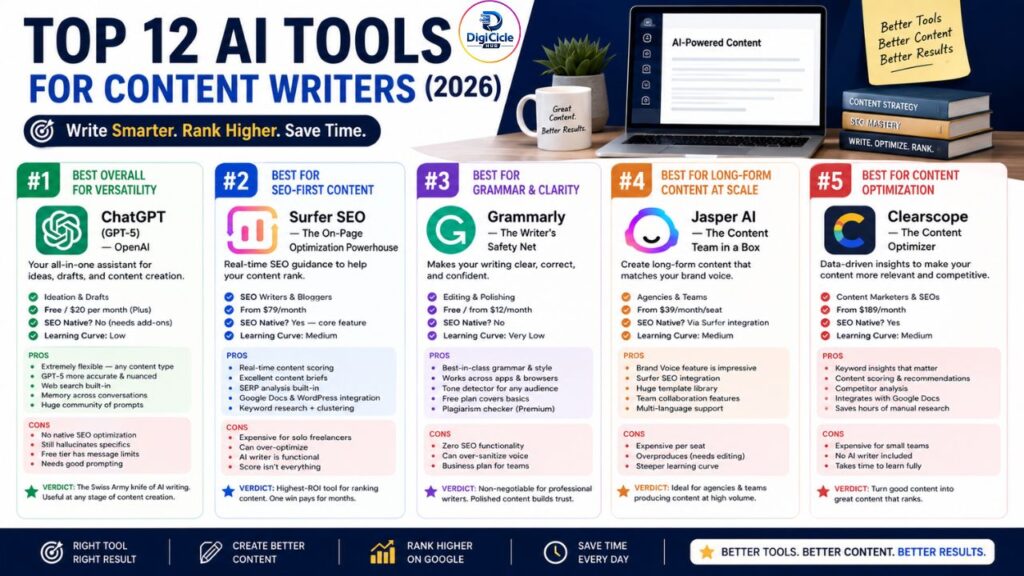
5 Clearscope — The Semantic SEO Specialist
Clearscope does something specific and does it extremely well: it tells you the exact terms, phrases, and concepts that need to appear in your content for it to match what Google considers a comprehensive treatment of a topic. It’s not about keyword stuffing — it’s about semantic coverage, which is how modern search engines actually evaluate content quality.
The report Clearscope generates for any keyword is remarkably detailed. You get competitor content analysis, recommended related terms, estimated word count, readability targets, and a live content grade as you write. For experienced SEO writers, this is the kind of tool that turns good articles into great ones.
The honest trade-off is price. Clearscope starts at $170 per month, which is difficult to justify for freelance writers unless you’re generating significant recurring revenue from content. For teams and agencies, it’s one of the most defensible line items in the content budget.
Best For
SEO Teams & Agencies
Pricing
From $170/month
SEO Native?
Yes — deeply
Learning Curve
Low (output is clear)
Pros
- Best semantic coverage analysis available
- NLP-powered content grading
- Clean, intuitive interface
- Integrates with Google Docs
- Excellent for content audits
Cons
- Very expensive for individuals
- No AI writing assistance — only optimization
- Limited keyword research features compared to dedicated tools
Verdict: If your content goal is to rank for competitive terms and you have the budget, Clearscope is hard to beat. Otherwise, Surfer SEO gives you most of the value at a lower price point.
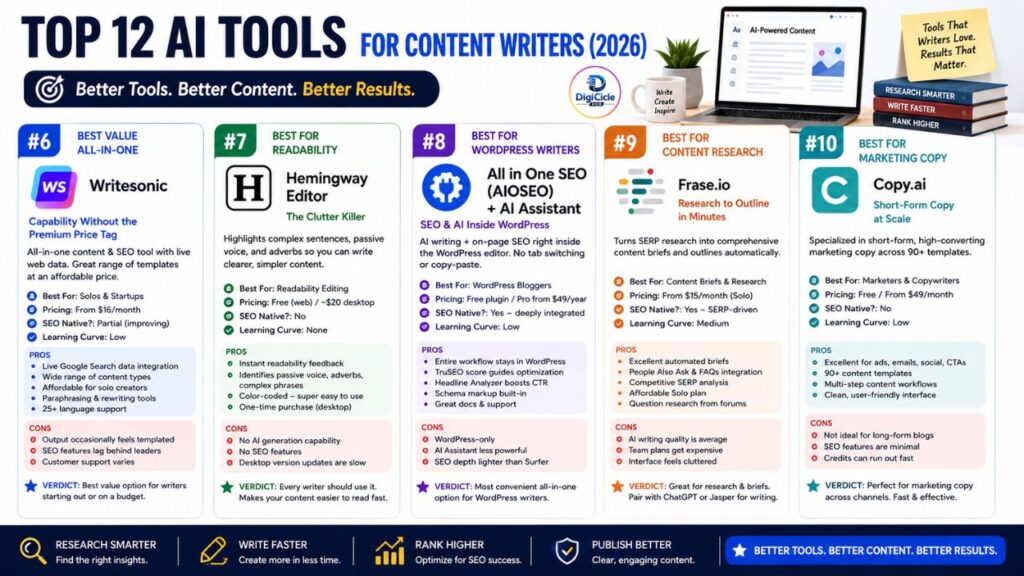
#6 — Best Budget Option
6 Writesonic — Capability Without the Premium Price Tag
Writesonic has matured significantly over the past two years. It’s now a legitimate all-in-one content creation and SEO tool at a price point that solo writers and small businesses can actually afford. Its Article Writer 6.0 can produce 2,000-word blog posts with live web data integration — meaning it pulls in current information rather than relying on stale training data, which is a meaningful upgrade over many competitors.
The range of templates is impressive: long-form articles, landing pages, social media captions, product descriptions, email subject lines, and more. For a creator who needs to write across formats, Writesonic reduces the context-switching that kills productivity. You stay in one tool instead of jumping between ChatGPT for drafts, a separate tool for social, and another for email.
The output quality sits just below Jasper or a carefully prompted ChatGPT session, but at $16–$30 per month versus $39+ for Jasper, the trade-off is often worth it for independent writers.
Best For
Solos & Startups
Pricing
From $16/month
SEO Native?
Partial (improving)
Learning Curve
Low
Pros
- Live Google Search data integration
- Wide range of content types covered
- Affordable pricing for solo creators
- Paraphrasing and rewriting tools included
- 25+ language support
Cons
- Output occasionally feels templated
- SEO features lag behind Surfer or Clearscope
- Customer support response times vary
Verdict: The best value option on this list. If you’re just starting out or writing for your own blog, Writesonic gives you 80% of the power of more expensive tools at a fraction of the cost.
#7 — Best for Readability
7 Hemingway Editor — The Clutter Killer
There’s something almost therapeutic about dropping your draft into the Hemingway Editor. It highlights adverbs in blue, passive voice in green, long sentences in yellow, and sentences that are genuinely too dense to parse in red. In about 30 seconds, you can see exactly where your writing is fighting the reader.
Hemingway doesn’t generate a single word of content. It’s a purely editorial tool. But for writers who have a habit of writing long, tangled sentences — which is most writers — it does more to improve the readability of a finished draft than any AI suggestion engine. Blog readers skim. The Hemingway Editor forces you to write for skimmers.
It’s also a fraction of the cost of most tools on this list, with a web app that’s free and a desktop version for around $20 as a one-time purchase. For the value it delivers, it’s one of the most cost-efficient tools a content writer can have in their kit.
Best For
Readability Editing
Pricing
Free (web) / ~$20 desktop
SEO Native?
No
Learning Curve
None
Pros
- Instant readability feedback
- Identifies passive voice, adverbs, complex phrases
- Color-coded — no learning required
- One-time purchase, no subscription
Cons
- Zero AI generation capability
- No SEO features
- Desktop version not updated as frequently
Verdict: Not a content generator, but every writer should use it. Run your draft through Hemingway before hitting publish — your readers will feel the difference even if they can’t name why.
#8 — Best for WordPress Writers
8 All in One SEO (AIOSEO) + AI Assistant
AIOSEO is the WordPress SEO plugin that most content writers already know. What fewer writers realize is that its built-in AI Writing Assistant has become genuinely useful for content creation inside the WordPress editor — without ever having to leave your draft, open another tab, or copy-paste between tools.
The AI Assistant can generate outlines, draft paragraphs, and suggest improvements based on your target keyword and the TruSEO score it’s already calculating in the background. It’s not as powerful as Surfer SEO for pure optimization depth, but for writers whose entire workflow lives in WordPress, the integration makes it the most frictionless option on this list.
The Headline Analyzer is worth calling out specifically — it grades your title against proven engagement factors, giving you concrete feedback on whether a headline is likely to get clicked. Given that your headline is often the deciding factor between a user clicking your result or a competitor’s, this feature earns its keep fast.
Best For
WordPress Bloggers
Pricing
Free plugin / Pro from $49/year
SEO Native?
Yes — deeply integrated
Learning Curve
Low
Pros
- Entire workflow stays inside WordPress
- TruSEO score guides on-page optimization
- Headline Analyzer drives click-through rate
- Schema markup built-in
- Excellent documentation and support
Cons
- WordPress-only — useless elsewhere
- AI Assistant less powerful than standalone tools
- SEO depth lighter than Surfer or Clearscope
Verdict: The best choice for WordPress bloggers who want SEO and AI writing in the same place without switching tabs. Not the most powerful AI writer, but by far the most convenient for its platform.
#9 — Best for Content Research
9 Frase.io — Research to Outline in Minutes
Frase sits in an interesting niche: it’s primarily a research and brief-generation tool that also has AI writing capabilities. What it does particularly well is pulling together a comprehensive picture of what’s already ranking for your keyword — who’s ranking, what they cover, how long those pieces are, and what questions users are asking around the topic.
From that research, Frase generates content briefs automatically. For writers who work with editors or manage a team of writers, the brief generation alone can save hours of manual research and template work every week. You stop telling writers to “look at the top 10 results and cover the main angles” and instead hand them a structured brief that already did that analysis.
The AI writing component is decent but not a standout. Where Frase earns its subscription is in the research and brief workflow, not the text generation. Think of it as the smart front-end of your content process.
Best For
Content Briefs & Research
Pricing
From $15/month (Solo)
SEO Native?
Yes — SERP-driven
Learning Curve
Medium
Pros
- Excellent automated content brief generation
- People Also Ask integration for FAQs
- Competitive SERP analysis built in
- Affordable Solo plan for freelancers
- Question research from forums and SERP features
Cons
- AI writing quality is average
- Team plans escalate in price quickly
- Interface can feel cluttered
Verdict: Great value for the content brief and research workflow, especially for teams managing multiple writers. Pair it with ChatGPT or Jasper for the actual writing, and you have a powerful combination.
#10 — Best for Marketing Copy
10 Copy.ai — Short-Form Copy at Scale
Copy.ai built its reputation on one thing: making great marketing copy fast. Product descriptions, email subject lines, ad headlines, social media captions, call-to-action text — the kinds of short, persuasion-driven writing that most long-form tools do poorly. Its template library covers over 90 content types, and the output tends to be punchy and usable without much editing.
The tool has expanded significantly into longer-form content since its early days, and it now supports multi-step content workflows where you can research, brief, draft, and refine inside one platform. But if long-form blog content is your main use case, you’ll probably find dedicated tools like Jasper or Writesonic more suited to that kind of depth.
For content marketers who write across channels — blog, email, social, ads — Copy.ai’s multi-format coverage makes it a genuinely useful Swiss Army knife for marketing copy specifically.
Best For
Marketing Copy
Pricing
Free / from $35/month
SEO Native?
Partial
Learning Curve
Low
Pros
- 90+ content templates across formats
- Strong brand voice consistency
- 25+ language support
- Good free plan to start
- Multi-step content workflows
Cons
- Long-form blog output is uneven
- SEO depth limited
- Less powerful than top tools for complex content
Verdict: Strongest for marketing copy and multi-channel content creators. Not the best choice if blog SEO is your primary objective.
#11 — Best for Idea Generation
11. Claude (Anthropic) — The Thinking Writer’s AI
Claude has carved out a distinct identity in the AI writing tool space: it’s the one that sounds most like a human wrote it. Where other tools tend toward marketing-speak and generic sentence structures, Claude leans into natural, thoughtful prose. It’s particularly good at tasks that require reasoning, nuanced takes, or holding a complex idea together across multiple paragraphs.
For content writers, the best use of Claude is the kind of thinking-out-loud work that precedes writing: “Help me figure out the real angle for this article,” or “I have three ideas for this blog post — which is most defensible and why?” The quality of its reasoning on those kinds of open-ended prompts is genuinely impressive.
It’s less strong than GPT-5 on structured task execution with lots of specific requirements, but for qualitative, thoughtful content work — analysis pieces, opinion articles, research summaries — it’s often the best AI writer available right now.
Best For
Analytical & Thoughtful Content
Pricing
Free / $20/month (Pro)
SEO Native?
No
Learning Curve
Low
Pros
- Most natural-sounding prose of any AI tool
- Excellent reasoning and nuanced analysis
- Very long context window for complex projects
- Handles sensitive or nuanced topics well
Cons
- No native SEO features
- Less plugged into external tool ecosystems
- Slightly more conservative with content at edges
Verdict: For writers who care about voice and authenticity, Claude is worth experimenting with. Especially strong for editorial, analysis, and conceptual writing tasks.
#12 — Best for Teams with Complex Workflows
12 SEOBoost — The All-in-One Content Management Platform
SEOBoost is a comprehensive content management platform built for teams that need to manage the full lifecycle of content — from keyword research and topic reports to briefs, writing, publishing, and auditing. It positions itself as a more affordable alternative to Clearscope, and in practice, it delivers a lot of that functionality at a fraction of the price.
The content audit feature is particularly useful for existing websites. It scans your published URLs and recommends optimization changes based on current SERP data, which is exactly the kind of ongoing content maintenance that most teams deprioritize because it’s tedious to do manually. With SEOBoost, that process becomes manageable at scale.
If you’re already using AIOSEO, SEOBoost integrates directly, which makes it an obvious recommendation for WordPress-heavy operations. The $22.50/month entry point is one of the most accessible price points for a tool that delivers this level of SEO depth.
Best For
Content Teams & Audits
Pricing
From $22.50/month
SEO Native?
Yes — full lifecycle
Learning Curve
Medium
Pros
- Full content lifecycle management
- Content audit for existing URLs
- Excellent Clearscope alternative at lower price
- Topic reports and keyword performance tracking
- AIOSEO integration
Cons
- Less intuitive for first-time users
- AI writing capabilities basic
- Smaller community and fewer tutorials online
Verdict: Excellent value for content teams who need Clearscope-style optimization without the Clearscope price. Strong for WordPress + AIOSEO users specifically.
Side-by-Side Comparison Table
| Tool | Best Use | Pricing | SEO? | Rating |
| ChatGPT (GPT-5) | Brainstorming & Drafts | Free / $20/mo | Add-ons needed | ⭐⭐⭐⭐⭐ |
| Surfer SEO | SEO-First Writing | From $79/mo | Core Feature | ⭐⭐⭐⭐⭐ |
| Grammarly | Editing & Polish | Free / $12/mo | None | ⭐⭐⭐⭐½ |
| Jasper AI | Long-Form at Scale | From $39/mo | Via Surfer | ⭐⭐⭐⭐½ |
| Clearscope | Semantic SEO | From $170/mo | Core Feature | ⭐⭐⭐⭐½ |
| Writesonic | Budget All-in-One | From $16/mo | Partial | ⭐⭐⭐⭐ |
| Hemingway Editor | Readability | Free / ~$20 once | None | ⭐⭐⭐⭐ |
| Frase.io | Research & Briefs | From $15/mo | SERP-driven | ⭐⭐⭐⭐ |
| Copy.ai | Marketing Copy | Free / $35/mo | Partial | ⭐⭐⭐½ |
| Claude | Voice & Analysis | Free / $20/mo | None | ⭐⭐⭐⭐½ |
| SEOBoost | Content Management | From $22.50/mo | Full lifecycle | ⭐⭐⭐⭐ |
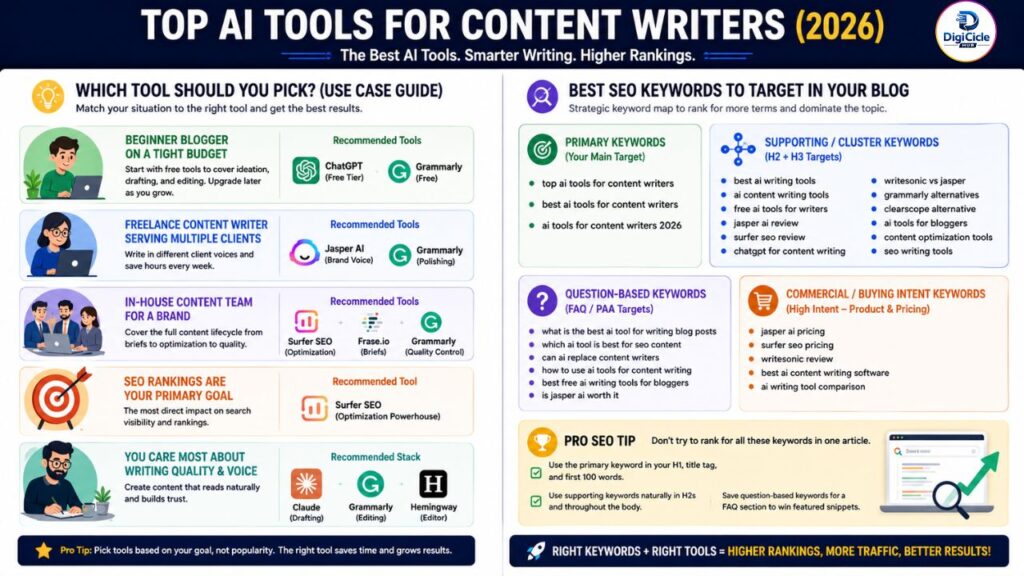
Which Tool Should You Pick? (Use Case Guide)
The most common mistake writers make with AI tools is picking the most popular one instead of the most fitting one. Here’s how to match your situation to the right tool:
If you’re a beginner blogger on a tight budget
Start with the free tier of ChatGPT and Grammarly. You’ll cover ideation, drafting, and editing without spending a single dollar. Once you’re publishing consistently and monetizing, upgrade to Writesonic for long-form workflow or Surfer SEO if ranking is your priority.
If you’re a freelance content writer serving multiple clients
Jasper AI’s Brand Voice feature is worth its price. Being able to write in 5 different client voices within one tool — without editing prompts between each client — saves genuine hours every week. Pair it with Grammarly for polishing.
If you run an in-house content team for a brand
Surfer SEO for optimization + Frase.io for content briefs + Grammarly for quality control is a stack that covers the full creation lifecycle. Add SEOBoost if you need content auditing for an existing site.
If SEO rankings are your primary goal
Surfer SEO is the single most impactful tool you can add to your workflow. Nothing else on this list has as direct a relationship between tool usage and search visibility improvement.
If you care most about writing quality and voice
Use Claude for drafting and thinking, Grammarly for editing, Hemingway Editor before publishing. This is the stack for writers who want to produce content that genuinely reads like a person wrote it — not a machine.
Best SEO Keywords to Target in Your Blog (Keyword Strategy)
Since you’re building content around top AI tools for content writers, here’s a strategic keyword map to help you cover the full topic cluster and rank for related terms, not just the primary keyword.
Primary Keyword (Your Main Target)
top ai tools for content writers best ai tools for content writers ai tools for content writers 2026
Supporting / Cluster Keywords (H2 + H3 Targets)
best ai writing tools ai content writing tools free ai tools for writers jasper ai review surfer seo review chatgpt for content writing writesonic vs jasper grammarly alternatives clearscope alternative ai tools for bloggers content optimization tools seo writing tools
Question-Based Keywords (FAQ / PAA Targets)
what is the best ai tool for writing blog posts which ai tool is best for seo content can ai replace content writers how to use ai tools for content writing best free ai writing tools for bloggers is jasper ai worth it
Commercial / Buying Intent Keywords
jasper ai pricing surfer seo pricing writesonic review best ai content writing software ai writing tool comparison
Pro SEO Tip: Don’t try to rank for all these keywords in one article. Use the primary keyword in your H1, title tag, and first 100 words. Use supporting keywords naturally in H2s and body text. Save the question-based keywords for a dedicated FAQ section (like the one below). This approach signals topical depth to Google and often earns featured snippets for the question queries.
Frequently Asked Questions
What is the best AI tool for content writers in 2026?
There isn’t one single answer — it depends on what you’re trying to solve. For pure writing output and versatility, ChatGPT (GPT-5) is the most widely capable option. For SEO-focused writing, Surfer SEO delivers the most direct impact on rankings. For editing and polish, Grammarly is unmatched. If you need one tool that does a decent job across all of these at an affordable price, Writesonic is the best budget option in 2026.
Can AI tools replace human content writers?
No — not yet, and arguably not anytime soon for high-quality work. AI tools generate plausible text; they don’t generate genuine insight, lived experience, or original research. The content that performs best in 2026 still has a strong human perspective driving it. Where AI genuinely helps is in reducing the time and friction involved in research, structure, and first drafts — freeing writers to focus on the parts that require actual judgment and voice.
Are there free AI writing tools for content writers?
Yes. ChatGPT has a free tier with GPT-4o access. Grammarly has a free plan covering most grammar and style checks. The Hemingway Editor web app is free. Copy.ai offers a free plan for light usage. For SEO-specific tools, free plans are more limited — Surfer SEO and Clearscope don’t have functional free tiers — but Frase.io occasionally runs trials, and AIOSEO has a free WordPress plugin that covers basic on-page SEO needs.
Will Google penalize content written with AI tools?
Google’s official position is that it evaluates content quality, not content origin. AI-written content that is helpful, accurate, and original is not inherently penalized. What Google does penalize is thin, low-effort, mass-produced content — regardless of whether a human or AI produced it. The practical takeaway: use AI as a starting point, then bring genuine editorial judgment, fact-checking, and your own voice to the final product.
Which AI tool is best for writing SEO blog posts?
Surfer SEO is the strongest choice for writers who prioritize search rankings. Its real-time content scoring against competitor pages directly influences how well-optimized your content is before you hit publish. For teams that also need research and brief generation, pairing Frase.io with Surfer SEO covers the complete SEO content workflow. WordPress users should also consider AIOSEO, which integrates SEO guidance directly into the editor.
What is the difference between Jasper AI and ChatGPT?
ChatGPT is a general-purpose AI assistant that can handle anything from coding to creative writing. Jasper is specifically designed for marketing and content writing, with a structured template library, brand voice training, and built-in integrations for content SEO. ChatGPT is more flexible and often produces better prose in open-ended tasks. Jasper provides more scaffolding and consistency, which makes it better suited for teams producing at scale across defined content types.
How do I make AI-generated content sound more human?
The most effective approach is to treat AI output as a rough draft, not a finished product. Read the draft out loud — anything that sounds unnatural will reveal itself immediately. Add personal examples, opinions, or observations that only a human could bring. Vary sentence length deliberately (AI tends toward uniform sentence rhythm). Use the Hemingway Editor to catch stilted constructions. And most importantly: edit for what you actually think, not just for grammar. The point of view is what makes writing feel human.
Final Verdict: The Stack That Actually Works
If I had to build a content writing stack from scratch today, for someone who writes blog content with SEO as a primary goal, here’s exactly what I’d recommend:
The Lean Solo Stack (under $50/month total): ChatGPT Plus for ideation and drafting. Grammarly Premium for editing. Hemingway Editor for final readability check. This covers the full creation lifecycle at a cost most professional writers recover in one client project.
The SEO-First Stack (for serious rankers): Surfer SEO for structure and optimization. ChatGPT Plus for drafting to Surfer’s brief. Grammarly Premium for editing. Total cost around $100–120/month, but the ROI in search visibility pays for it quickly if you’re publishing consistently.
The Agency Stack (for teams): Jasper for brand-consistent drafting at scale. Surfer SEO for optimization. Frase.io for content briefs. Grammarly Business for team-wide editing standards. SEOBoost for content audits. This is a complete content operation, and the output quality shows.
The tools keep improving, and the best writers keep adapting. The ones who will still be thriving in five years aren’t the ones who refuse to touch AI — or the ones who outsource everything to it. They’re the ones who’ve figured out where their own judgment adds irreplaceable value, and they let the tools handle everything else.
That’s the game. Know your tools. Know your role. Write something worth reading.