What is Digital Marketing? A Complete Guide for Beginners (2026)
What is Digital Marketing (Complete information) | By Saksham Verma | Last Updated: June 2026 | Reading Time: ~15 minutes
Here’s something most marketing guides won’t tell you upfront.
Digital marketing is not about posting on Instagram every day. It’s not about running Google Ads and hoping for the best. And it’s definitely not about buying followers to make your brand look popular.
At its core, digital marketing is about one thing: putting the right message in front of the right person at the right time — using the internet to do it.
That sounds simple. But most businesses get it wrong because they jump into tactics without understanding the strategy behind them.
This guide fixes that. By the end, you’ll understand what digital marketing actually is, how each channel works, why some businesses succeed online while others don’t, and exactly where to start if you’re a beginner.
Table of Contents
- What is Digital Marketing?
- Digital Marketing vs. Traditional Marketing
- Why Digital Marketing Matters in 2026
- The Core Channels of Digital Marketing
- How to Build a Digital Marketing Strategy
- Digital Marketing Tools You Actually Need
- How to Measure Whether Your Digital Marketing is Working
- Common Digital Marketing Mistakes Beginners Make
- How to Get Started — A Practical First Step
- FAQ
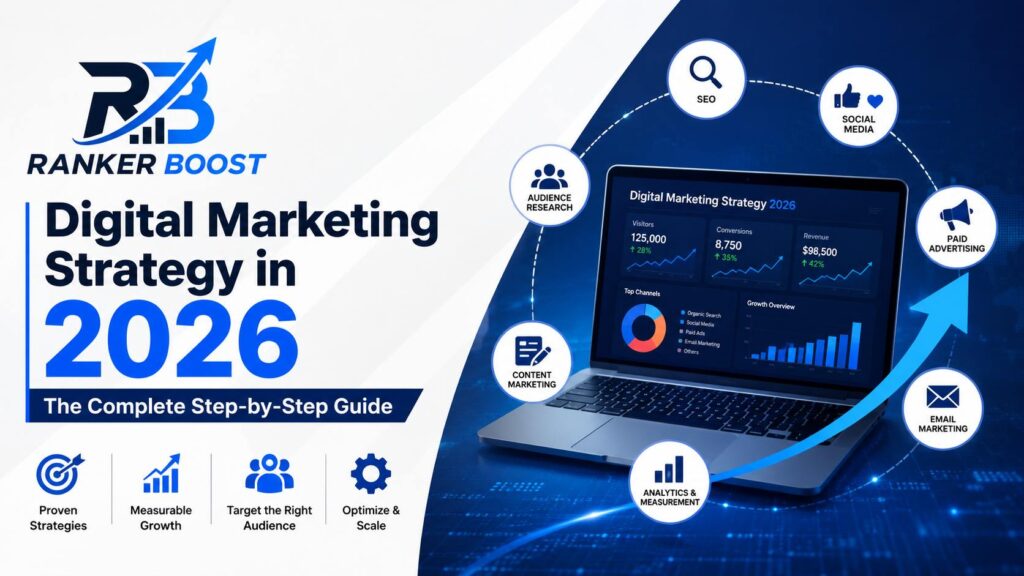
1. What is Digital Marketing?
Digital marketing is the promotion of products, services, or brands using digital channels — primarily the internet, but also mobile apps, SMS, email, and search engines.
If someone finds your business through a Google search, sees your ad on YouTube, reads your blog post, or clicks a link in an email you sent — that’s digital marketing at work.
The reason it’s become the dominant form of marketing is straightforward: people spend the majority of their time online. The average person spends over 6 hours per day on digital devices. If you want to reach customers, you need to go where they already are.
But here’s what separates digital marketing from traditional marketing in a meaningful way: digital marketing is measurable. With a newspaper ad, you have no idea how many people saw it, how many were interested, or how many bought something because of it. With digital marketing, you know exactly how many people saw your content, clicked your link, visited your website, and made a purchase. That data lets you improve continuously — something traditional marketing simply can’t offer.
2. Digital Marketing vs. Traditional Marketing
Before digital marketing existed, businesses relied on what we now call traditional marketing — TV commercials, radio ads, newspaper and magazine placements, billboards, and direct mail.
Traditional marketing still works for certain businesses and contexts. But it has three fundamental limitations that digital marketing doesn’t share.
Geographic reach. A billboard only reaches people who drive past it. A local newspaper ad only reaches that paper’s readership. Digital marketing can reach anyone, anywhere in the world, with no additional cost per person reached.
Cost. A 30-second TV commercial on a major network can cost hundreds of thousands of dollars. A well-targeted Facebook ad campaign can reach thousands of relevant people for a few hundred rupees. The cost difference is not incremental — it’s transformational for small businesses.
Measurability. As mentioned above, traditional marketing is largely a guessing game when it comes to results. Digital marketing gives you precise data on every campaign. You know what worked, what didn’t, and why.
This is why digital marketing has leveled the playing field between large corporations and small businesses. A well-run digital marketing strategy from a small team can outperform a large company with an average one.
3. Why Digital Marketing Matters in 2026
The numbers tell the story clearly.
There are over 5 billion internet users worldwide. In India alone, there are over 900 million internet users — a number that keeps growing as smartphone penetration spreads into smaller cities and rural areas.
More importantly, buying behavior has shifted online. Customers now research products on Google before buying them in a physical store. They read reviews on social media before trusting a brand. They compare prices across multiple websites before making a decision. They watch YouTube videos to understand how a product works.
If your business doesn’t have a digital presence, you’re invisible to a large and growing portion of your potential customer base.
For individuals, digital marketing skills are among the most in-demand in the job market right now. Every business — from a local restaurant to a multinational corporation — needs people who understand how to grow an audience and acquire customers online. Learning digital marketing isn’t just useful for running a business; it’s a career path with genuine demand.
4. The Core Channels of Digital Marketing
Digital marketing isn’t one thing — it’s a collection of channels, each with its own logic, strengths, and best use cases. Here’s an honest breakdown of what each one is and when it makes sense.
Search Engine Optimization (SEO)
SEO is the process of getting your website to appear in Google’s organic (non-paid) search results when people search for topics related to your business.
When someone searches “best running shoes under 3000 rupees” or “how to fix a leaky tap,” Google shows them a list of results. Those results didn’t pay to be there — they earned their position through the quality and relevance of their content, combined with how well their website is optimized.
SEO is arguably the most valuable long-term digital marketing channel because organic traffic is free once you rank. A well-ranking article can bring consistent traffic for years without ongoing spend. The tradeoff is time — SEO results typically take 3 to 6 months to materialize, and maintaining rankings requires ongoing effort.
For any business with a website or blog, SEO should be a core part of the digital marketing strategy. It builds compounding value over time in a way paid advertising does not.
Content Marketing
Content marketing is the practice of creating valuable, relevant content — blog posts, videos, podcasts, infographics, guides — that attracts and educates your target audience.
The underlying logic is this: instead of interrupting people with ads they didn’t ask for, you create content they actually want to consume. When they find your content useful, they develop trust in your brand. That trust eventually converts into customers.
Content marketing and SEO are deeply interconnected. The content you create is what gets indexed and ranked by Google. A blog post that ranks on page one for a relevant keyword is simultaneously an SEO win and a content marketing win.
The businesses that take content marketing seriously — publishing consistently, covering topics their audience actually cares about, going deeper than competitors — tend to build the strongest long-term digital marketing presence.
Social Media Marketing
Social media marketing involves using platforms like Instagram, Facebook, LinkedIn, X (Twitter), and YouTube to build an audience and promote your brand.
Each platform has a different primary audience and content format. Instagram is visual — photos, reels, and stories work best. LinkedIn is professional — thought leadership content and career-related topics perform well. YouTube rewards longer-form video content. X/Twitter favors short, sharp commentary and real-time conversation.
The mistake most beginners make with social media is trying to be everywhere at once. A better approach is to identify where your target audience spends the most time and focus your energy on that one or two platforms first. Do those well before expanding.
Social media marketing can be done organically (posting without paying) or through paid advertising. Both have their place — organic builds community and brand trust over time, while paid advertising can reach a targeted audience quickly.
Email Marketing
Email marketing is the practice of building a list of subscribers and sending them regular, valuable communication — newsletters, product updates, promotional offers, educational content.
Despite being one of the oldest digital marketing channels, email consistently delivers among the highest returns on investment of any channel. The reason is simple: email reaches people who have explicitly said they want to hear from you. That’s a fundamentally different kind of attention than an ad that appears in someone’s feed uninvited.
Building an email list takes time and requires offering something valuable in exchange for a subscription — a free guide, a discount code, exclusive content. But once built, it’s an asset that no algorithm change can take away from you, unlike social media followers.
Every business that takes digital marketing seriously should be building an email list from day one.
Pay-Per-Click Advertising (PPC)
PPC advertising — primarily Google Ads and Meta Ads (Facebook and Instagram) — lets you pay to place your content or products in front of a targeted audience.
With Google Ads, you bid on specific keywords and your ad appears at the top of search results when someone searches those terms. You pay only when someone clicks your ad — hence “pay-per-click.”
With Meta Ads, you define your target audience by demographics, interests, and behaviors, and your ads appear in their social media feeds.
The major advantage of PPC is speed. Unlike SEO, which takes months, a PPC campaign can drive traffic to your site within hours of launching. The disadvantage is cost — the moment you stop paying, the traffic stops. This makes PPC most effective as a complement to long-term channels like SEO and content marketing, not a replacement for them.
Search Engine Marketing (SEM)
SEM is a broader term that encompasses both SEO and paid search advertising. When people talk about SEM, they’re usually referring specifically to paid search — running Google Ads to appear at the top of search results.
The distinction matters because the strategies are different. SEO is about earning organic rankings through content quality and technical optimization. SEM is about bidding on keywords and paying for placement. Both aim to get you visible in search results — through different means.
Affiliate Marketing
Affiliate marketing is a performance-based model where you earn a commission for referring customers to another business. If you write a blog post recommending a product and include a special affiliate link, you earn a percentage of each sale made through that link.
For bloggers and content creators, affiliate marketing is one of the most effective ways to monetize an audience. For businesses, it’s a way to expand reach through a network of publishers who are incentivized to promote your product.
Influencer Marketing
Influencer marketing involves partnering with individuals who have an established audience — on YouTube, Instagram, or other platforms — to promote your product or service to their followers.
It works because trust transfers. People trust recommendations from creators they follow more than they trust ads from brands they don’t know. A genuine endorsement from a respected creator can drive significant awareness and sales.
Influencer marketing doesn’t have to mean mega-celebrities. Micro-influencers — creators with 10,000 to 100,000 highly engaged followers in a specific niche — often deliver better results for smaller budgets than top-tier celebrities with massive but less engaged audiences.
5. How to Build a Digital Marketing Strategy
Having accounts on every platform is not a strategy. Posting whenever you remember is not a strategy. Trying every new trend is not a strategy.
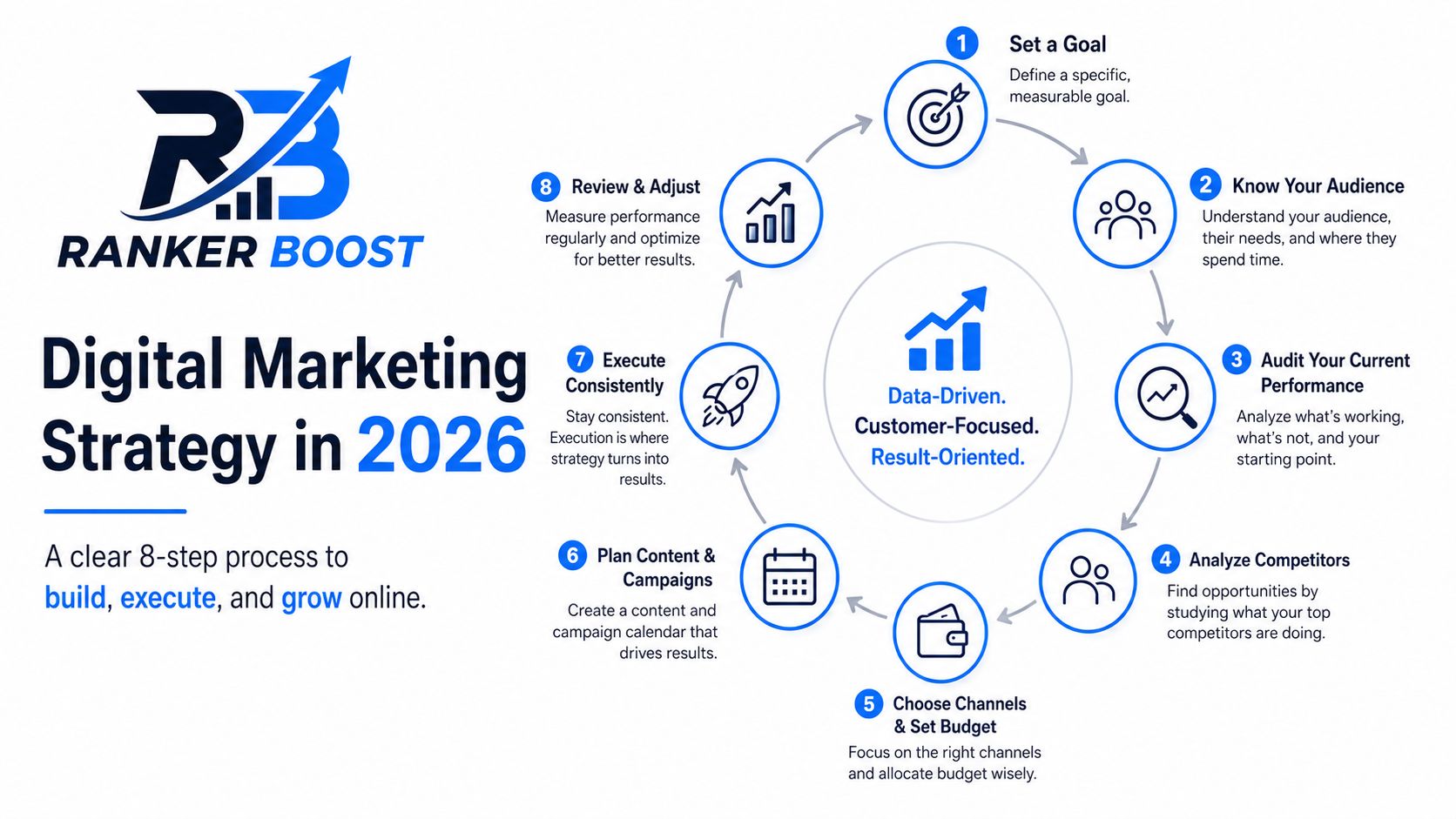
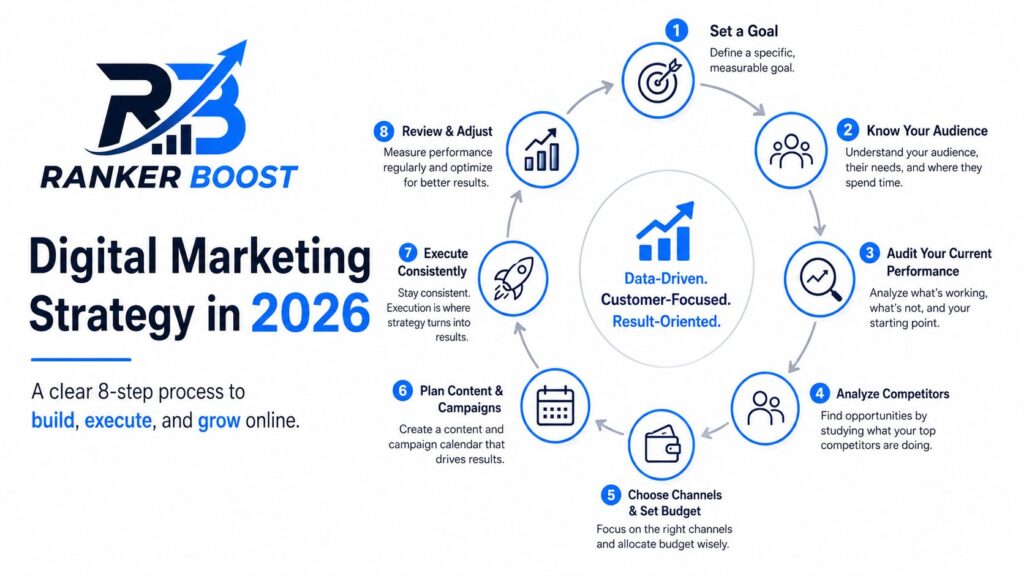
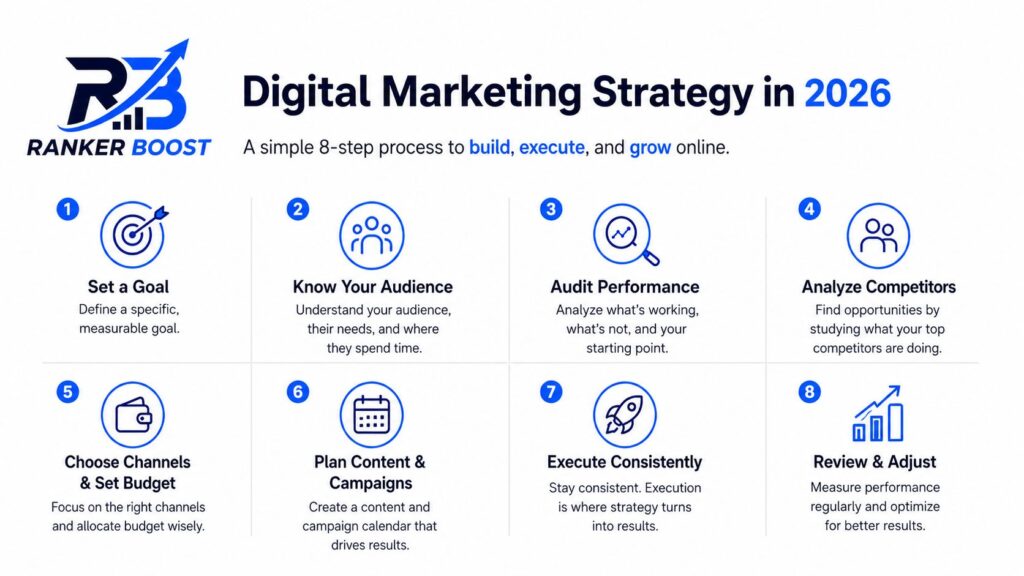
A digital marketing strategy is a deliberate plan that connects your business goals to specific actions, channels, and metrics. Here’s how to build one.
Start With Your Goal
Every marketing activity should connect to a clear business goal. Common digital marketing goals include:
- Increase website traffic
- Generate leads (contact form submissions, email sign-ups)
- Drive online sales
- Build brand awareness in a specific market
- Grow a social media following
Be specific. “Increase traffic” is not a goal. “Increase organic traffic by 50% in 6 months” is a goal. The specificity lets you measure progress and make decisions.
Know Your Audience
You need a clear picture of who you’re trying to reach. This is your target audience — the specific group of people most likely to benefit from and buy your product or service.
Define your audience in terms of:
- Demographics (age, location, income, occupation)
- Interests and behaviors (what do they read, watch, search for?)
- Pain points (what problems are they trying to solve?)
- Buying behavior (where do they research? what influences their decisions?)
The more precisely you understand your audience, the more effectively you can reach them.
Choose Your Channels
Don’t try to do everything. Based on your goals, audience, and resources, pick the two or three channels that make the most sense and focus on those.
If your goal is long-term organic traffic, SEO and content marketing should be your priority. If you need fast results for a product launch, PPC might make sense. If your audience is primarily professionals, LinkedIn might be more valuable than Instagram.
Create a Content Plan
Once you’ve chosen your channels, plan what content you’ll create, how often, and in what format.
For a blog focused on SEO, this means deciding which topics to write about, which keywords to target, how often to publish, and how to promote each article after publishing.
For social media, this means deciding what types of posts to create, how frequently to post, and what topics to cover.
Consistency matters more than volume. A realistic plan you actually execute beats an ambitious one you abandon after two weeks.
Set a Budget
Digital marketing can be done with a very small budget — especially if you focus on organic channels like SEO and content marketing. But even organic strategies have costs: your time, any tools you use, design resources, and potentially freelance help.
For paid advertising, start small and test. Run small campaigns, see what works, and scale what delivers results. Don’t commit large budgets before you understand which ads and audiences convert for your business.
6. Digital Marketing Tools You Actually Need
The digital marketing tools landscape is overwhelming — there are hundreds of options. Here are the ones that actually matter for beginners.
Google Search Console — Free. Connects your website to Google and shows you which searches bring people to your site, how often your pages appear in results, and any technical issues Google finds. Non-negotiable if you have a website.
Google Analytics — Free. Shows you who visits your site, where they come from, which pages they read, and how they behave. Essential for understanding your audience and measuring marketing performance.
Google Keyword Planner — Free with a Google account. Shows you search volume and competition data for keywords. Useful for SEO and paid search planning.
Canva — Free tier available. Design tool for creating social media graphics, blog images, presentations, and other visual content. You don’t need to be a designer to produce clean, professional visuals with Canva.
Mailchimp or Brevo — Free tiers available. Email marketing platforms for building a subscriber list and sending campaigns. Start with one and stick with it.
Ubersuggest — Free tier available. Keyword research and basic SEO analysis tool. Good for beginners who aren’t ready to invest in premium tools like Ahrefs or SEMrush.
Meta Business Suite — Free. Manage your Facebook and Instagram presence, schedule posts, run ads, and track performance from one dashboard.
You don’t need to start with all of these. For a complete beginner, Google Search Console, Google Analytics, and Canva cover 80% of what you need in the early stages.
7. How to Measure Whether Your Digital Marketing is Working
One of the most valuable aspects of digital marketing is measurability. But measuring everything is just as unhelpful as measuring nothing. Focus on the metrics that connect directly to your goals.
Website Traffic — How many people are visiting your site? Track this in Google Analytics. For most content-focused businesses, growing organic traffic is the primary measure of SEO success.
Keyword Rankings — Where does your site appear in Google for your target keywords? Improving from position 20 to position 5 is significant progress, even if traffic hasn’t spiked yet.
Conversion Rate — Of the people who visit your site or see your ads, what percentage take the action you want (buying, signing up, contacting you)? This is often more important than raw traffic numbers.
Email Open Rate and Click Rate — For email marketing, these metrics tell you whether your subscribers are engaged and whether your content is compelling.
Social Media Engagement — Likes and follower counts are vanity metrics. Focus instead on comments, shares, saves, and direct messages — these indicate real engagement.
Return on Ad Spend (ROAS) — For paid advertising, this is how much revenue you generate for every rupee spent. A ROAS of 3x means you earn ₹3 for every ₹1 spent on ads.
Set up a simple monthly review. Look at your key metrics, compare them to the previous month, identify what improved and what didn’t, and adjust your approach accordingly.
8. Common Digital Marketing Mistakes Beginners Make
Learning from mistakes is valuable. Learning from other people’s mistakes is more efficient. Here are the most common ones.
Trying to do everything at once. New marketers often open accounts on every platform, start a blog, run ads, and build an email list simultaneously — and do all of it poorly. Pick one or two channels, do them well, and expand from there.
Optimizing for vanity metrics. 10,000 Instagram followers sounds impressive. But if none of them buy from you, they’re decorative, not valuable. Focus on metrics that connect to actual business outcomes.
Ignoring SEO. Many businesses invest in paid ads and social media while completely neglecting SEO. Paid ads stop working the moment you stop paying. A well-ranking blog post can drive free traffic for years. Both have their place, but ignoring SEO entirely is a long-term mistake.
Publishing thin, generic content. The internet is saturated with average content. An article that repeats what every other article says provides no real value and will not rank. Every piece of content you publish should be the most useful resource available on that specific topic.
No clear call to action. Every piece of content should guide the reader toward a next step — reading another article, signing up for your email list, contacting you, or making a purchase. Content without a clear direction wastes its own potential.
Expecting instant results. SEO takes months. Building an email list takes time. Growing a loyal social media audience takes consistency. The businesses that succeed at digital marketing are the ones that commit to a long enough timeline to see results.
Not testing and iterating. Digital marketing’s greatest advantage is measurability. If you’re not testing different approaches and updating your strategy based on data, you’re leaving most of that advantage unused.
9. How to Get Started — A Practical First Step
If you’ve read this far and feel overwhelmed by the options, here’s a simple starting point.
Step 1: Set up Google Search Console and Google Analytics on your website. This takes about 30 minutes and immediately gives you data you need.
Step 2: Define your target audience clearly. Write down specifically who you’re trying to reach, what problems they have, and how your business helps solve those problems.
Step 3: Choose one channel to focus on first. If you have a blog or content-heavy site, start with SEO. If you need fast results, start with paid ads. If your audience is on a specific social platform, start there.
Step 4: Create a 30-day content or campaign plan for that channel. Commit to it.
Step 5: At the end of 30 days, review your data. What worked? What didn’t? What do you do more of next month?
That’s the entire framework. The specifics will vary based on your business, your audience, and your goals — but the process of plan, execute, measure, adjust, repeat is universal.
Digital marketing rewards consistency and patience more than any single tactic or tool. The businesses that win online are rarely the ones who discovered some secret strategy. They’re the ones who executed the fundamentals better, for longer, than everyone else.
F.A.Q
Digital marketing is promoting your business, product, or service using the internet. This includes appearing in Google search results, running social media ads, sending emails to customers, creating blog content, and running paid advertising campaigns online.
For most beginners with a website or blog, SEO and content marketing is the best starting point. It requires no ad budget, builds long-term compounding value, and teaches you how your audience thinks and searches. Once you have traffic coming from search, you can layer in other channels.
It depends entirely on the channels you use. SEO and content marketing can be done for near zero cost if you’re doing the work yourself — you’ll need basic tools, some of which have free tiers. Paid advertising (Google Ads, Meta Ads) can start with as little as ₹500 to ₹1000 per day and scale from there. The real investment in early-stage digital marketing is time, not money.
For SEO: 3 to 6 months before meaningful traffic. For paid advertising: results can appear within days of launching a campaign. For social media: building an engaged audience typically takes 3 to 12 months of consistent posting. Email marketing starts showing returns once you have a list of at least a few hundred engaged subscribers.
Yes. Digital marketing skills are in high demand across virtually every industry. Companies of all sizes need people who can manage SEO, run paid ads, create content, and analyze marketing data. Specializing in one area — like SEO, paid search, or email marketing — tends to be more career-valuable than being a generalist who does everything at a surface level.
Social media marketing is one component of digital marketing. Digital marketing is the broader category that includes SEO, email marketing, paid advertising, content marketing, affiliate marketing, and more. Social media marketing specifically refers to using platforms like Instagram, Facebook, LinkedIn, and YouTube to reach and engage an audience.
No. Many of the most effective digital marketing channels — SEO, content marketing, email marketing, and organic social media — require time and effort more than money. Paid advertising requires a budget, but you can start small, test what works, and scale gradually. A small business with a smart, consistent organic digital marketing strategy can outperform a larger competitor spending heavily on ads.
The foundational skills include: basic understanding of SEO and how search engines work, content writing, familiarity with social media platforms, basic data analysis (reading Google Analytics and Search Console), and an understanding of paid advertising principles. You don’t need to master all of these at once — pick one skill, go deep on it, and build from there.
Final Word
Digital marketing is not a magic switch. It’s a set of channels and disciplines that, when understood and executed consistently, build a sustainable engine for reaching customers and growing a business online.
The beginner’s temptation is to look for shortcuts — viral growth hacks, paid follower schemes, AI-generated content factories. These either don’t work or create short-term results that collapse quickly.
The businesses that build lasting digital marketing success do it the same way: they understand their audience deeply, create content and campaigns that genuinely help people, measure what works, and keep improving.
Start with one channel. Execute it well. Let the data guide you. And give it enough time to work.
Written by Saksham Verma | RankerBoost — SEO, Blogging & Digital Marketing for Beginners
Complete SEO for beginners :-Click here