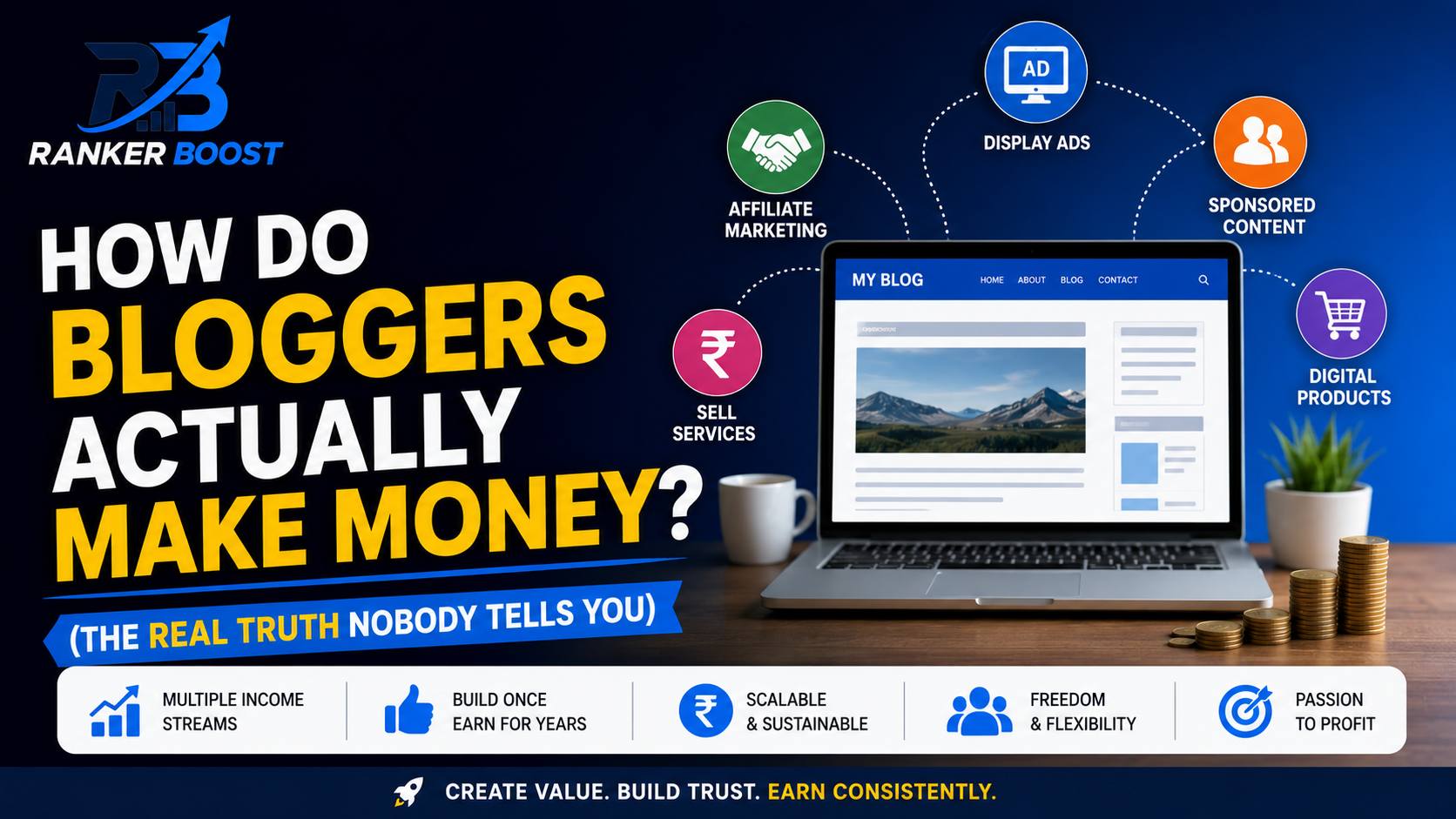
How Do Bloggers Actually Make Money? (The Real Truth Nobody Tells You)
How to Earn Money from a Blog in India – I remember the first time I stumbled onto a blogger’s lifestyle reel on Instagram.
Guy was sitting at a wooden table in some café, laptop open, iced coffee sweating beside him, and the caption said something like — “another Monday working from wherever I want.”
My immediate thought? This has to be fake.
But here’s the thing — it wasn’t. And the more I looked into it, the more I realized that blogging is one of the most misunderstood income sources out there. Not because it doesn’t work. Because nobody explains how it actually works.
So I’m going to do that today. Clearly, honestly, with real numbers where they exist — and without any of the exaggerated nonsense that fills most articles on this topic.
“How to Earn Money from a Blog in India”
First, Let’s Have an Honest Conversation About Expectations
Before I walk you through the methods, let me say something that most blogging guides won’t:
Most bloggers don’t make serious money in their first year. Some never do. Not because blogging doesn’t pay — it absolutely does — but because people treat it like a lottery ticket instead of a business.
The Indian bloggers who are genuinely earning well — think ₹50,000 to ₹3 lakh per month — got there by showing up for a long time, learning what works, and building something that has real value.
If that sounds like work, good. It is.
Now, with that out of the way, let’s get into the actual methods.
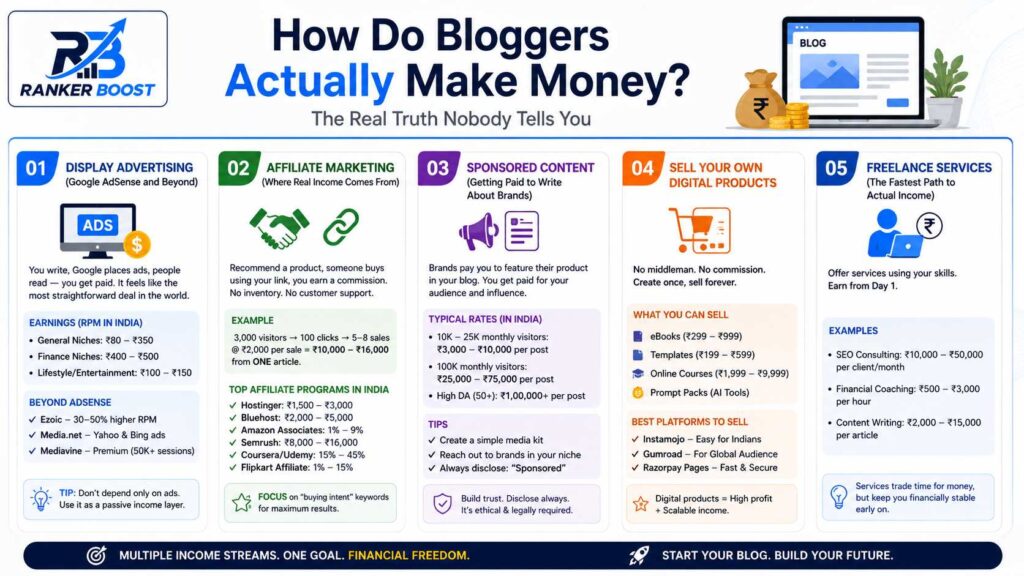
1. Display Advertising (Google AdSense and Beyond)
This is where most people start, and honestly, it makes sense. You write, Google places ads, people read — you get paid. It feels like the most straightforward deal in the world.
And in a way, it is. The problem isn’t how it works. The problem is how little it pays at low traffic volumes.
In India, AdSense RPM — that’s what you earn per 1,000 page views — typically hovers between ₹80 and ₹350 for most niches. Finance topics can push it higher, sometimes ₹400 to ₹500. But general lifestyle or entertainment content? You’re probably looking at ₹100 to ₹150.
Run the math on that. If you have 10,000 monthly page views, you’re earning ₹1,000 to ₹1,500. That’s one decent dinner, not a business.
This doesn’t mean AdSense is useless — far from it. Once your traffic crosses 50,000 to 80,000 monthly page views, ad revenue starts compounding in a way that matters. At 1 lakh page views per month, you could reasonably earn ₹10,000 to ₹25,000 from ads alone. That’s not bad when you factor in everything else stacking on top.
Beyond AdSense, a few other networks are worth knowing:
Ezoic works with blogs that have as few as 10,000 monthly visitors and often outperforms AdSense on RPM. Many Indian bloggers have reported 30–50% higher earnings after switching.
Media.net runs on Yahoo and Bing’s ad inventory. It works well alongside AdSense, especially for English content targeting Indian readers.
Mediavine is the premium tier. You need 50,000 sessions per month to qualify, but once you’re in, the RPM improvement — particularly for traffic from the US, UK, and Canada — is substantial.
The key insight here is this: don’t build your entire monetization strategy around display ads, especially early on. Treat them as a passive income layer that grows quietly while your other income sources do the heavy lifting.
2. Affiliate Marketing — Where Real Blogging Income Comes From
If you read nothing else in this article, read this section.
Affiliate marketing is the single most powerful income method for Indian bloggers, and I say that not because it sounds impressive but because the math genuinely holds up at every traffic level.
Here’s the basic idea: you recommend a product or service inside an article. Someone clicks your link and buys. You earn a commission. The sale happens on the merchant’s website — you never hold inventory, never handle customer service, never deal with refunds.
What makes this so compelling is the concept of buying intent.
Most traffic is just curiosity. Someone searching “what is DSLR photography” is browsing. Someone searching “best DSLR camera under ₹40,000 for beginners” is shopping. Same niche, wildly different value to an affiliate marketer.
The bloggers who earn serious money from affiliate marketing have learned to target the second type of search, almost exclusively.
Let me show you what the numbers look like in practice.
Say you write a well-researched article: “Best Web Hosting in India for Beginners (2026).” It ranks on the first page of Google and pulls 3,000 visitors a month. If 100 of them click your hosting affiliate link and 5 to 8 actually sign up — at roughly ₹2,000 per conversion — that’s ₹10,000 to ₹16,000 per month. From one article. Without you doing anything additional.
Now imagine 20 articles performing similarly.
The affiliate programs worth your attention in India:
Hosting affiliates are the highest-paying in the Indian market. Hostinger India pays ₹1,500 to ₹3,000 per conversion. Bluehost India offers ₹2,000 to ₹5,000. If any part of your audience is building websites or starting blogs, this alone can generate significant monthly income.
Amazon Associates India has a reputation for low commissions — 1% to 9% depending on category — but the 24-hour cookie window changes the calculation. If someone clicks your link for a ₹999 book and ends up buying a ₹45,000 laptop the same session, you earn commission on the laptop too. At volume, this adds up.
SEO tools like Semrush pay ₹8,000 to ₹16,000 per successful referral. If you write about digital marketing, content strategy, or SEO itself, this niche is disproportionately valuable.
Course platforms like Coursera and Udemy offer 15% to 45% commissions. Given how willing Indian audiences are to invest in online education, this is a growing opportunity.
Flipkart Affiliate gives 1% to 15% depending on product category. Low per-item commissions, but electronics and appliance sales can make up for it through volume.
3. Sponsored Content — Getting Paid to Write About Brands
As your blog grows, brands start noticing. And eventually, they’ll reach out with a simple proposition: “We’d like to feature our product on your blog. What do you charge?”
This is sponsored content. A brand pays you to write an article — review, comparison, feature — that includes their product. You write it in your voice, publish it on your site, and they pay you for the placement and the audience access.
The rates depend heavily on your traffic, domain authority, and niche credibility:
A newer blog with 10,000 to 25,000 monthly visitors can typically charge ₹3,000 to ₹10,000 per sponsored post. Once you’re at 1 lakh monthly visitors, ₹25,000 to ₹75,000 per post is realistic. Blogs with strong domain authority (DA 50 and above) and loyal audiences can command ₹1 lakh or more.
You don’t have to wait for brands to find you. Once you have even a modest audience, you can proactively reach out. Build a simple media kit — one page with your traffic numbers, audience demographics, and a brief description of your blog’s focus — and email it to 10 or 15 brands in your niche. In most cases, two or three will respond with genuine interest.
One thing that matters a great deal: always disclose sponsored content clearly. Mark it as “Sponsored” or “Paid Partnership.” This isn’t just an ethical standard — it’s legally required in India — and it protects the trust you’ve built with your readers.
4. Selling Your Own Digital Products
Every other method on this list involves someone else — Google, Amazon, a brand, a client. This one is different.
When you sell your own digital products, there is no commission, no middleman, no waiting for approval. You create something, price it, and keep everything that comes in. For many bloggers, this becomes their most profitable income stream once they’ve established an audience.
The beauty of digital products is that they’re created once and sold indefinitely. A PDF guide you write in a weekend can generate income for years.
What can you actually sell?
eBooks work extremely well when they solve a specific problem. Price them between ₹299 and ₹999 for the Indian market — the range where the value feels real but the decision feels easy.
Templates are underrated. Notion page templates, Canva design kits, Excel trackers, resume formats — people pay for things that save them an afternoon of work. ₹199 to ₹599 each, selling in volume.
Online courses are where the real ceiling rises. If you know something deeply — photography, cooking, copywriting, personal finance — a structured course priced at ₹1,999 to ₹9,999 can transform your monthly income. Thirty sales at ₹4,999 is ₹1.5 lakh from a single course.
Prompt packs are a newer category but growing fast. Curated prompt collections for AI tools like ChatGPT or Claude — organized by use case, niche, or workflow — are selling well in 2025 and 2026 as more people look for shortcuts.
For selling, Instamojo is the simplest starting point for Indian creators — it handles UPI, credit cards, and bank transfers out of the box. Gumroad works well for international sales. Razorpay Pages is clean, fast to set up, and integrates well with Indian payment preferences.
5. Freelance Services — The Fastest Path to Actual Income
Here’s the thing about all the methods above: they take time to generate meaningful money. Traffic builds slowly. Affiliate commissions trickle in before they flow. Products need an audience to sell to.
Services are different. Services let you earn money from day one.
Your blog is proof of what you know. If you write about fitness, you understand fitness. If you write about copywriting, you can write copy. If you write about web design, you can build websites. And there are businesses right now willing to pay for those skills.
Some realistic examples:
A blogger who writes about SEO can offer SEO consulting or implementation to small businesses — ₹10,000 to ₹50,000 per client per month.
A blogger in the personal finance space can offer financial coaching sessions — ₹500 to ₹3,000 per hour.
A tech blogger can freelance as a content writer for software companies — ₹2,000 to ₹15,000 per article.
The honest caveat: services trade time for money. They don’t scale the way passive income does. But in the early stage of a blog — when your traffic is still modest and your affiliate links haven’t found their audience yet — services are what keep you financially viable. Many of India’s most successful bloggers kept freelancing throughout their first year, then gradually shifted focus as their passive income grew.
6. Memberships and Paid Newsletters
There’s a moment in a blog’s growth where something shifts. The audience stops being anonymous traffic and starts becoming a community. People reply to your posts, follow your updates, and genuinely care what you think next.
When that happens, a paid membership or newsletter starts making sense.
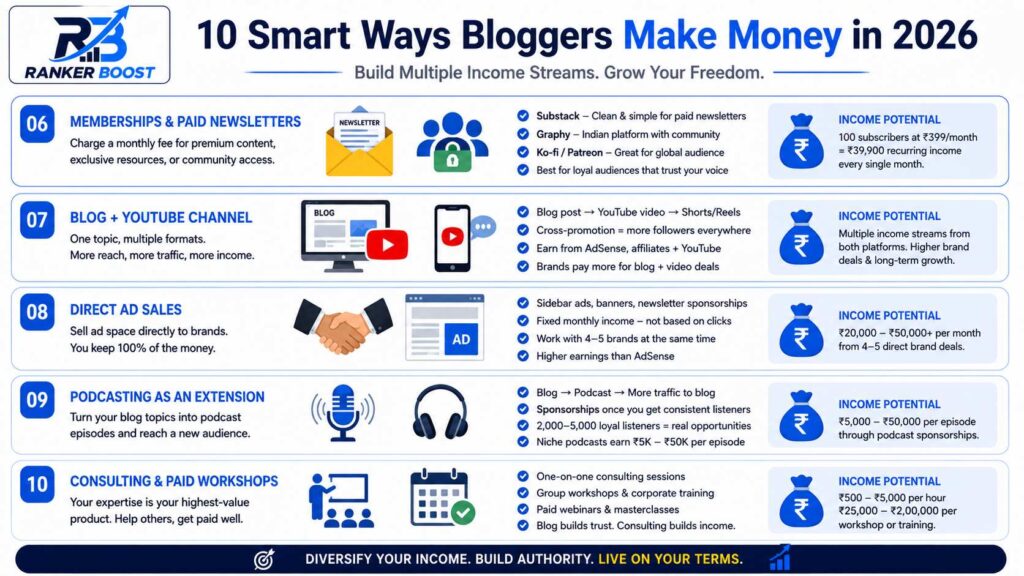
The model is simple: charge a monthly fee — ₹199 to ₹999 depending on what you offer — for premium content, deeper analysis, exclusive resources, or community access. One hundred paying subscribers at ₹399 per month is ₹39,900 recurring income. Every month. Without acquiring a single new subscriber.
Substack is the cleanest platform for paid newsletters. The setup takes twenty minutes. Graphy is an Indian platform with community features built in. Ko-fi and Patreon work well if part of your audience is international.
This model works best once you have a loyal audience that trusts your perspective — usually after you’ve been consistently publishing for at least six months to a year.
7. Running a Blog and YouTube Channel Together
This combination is possibly the smartest content strategy available to Indian creators right now, and most people still aren’t fully using it.
The workflow is more efficient than it seems: write a blog article on a topic, script a YouTube video on the same topic, record and upload, then cut a short clip for YouTube Shorts or Instagram Reels. One core piece of research, four content outputs.
More importantly, the two platforms cross-pollinate. Blog readers discover your YouTube and subscribe. YouTube viewers click the blog link in your description and bookmark it. Your Google search presence grows on both sides.
Income-wise, you’re now running two parallel streams — AdSense and affiliate links on the blog, plus YouTube monetization and brand deals on the channel. As your authority in a niche grows, brands also start paying more for sponsorships when you can offer both a blog post and a YouTube video in a single deal.
8. Direct Ad Sales — Cutting Out the Middleman
Google AdSense is convenient, but Google takes a significant cut of every ad dollar that runs through it.
Direct advertising flips that arrangement. Instead of working through a network, you contact brands directly and sell them ad space — sidebar banners, newsletter placements, article sponsorships — at a fixed monthly rate that you set.
Example: You run a travel blog focused on destinations in Rajasthan. A boutique hotel in Jaipur pays you ₹5,000 per month to display their banner on your site. That’s ₹5,000 guaranteed, regardless of clicks or impressions — compared to the ₹300 to ₹500 you might have earned from the same space through AdSense.
Work with four or five brands at once and you’re looking at ₹20,000 to ₹50,000 per month from ad space alone. This becomes realistic once your blog has a niche-specific audience that brands actually want to reach.
9. Podcasting as a Blog Extension
India’s podcast market is still in an early growth phase. That means less competition but a rapidly expanding listener base — a rare window that won’t stay open indefinitely.
The workflow is straightforward: your blog topics become podcast episodes. Your podcast drives listeners back to your blog. Your blog readers find the podcast in your author bio. Everything feeds into the same funnel.
Once your podcast reaches a meaningful listener count — even 2,000 to 5,000 regular listeners in a specific niche — sponsorship conversations become realistic. Established niche podcasts in India earn ₹5,000 to ₹50,000 per episode through sponsorships, and those deals are often negotiated separately from any blog partnerships you already have.
10. Consulting and Paid Workshops
This is where blogging’s long-term value becomes most visible.
When you’ve spent two or three years writing thoughtfully about a topic, something happens to your credibility. People stop seeing you as a blogger and start seeing you as an expert. And they want access to that expertise directly.
At that point, you can offer one-on-one consulting, group workshops, corporate training sessions, or paid webinars. The rates depend on your niche — a financial planning consultant charges differently from a fitness coach — but the range is wide:
One-on-one sessions: ₹500 to ₹5,000 per hour. Corporate workshops: ₹25,000 to ₹2,00,000 per session. Online webinars: ₹500 to ₹2,000 per ticket, with audiences of 50 to 500 participants.
The blog is what makes people trust you enough to pay for your time. The consulting is where that trust converts into its highest-value form.
Realistic Timeline: When Does the Money Actually Come?
This is the question everyone has but most guides answer dishonestly.
I’m not going to promise you a specific number by a specific date. Anyone who does that is guessing or selling something. What I can give you is a grounded sense of what consistent, quality effort typically produces:
Months 1 to 3: Focus on building. Write regularly, understand your audience, learn the basics of SEO. Income during this phase is near zero — ₹0 to ₹1,000 at most. This phase feels discouraging. That’s normal. Push through it anyway, because the foundation you build here determines everything that follows.
Months 4 to 6: Things start clicking. Your first affiliate commissions arrive. AdSense approval comes through. Income is still modest — ₹2,000 to ₹8,000 per month — but it’s real, and it’s proof the model works.
6 months to 1 year: With consistent publishing and improving SEO, income in the ₹10,000 to ₹40,000 range becomes achievable. Multiple income streams are running simultaneously now.
Year 1 to Year 2: ₹40,000 to ₹1,50,000 monthly for bloggers who’ve executed well. The blog now has authority, ranking articles, and an audience that trusts it.
Year 2 to Year 3: ₹1,50,000 to ₹5,00,000+ monthly for bloggers who’ve built in multiple monetization layers. At this point, the blog functions as a full business.
One important caveat that changes everything: this timeline assumes you’re publishing high-quality content consistently, learning SEO as you go, and actively working on monetization — not just hoping it figures itself out. For people who publish irregularly or treat the blog as a hobby, these timelines stretch considerably.
Which Niches Pay Best in India?
Not all blog topics are created equal when it comes to monetization. Here’s where the real opportunity sits:
Personal Finance is the strongest niche in India right now. Mutual funds, stock investing, insurance, credit cards, tax planning — these topics carry high ad RPMs and align with high-commission affiliate programs. Established personal finance blogs in India often earn ₹1 lakh to ₹10 lakh per month.
Technology and Gadget Reviews benefit from strong Amazon and Flipkart affiliate income. A single well-ranking review of a ₹50,000 laptop can generate ₹1,500 to ₹4,500 in affiliate commissions per sale, repeatedly, for as long as the article ranks.
Health and Fitness taps into a growing Indian market. Supplement affiliates, fitness equipment, online coaching programs, and wellness products all convert well — and the audience is willing to spend.
Digital Marketing and SEO carries triple monetization potential: high ad RPM from an educated audience, expensive software tool affiliates (Semrush, Ahrefs, etc.), and consulting opportunities that flow naturally from the authority you build.
Education and Career Guidance is consistently strong in India. Online course affiliates, exam preparation guides, career coaching — Indian families invest heavily in education, and that willingness extends to well-researched online content.
A Note on Taxes That Most Bloggers Learn Too Late
Blogging income in India is classified as business income under the Income Tax Act. If your total annual income crosses ₹2.5 lakh, you’re required to file an ITR.
For income received from international platforms — Google AdSense paid in USD, Amazon US affiliate commissions, Semrush payouts — your bank will issue a FIRC (Foreign Inward Remittance Certificate), which serves as proof of foreign income.
The advice here is simple: speak with a chartered accountant before you start earning significant amounts. Setting up your bookkeeping correctly from the beginning is far less painful than sorting it out retroactively when the numbers are larger.
Frequently Asked Questions
Yes — but with clear eyes. The opportunity is real. The people who’ve built successful blogs in India are genuinely earning significant income. The catch is that it requires sustained effort over at least a year before most people see life-changing results. If you treat it like a business from the beginning, the odds of it working are much better than most people assume.
You need a domain — roughly ₹500 to ₹800 per year — and hosting, which runs ₹2,000 to ₹4,000 per year for a good shared hosting plan. A professional WordPress setup costs ₹2,500 to ₹5,000 total to get running. Free platforms exist, but they limit what you can do with monetization and SEO.
Offering services — writing, consulting, SEO, design — is the fastest because you don’t need traffic to get started. You can approach clients directly with your blog as a portfolio. Affiliate marketing starts generating passive income in the medium term. Display ads are the slowest to build meaningful income but the most passive once they’re running.
There’s no universal answer. Hindi blogs face less competition in many niches and connect more naturally with a large Indian audience, but ad RPMs are lower and fewer premium affiliate programs actively target Hindi content. English blogs have higher earning potential per visitor and broader reach, but the competition is steeper. Hinglish — a natural mix of both, like the way educated Indians actually speak — is genuinely underserved and often performs well on both dimensions.
Absolutely. SEO-driven blogs regularly pull hundreds of thousands of visitors without a single social media account. That said, social media does accelerate the early growth phase — particularly Pinterest, which drives substantial traffic to content-rich blogs in niches like food, travel, personal finance, and lifestyle.
Look for the overlap between three things: what you know well enough to write about consistently, what people actively search for, and what has proven monetization paths (affiliate programs, advertisers, products to sell). A niche that checks all three is significantly more likely to succeed than one that only checks one or two.
Writing clearly is the foundation. SEO is non-negotiable — without it, your content doesn’t get found. Basic WordPress management is useful. Understanding how to read Google Search Console and Analytics data helps you improve. And patience, genuinely, is the most underrated skill in blogging. The people who succeed are almost always the ones who stayed in the game long enough for the results to appear.
Starting it as a side hustle is almost always the smarter move. Build the blog while keeping your income stable. When your blog income is consistently close to or exceeding what your current work pays, that’s the moment to seriously consider the transition. Jumping to full-time blogging before the income is there adds financial pressure that tends to hurt content quality — which is the exact opposite of what you need.
The Bottom Line
How to Earn Money from a Blog in India. It has made full-time incomes — and in some cases, genuinely life-changing wealth — for Indian creators across dozens of niches. The mechanism is real, the opportunity is real, and the earning potential is real.
What it requires is time, consistency, and the willingness to treat it as a business rather than a hobby.
If you’ve read this far, you’re already more serious about this than most people who click articles like this one. That matters. The gap between people who wonder about blogging and people who actually build something is almost always not talent or knowledge — it’s the decision to start and keep going.
So if you’re going to do this, start today. Not next week, not after you’ve thought about it more. Pick a niche, buy a domain, set up WordPress, and write your first article. It won’t be perfect. That’s completely fine. Nothing about this has to be perfect to work — it just has to be done.
Check out our complete How to Start a Blog in 2026 ? Ranker Boost covers all of it.