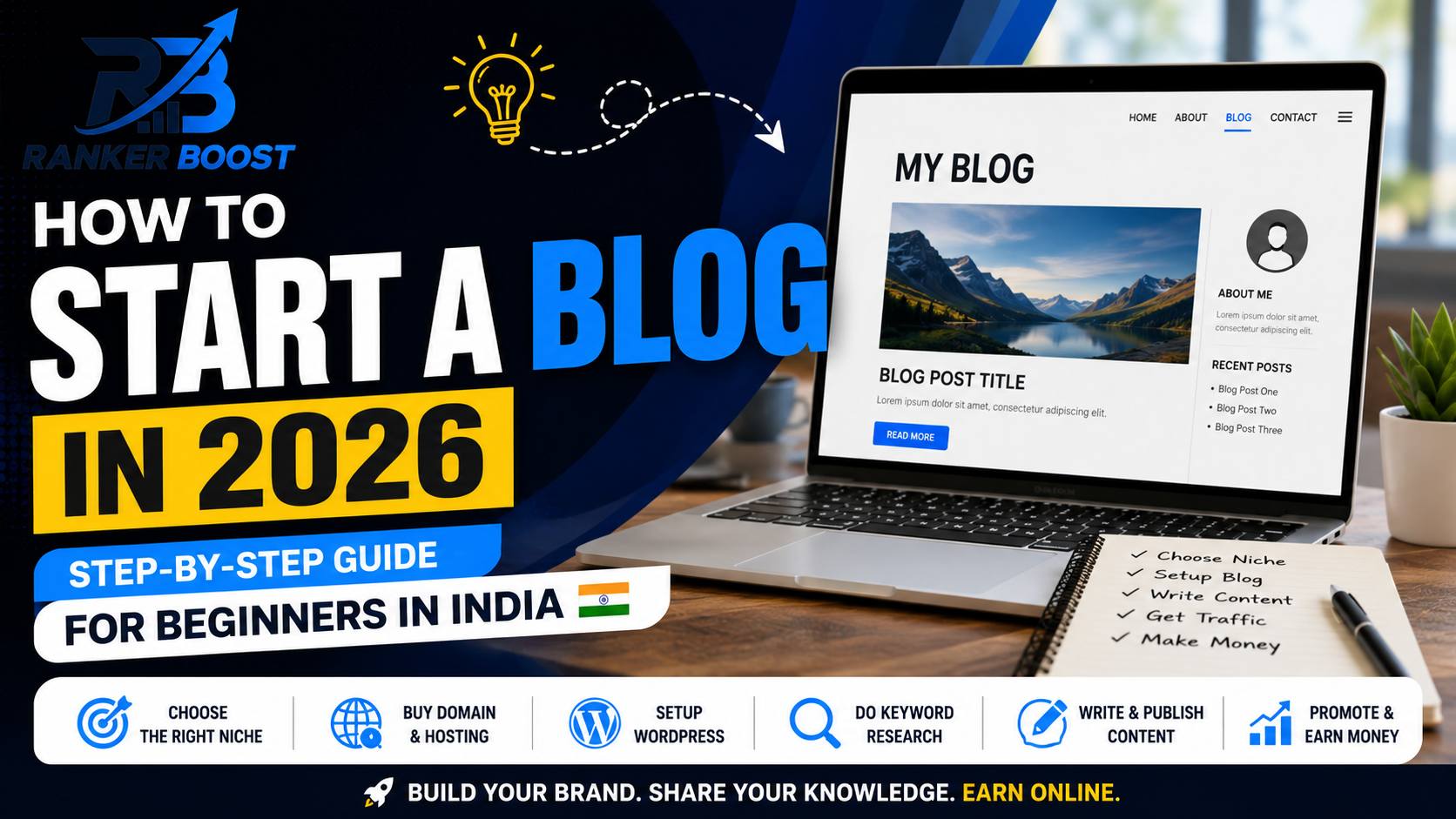
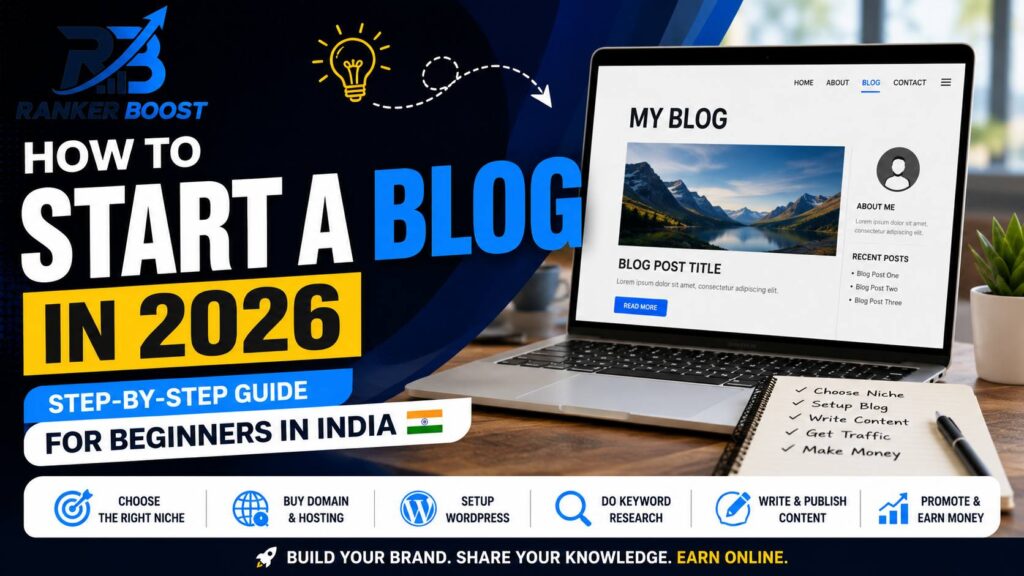
How to Start a Blog in 2026 (Step-by-Step Guide for Beginners in India)
By Saksham Verma | Updated: June 2026 |How to start a Blog
Okay, let me tell you something nobody really tells beginners.
Starting a blog? Easy. Genuinely, a monkey with a Wi-Fi connection could technically launch one in 2026. But starting a blog that actually pulls in traffic, builds a real audience, and eventually pays you something — that’s a whole different animal.
I started Ranker Boost because I got fed up reading blogging guides written for an American audience, priced in dollars, assuming I had a credit card and $500 lying around for hosting. Most of those guides quietly skip the stuff that actually matters if you’re sitting in Delhi, or Noida, or Pune, trying to piece this together from zero.
So this is the guide I wish someone had handed me two years ago. India-specific. Honest. No fluff, no filler.
Let’s get into it. How to start a Blog
Is Blogging Still Worth Starting in 2026?
This is usually the first question people ask. And fair enough — it’s a reasonable one.
Short answer: yes. But there’s a catch.
Blogging today is more crowded than it was back in 2018, or even 2022. AI has made it stupidly easy for anyone to churn out content, so there’s more noise floating around than ever. But here’s what most people miss — the bulk of that AI-written content is, frankly, garbage. Thin, generic, forgettable stuff that reads like a Wikipedia page had a baby with a textbook.
Real writing, the kind backed by actual lived experience, still wins. Google’s own guidelines now lean heavily on what they call E-E-A-T — Experience, Expertise, Authoritativeness, and Trustworthiness. They’re actively looking for content written by people who’ve actually done the thing they’re writing about.
So if you write from real experience and genuinely try to help people, blogging still works. The window hasn’t closed. It’s just gotten pickier about who it rewards.
What Kind of Blog Should You Start?
Before you go anywhere near WordPress or buy a domain, answer this question first. And answer it honestly, not the way you wish it were true.
Most beginners pick a niche based on one of two things — what seems profitable, or what they’re vaguely into. Either one on its own is usually a mistake.
The sweet spot sits where three things overlap:
Something you actually know. Not necessarily “expert” level — but you’ve spent real time in this world. Made mistakes, learned a few things, figured stuff out the hard way. That lived experience is exactly what separates your writing from the AI-flavored noise everywhere else.
Something people are actually searching for. There needs to be real demand. Your deep fascination with vintage train ticket stubs might be genuinely interesting — to you — but if nobody’s googling it, nobody’s finding it either.
Something with monetization potential. Matters a lot if you want income down the line. Finance, health, travel, digital marketing, education, food — these niches attract advertisers who actually pay, and affiliate products that actually sell.
If you’re blogging from India specifically, a few niches are working really well right now:
- Personal finance and investing (mutual funds, stock market basics, SIP guides)
- Digital marketing and blogging (yes, like this article)
- Career guidance and government exam prep
- Health and wellness with an Indian context
- Regional travel and food
Pick your niche before you do anything else. Write it down somewhere. Then spend a week just reading the top 10 blogs in that space before you write a single word of your own.
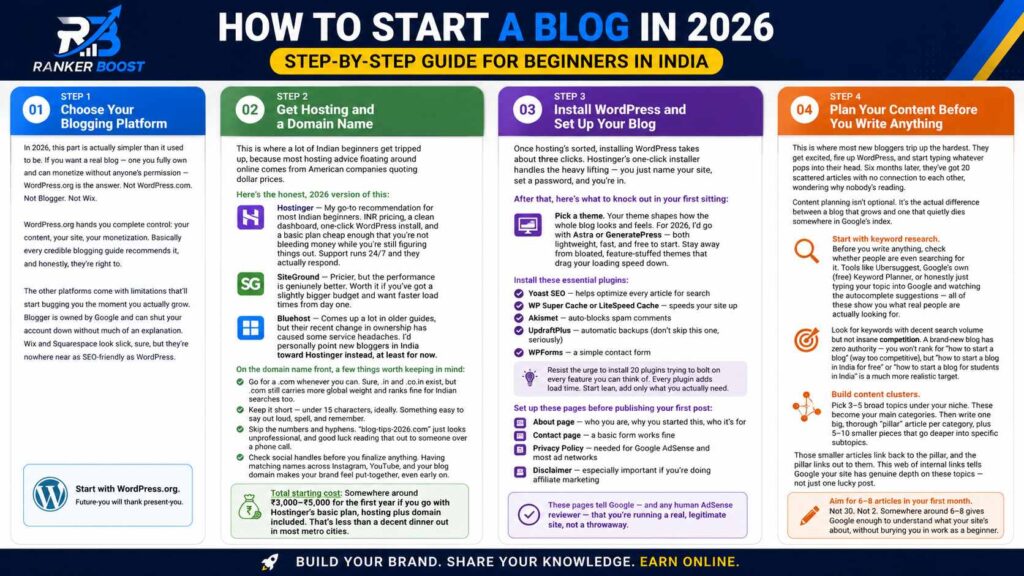
Step 1 — Choose Your Blogging Platform
In 2026, this part is actually simpler than it used to be. If you want a real blog — one you fully own and can monetize without anyone’s permission — WordPress.org is the answer. Not WordPress.com. Not Blogger. Not Wix.
WordPress.org hands you complete control: your content, your site, your monetization. Basically every credible blogging guide recommends it, and honestly, they’re right to.
The other platforms come with limitations that’ll start bugging you the moment you actually grow. Blogger is owned by Google and can shut your account down without much of an explanation. Wix and Squarespace look slick, sure, but they’re nowhere near as SEO-friendly as WordPress.
Start with WordPress.org. Future-you will thank present-you.
Step 2 — Get Hosting and a Domain Name
This is where a lot of Indian beginners get tripped up, because most hosting advice floating around online comes from American companies quoting dollar prices.
Here’s the honest, 2026 version of this:
Hostinger — My go-to recommendation for most Indian beginners. INR pricing, a clean dashboard, one-click WordPress install, and a basic plan cheap enough that you’re not bleeding money while you’re still figuring things out. Support runs 24/7 and they actually respond.
SiteGround — Pricier, but the performance is genuinely better. Worth it if you’ve got a slightly bigger budget and want faster load times from day one.
Bluehost — Comes up a lot in older guides, but their recent change in ownership has caused some service headaches. I’d personally point new bloggers in India toward Hostinger instead, at least for now.
On the domain name front, a few things worth keeping in mind:
Go for a .com whenever you can. Sure, .in and .co.in exist, but .com still carries more global weight and ranks fine for Indian searches too.
Keep it short — under 15 characters, ideally. Something easy to say out loud, spell, and remember.
Skip the numbers and hyphens. “blog-tips-2026.com” just looks unprofessional, and good luck reading that out to someone over a phone call.
Check social handles before you finalize anything. Having matching names across Instagram, YouTube, and your blog domain makes your brand feel put-together, even early on.
Total starting cost: Somewhere around ₹3,000–₹5,000 for the first year if you go with Hostinger’s basic plan, hosting plus domain included. That’s less than a decent dinner out in most metro cities.
Step 3 — Install WordPress and Set Up Your Blog
Once hosting’s sorted, installing WordPress takes about three clicks. Hostinger’s one-click installer handles the heavy lifting — you just name your site, set a password, and you’re in.
After that, here’s what to knock out in your first sitting:
Pick a theme. Your theme shapes how the whole blog looks and feels. For 2026, I’d go with Astra or GeneratePress — both lightweight, fast, and free to start. Stay away from bloated, feature-stuffed themes that drag your loading speed down.
Install these essential plugins:
- Yoast SEO — helps optimize every article for search
- WP Super Cache or LiteSpeed Cache — speeds your site up
- Akismet — auto-blocks spam comments
- UpdraftPlus — automatic backups (don’t skip this one, seriously)
- WPForms — a simple contact form
Resist the urge to install 20 plugins trying to bolt on every feature you can think of. Every plugin adds load time. Start lean, add only what you actually need.
Set up these pages before publishing your first post:
- About page — who you are, why you started this, who it’s for
- Contact page — a basic form works fine
- Privacy Policy — needed for Google AdSense and most ad networks
- Disclaimer — especially important if you’re doing affiliate marketing
These pages tell Google — and any human AdSense reviewer — that you’re running a real, legitimate site, not a throwaway.
Step 4 — Plan Your Content Before You Write Anything
This is where most new bloggers trip up the hardest. They get excited, fire up WordPress, and start typing whatever pops into their head. Six months later, they’ve got 20 scattered articles with no connection to each other, wondering why nobody’s reading.
Content planning isn’t optional. It’s the actual difference between a blog that grows and one that quietly dies somewhere in Google’s index.
Start with keyword research. Before you write anything, check whether people are even searching for it. Tools like Ubersuggest, Google’s own (free) Keyword Planner, or honestly just typing your topic into Google and watching the autocomplete suggestions — all of these show you what real people are actually looking for.
Look for keywords with decent search volume but not insane competition. A brand-new blog has zero authority — you won’t rank for “how to start a blog” (way too competitive), but “how to start a blog in India for free” or “how to start a blog for students in India” is a much more realistic target.
Build content clusters. Pick 3–5 broad topics under your niche. These become your main categories. Then write one big, thorough “pillar” article per category, plus 5–10 smaller pieces that go deeper into specific subtopics.
Those smaller articles link back to the pillar, and the pillar links out to them. This web of internal links tells Google your site has genuine depth on these topics — not just one lucky post.
Aim for 6–8 articles in your first month. Not 30. Not 2. Somewhere around 6–8 gives Google enough to understand what your site’s about, without burying you in work as a beginner.
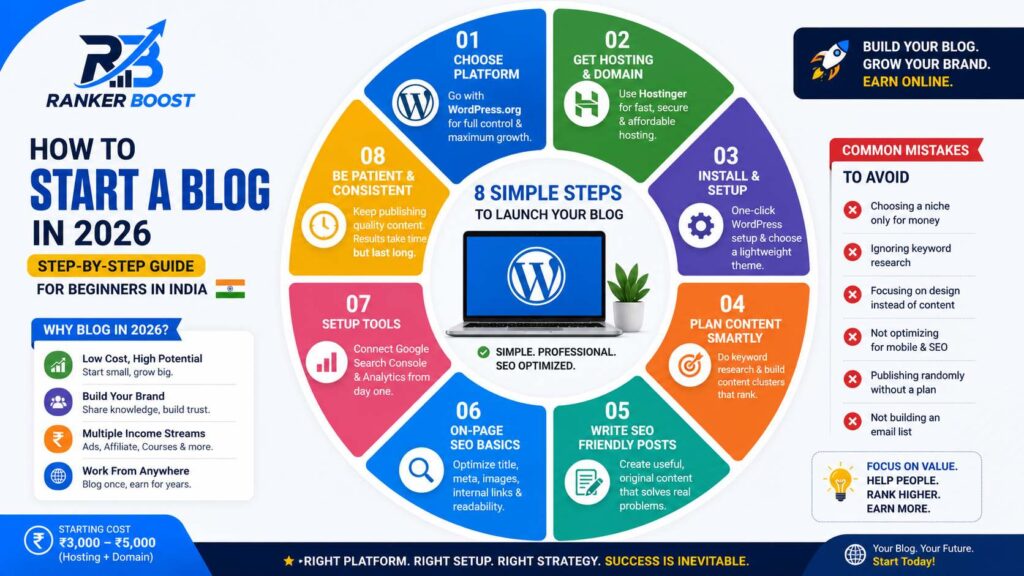
Step 5 — Write Articles That Actually Rank
Writing for SEO doesn’t mean cramming keywords into every other sentence. In 2026, that approach actively works against you.
Google wants content that genuinely helps whoever typed that search query. That’s really the whole game.
Here’s what’s working right now:
Answer the question completely. If someone searches “how to start a blog in India,” give them everything — don’t make them bounce to three other articles just to fill the gaps you left.
Write like an actual human. Read your draft out loud. If it sounds stiff or textbook-y, rewrite it. People connect with writing that sounds like it came from someone who’s actually lived the thing they’re describing.
Lean on your own experience. What went wrong for you? What caught you off guard? What do you wish someone had warned you about? These small, personal details are basically impossible to fake — and they’re exactly what Google’s quality raters are trained to notice.
Structure matters. H2s for main sections, H3s for sub-points. Keep paragraphs short — 2 to 4 sentences, tops. Use bullets and numbered lists where they genuinely add clarity, not just to make the page look less intimidating.
Aim for 1,500–2,500 words for regular posts, 3,000+ for pillar content. Longer isn’t automatically better — but for competitive keywords, thorough usually beats thin.
Step 6 — Understand Basic SEO From Day One
You don’t need to be an SEO expert before your first post goes live. But you do need the basics down, because fixing SEO mistakes after the fact is far more painful than getting it right the first time.
On-page SEO basics:
- Drop your main keyword into the title, the first paragraph, and at least one subheading
- Write a meta description that actually makes someone want to click (Yoast has a field for this)
- Add alt text to every image — just describe what’s actually in it
- Link to your own other articles within each post (internal linking)
- Link out to one or two credible external sources where it makes sense
Technical basics:
- Aim for under 3 seconds load time — check it with Google PageSpeed Insights
- Make sure it’s mobile-friendly; most Indian readers will be on their phones
- Get an SSL certificate so your URL starts with https, not http. Most hosts throw this in for free anyway.
One thing beginners almost always overlook: your permalink structure. Head to Settings > Permalinks in WordPress and choose “Post name.” That way your URLs look like rankerboost.com/how-to-start-a-blog instead of some ugly rankerboost.com/?p=123. Much cleaner — for readers and for search engines.
Step 7 — Set Up Google Search Console and Analytics
Non-negotiable, and it costs nothing.
Google Search Console shows you exactly which keywords people use to land on your site, which pages are getting seen, and any technical issues Google’s flagged. Without it, you’re basically guessing whether your SEO efforts are doing anything.
Google Analytics shows you who’s actually visiting, how long they stick around, which posts they read most, and where they’re coming from. This data tells you, in plain numbers, what’s working and what’s quietly flopping.
Set both up before your first article goes live. The sooner you start collecting data, the more useful it becomes down the line.
Step 8 — Be Patient With SEO Results
I really can’t stress this one enough.
New blogs typically need 4–6 months before any meaningful organic traffic shows up. Sometimes longer.
This is exactly where most beginners quit. They publish 10 articles, check their stats a month in, see maybe 50 visitors, and decide blogging just “doesn’t work.” Then they walk away — right before the compounding would’ve kicked in.
SEO is slow, and then suddenly it isn’t. Pages stuck on page three of Google start climbing. Articles you wrote six months ago start pulling traffic out of nowhere. The site’s overall authority builds and lifts everything else along with it.
The bloggers actually earning consistently are, almost without exception, the ones who kept writing through the boring, disappointing-numbers phase.
How to Make Money From Your Blog in India
Now let’s talk about the part everyone’s actually curious about.
Google AdSense is the easiest entry point. Once your blog has solid content and follows Google’s policies, you can apply, get approved, and place ads. You earn when visitors see or click them. Realistic range for a new blog: ₹50–₹200 per 1,000 page views. Small at first, but it scales as traffic grows.
Affiliate marketing generally pays a lot better than AdSense. You recommend products using tracked links, and when someone buys through your link, you get a cut. Indian-friendly programs worth checking out include Amazon India Associates, Hostinger, a bunch of fintech apps, and course platforms like Teachable and Graphy.
Sponsored content comes later, once you’ve got a real audience. Brands pay you to feature their product or mention their service inside your articles. Even smaller blogs with just a few thousand monthly visitors can pull ₹3,000–₹10,000 per sponsored post in the right niche.
Digital products — ebooks, templates, mini-courses — tend to have the best margins because you build them once and keep selling forever. Harder to get started with, but worth working toward.
Most consistently-earning bloggers don’t rely on just one stream — they stack two or three together.
Common Mistakes New Bloggers Make in 2026
Picking a niche purely for the money. If you don’t genuinely care about the topic, it shows in your writing, and you’ll burn out within a few months.
Obsessing over design instead of content. Spent two weeks agonizing over fonts and color palettes? That’s two weeks you didn’t spend writing articles that could actually rank. Content drives traffic. Traffic drives everything else.
Ignoring the mobile experience. In India, the vast majority of your readers will be on their phones. If your site looks broken on mobile or crawls on a 4G connection, you’re losing people before they even read a word.
Publishing in bursts, then vanishing. You can’t drop five articles, disappear for two months, post three more, and expect results. Consistency beats volume, every time. Two articles a week, week after week, beats eight articles crammed into one month followed by silence.
Skipping the email list. Social platforms change their algorithms overnight. Google updates and your rankings can drop without warning. Your email list is the one audience you actually own, full stop. Start collecting emails from day one — even a simple signup box at the bottom of your posts works.
Copying competitors instead of learning from them. Study what’s working in your niche — the structure, the topics, the depth. But write your own version, with your own experience baked in. Google’s gotten very good at spotting thin, copycat content.
Realistic Timeline for a New Blog
Everyone wants the same answer: how long until this actually pays?
Here’s the honest version of what tends to happen:
Month 1–2: Setup, first few articles published, basically zero traffic. Totally normal.
Month 3–4: Google starts indexing your stuff. A handful of articles might land on page 4 or 5. Traffic somewhere around 50–200 visitors a month — not nearly enough to monetize yet.
Month 5–6: If you’ve been consistent and the content’s solid, a few pages start climbing. Traffic might hit 500–1,500 a month. You could realistically apply for AdSense around here.
Month 8–12: Keep at it, and some articles land on page one. Monthly traffic could reach 3,000–10,000. AdSense might bring in ₹1,000–₹5,000 a month. Not life-changing, but real money.
Year 2: This is where things start to snowball. Traffic compounds faster. Old posts keep climbing. Brands start sliding into your inbox. Some bloggers hit ₹20,000–₹50,000 a month by the end of year two.
None of this is guaranteed — but it’s a realistic picture for someone writing good content consistently and refusing to quit.
Frequently Asked Questions (FAQ)
Technically, yes — Blogger and WordPress.com don’t cost anything. But free platforms come with real limitations: AdSense doesn’t run properly, you have less control, and your blog can be shut down without warning. For anything serious, spending ₹3,000–₹5,000 a year on hosting and a domain is worth it.
For a new blog, one to two well-researched articles a week is the sweet spot. Quality wins over quantity, every time. A solid 2,500-word article that fully answers a specific question will outrank five thin 500-word posts covering the same ground.
Nope. WordPress, paired with a decent theme, handles all the technical heavy lifting. You don’t need HTML, CSS, or any programming knowledge to run a successful blog in 2026.
Usually 2–4 weeks after applying, assuming your site meets their content policies. You’ll want at least 15–20 solid articles, the right pages (About, Contact, Privacy Policy, Disclaimer), and entirely original content with no copyright issues.
Hindi blogs can reach a much bigger audience in raw numbers across India. English blogs, though, tend to attract higher-paying advertisers and better affiliate commissions. A lot of successful Indian bloggers end up running bilingual content, or starting in English and adding regional-language versions later.
The range is honestly huge. Casual bloggers pulling 5,000 monthly visitors might see ₹2,000–₹5,000 a month from AdSense. Full-time bloggers with 50,000+ monthly visitors can pull ₹50,000–₹3,00,000 a month combining AdSense, affiliate income, and sponsored posts.
Personal finance, digital marketing, health and wellness, career guidance, and regional travel are all performing well for Indian audiences right now. But honestly, the best niche for you is whichever one you already know enough about that you’re not constantly stopping to Google basic facts.
Not strictly. Plenty of bloggers grow mainly through SEO and Google search traffic without much social media presence at all. That said, having even one channel — Instagram, YouTube, or Pinterest, depending on your niche — does help speed things up and gives you a backup source of traffic.
Final Thoughts
Starting a blog in 2026 really isn’t complicated. What’s hard is staying consistent when growth crawls, writing when it feels like nobody’s reading, and not quitting right before things finally start moving.
The bloggers who actually win aren’t the most talented writers out there. They’re not the most technically skilled either. They’re just the ones who keep showing up, keep learning, and keep getting a little better long after most people have already given up.
Pick your niche. Buy the domain. Set up WordPress. Write your first article — and publish it, even if it’s not perfect.
That first step is the hardest part. Everything after it is just iteration.
Found this guide useful? Next, read our Complete SEO Guide for Beginners — it covers everything you need to know about getting your new blog to rank on Google.