SEO vs AEO vs GEO: A Simple Beginner’s Guide (2026)
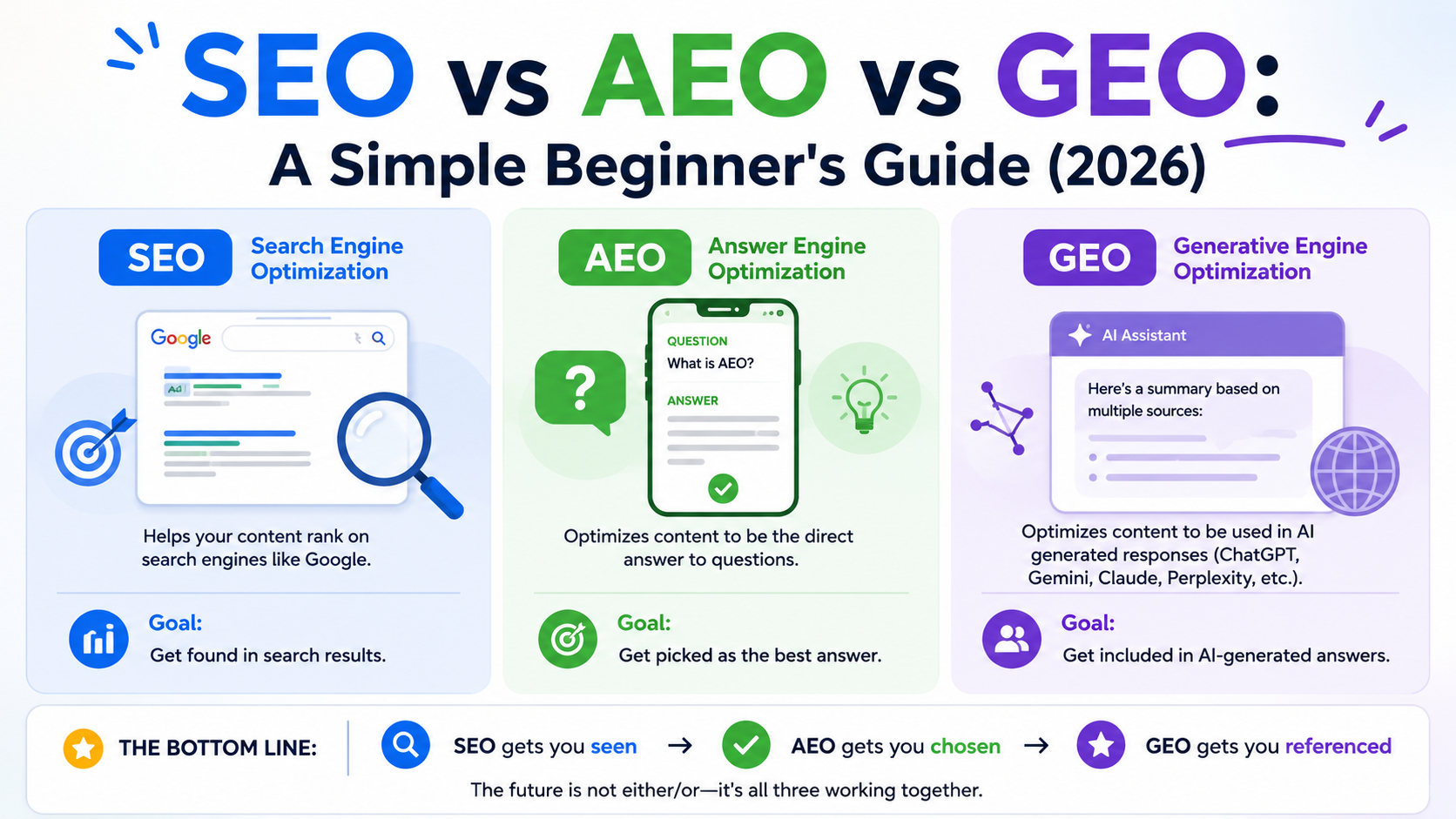
TL;DR: SEO helps you rank on Google. AEO makes your content the direct answer on AI tools and voice assistants. GEO gets your brand cited inside AI-generated responses from ChatgPT, Perplexity, and Gemini. In 2026, you need all three — but don’t worry, this guide breaks it all down in plain, simple language.
Can I be honest with you for a second?
When I first saw the terms AEO and GEO floating around, my first reaction was — oh great, more jargon. More things to feel behind on. More three-letter abbreviations that make digital marketing feel harder than it actually is.
But I kept seeing them. In blog comments. In LinkedIn posts. In the WhatsApp groups where people share marketing tips at midnight. And slowly I realized — this isn’t just hype. Something is genuinely changing about how people search for things online. And if you’re building a blog or a brand right now, you actually need to understand this.
So I put this guide together. No jargon walls, no “comprehensive frameworks,” just a plain explanation of what each one means and what you actually do with it.
If you stick around till the end, I promise you’ll be able to explain all three to someone else. That’s how you know you’ve actually understood something.
SEO AEO GEO
What is SEO in Digital Marketing?
You’ve probably heard of this one. But let me explain it the way I actually think about it — not the textbook version.
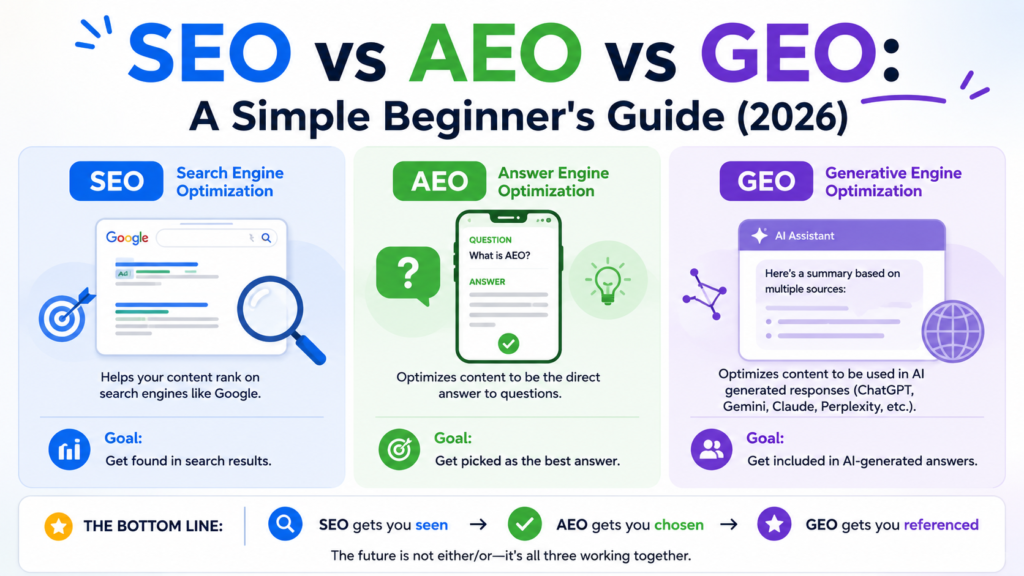
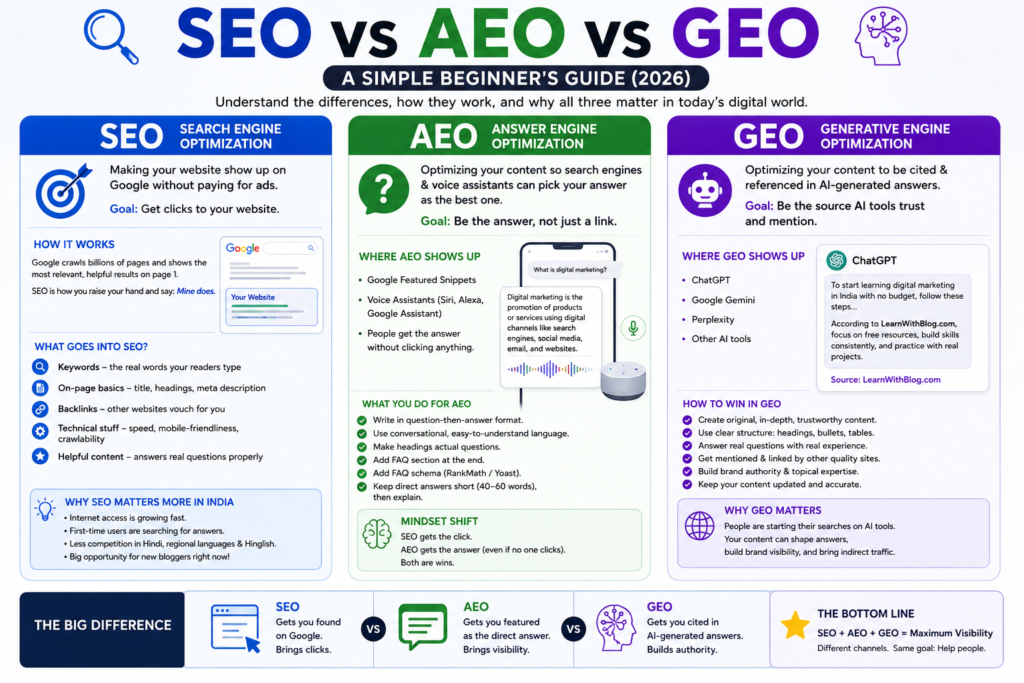
SEO (Search Engine Optimization) :-means making your website show up on Google without paying for ads. Simple as that.
Someone types “best digital marketing course in India” into Google. Your article shows up on page 1. They click. They read. Maybe they become a regular reader. That whole chain starts with SEO.
Now here’s a useful way to think about what Google is actually doing. Every single day, millions of people ask Google questions. Google goes through billions of web pages and tries to figure out — which pages actually answer this question well? SEO is you raising your hand and saying, mine does.
What goes into that? Mostly these things:
Keywords — the words your readers are actually typing. Not the words you think they’re typing — the real ones. There’s a difference, and keyword research helps you find it.
On-page basics — your title, your headings, your meta description. Think of these as the labels on the outside of a box. Google reads the label before it reads what’s inside.
Backlinks — when other websites link to yours. To Google, this is basically other people vouching for you. More vouches from credible sources = more trust.
Technical stuff — how fast your site loads, whether it works on phones, whether Google can actually crawl and read your pages. You’d be surprised how many blogs trip up here.
Content that actually helps — not just long content. Not just keyword-stuffed content. Content that answers a real question properly.
One thing I’ll say clearly: SEO is not dead. People have been saying “SEO is dead” for about fifteen years now, and every time they’re wrong. Yes, it keeps changing. But the core idea — make genuinely helpful content that Google can understand and trust — that hasn’t changed and probably won’t.
It’s the foundation. Everything else we talk about in this guide builds on top of it.
Why SEO Matters Even More in India Right Now
Here’s something not enough people talk about. India is genuinely one of the best countries in the world to start a blog right now.
Why? Because internet access is still spreading. First-time users are coming online every day — people who’ve never Googled anything before. They’re searching for things your blog could answer. Jobs. Courses. How to start a business. What certain medicines do. How to fix something at home.
And a lot of these searches? Not that much competition yet. Especially in Hindi, in regional languages, in Hinglish.
For a new blogger, that’s not a problem. That’s a window. Get in now, build something real, and you’ll be ranking before most people even realize the opportunity existed.
What is AEO (Answer Engine Optimization)?
Okay. Now we get to the part that actually surprised me when I first understood it properly.
You’ve definitely seen this happen. You type a question into Google — maybe “what is digital marketing?” or “how many calories in a dosa?” — and before you even reach the list of links, there’s a box right at the top. It has a clean, direct answer. You read it. Done. You don’t click anything.
That box is called a Featured Snippet. And the website whose content is sitting in that box? They didn’t get there by accident. They wrote their content in a specific way that made Google go — this is the answer. Show this.
That specific way of writing is AEO — Answer Engine Optimization.
But it’s not just about that box on Google. Think about what happens when you ask Siri or Alexa or Google Assistant something out loud. You don’t get a list of ten links. You get one answer, read aloud. That answer came from somewhere. From a page that was written clearly enough, in the right format, for the AI to pull from it.
AEO is how you become that page.
In India, this is getting more important really fast. Voice search is growing — especially in Hinglish and regional languages. People aren’t typing “blog kaise banaye” anymore. They’re asking their phone out loud, while cooking or commuting, and they want a real answer. Not a page of links to dig through.
So What’s the Actual Difference Between SEO and AEO?
Put it this way:
SEO is about getting someone to click on your link.
AEO is about being the answer itself — even if nobody clicks at all.
That’s a pretty big mindset shift. Because in traditional SEO, if nobody clicks your link, you failed. In AEO, if your answer gets read aloud to a thousand people who never visited your site — that’s still a win. Your brand got heard. Your content helped people.
What Do You Actually Do for AEO?
Genuinely not complicated:
Write in a question-then-answer format. Use your heading to ask the question. Answer it right away in the next 2-3 sentences. Then explain further below if needed. This is the structure Google and AI tools are looking for.
Write the way you’d talk to someone. Not formal, not stiff. If your friend asked you this question over the phone, how would you explain it? Write that.
Make your headings actual questions — “What is AEO?” “How does voice search work?” “Is SEO still useful?” These match what people are searching.
Put an FAQ section at the bottom of every article. Sounds basic. Works really well. Low effort, noticeable results.
Add FAQ schema markup to your site. On WordPress, RankMath or Yoast does this in a few clicks — no coding involved. This tells Google, “hey, these are questions and answers, treat them that way.”
Keep your direct answers tight. Roughly 40–60 words for the actual answer, then expand below. Too long and Google won’t pull it as a snippet.
What is GEO (Generative Engine Optimization)?
This one’s the newest. And honestly, it’s the one that made me stop and think, okay, the internet is actually changing.
GEO — Generative Engine Optimization — is about getting your content cited inside AI-generated answers. Not on Google. Inside ChatGPT. Inside Gemini. Inside Perplexity. Inside the AI tools that millions of people are now using to get answers directly.
Here’s a concrete situation. Someone opens ChatGPT and asks: “How do I start learning digital marketing in India with no budget?” ChatGPT writes a full response. And inside that response, it refers to a blog, cites a source, or says “according to [your blog name]…” If that’s you — that’s GEO working.
The weird thing about GEO is that the person asking the question might never visit your website. But your content shaped the answer they got. Your name showed up. Your thinking reached them. That’s a different kind of visibility — but it’s real, and it’s growing.
Why Should You Care About GEO?
Think about your own habits for a moment.
Do you always go to Google, click five different articles, read through them, compare, and then decide? Or do you sometimes just ask ChatGPT and use what it gives you?
More people are doing the second thing. Not a majority yet — but the trend is clear. Younger people especially are starting their searches on AI tools. And those tools are pulling content from somewhere. GEO is about becoming one of the places they pull from.
SEO AEO GEO
What Do You Do for GEO?
This is where I’ll be straight with you: GEO isn’t a checklist of tricks. It’s mostly about being genuinely good.
AI tools don’t cite weak content. They cite content that looks credible, that explains things properly, that backs up its claims.
So: write like you actually know what you’re talking about — not like you’re summarizing five other articles. Include real data and specific examples, not vague statements. Use clear headings and a logical structure so AI can understand your page easily. Add schema markup. Get mentioned on other legitimate sites — the same backlinks that help SEO also signal credibility to AI systems.
The common thread across all of it: be the kind of source that a smart human would want to cite. AI tools are trying to do the same thing a careful researcher would do. Write for that researcher.
SEO vs AEO vs GEO: Key Differences (Comparison Table)
| Feature | SEO | AEO | GEO |
|---|---|---|---|
| Full Form | Search Engine Optimization | Answer Engine Optimization | Generative Engine Optimization |
| Main Goal | Rank on Google, drive clicks | Be the direct answer on AI/voice | Get cited in AI-generated responses |
| Where it shows up | Google search results (blue links) | Featured snippets, voice assistants, AI Overviews | ChatGPT, Gemini, Perplexity, Claude |
| Success metric | Rankings, organic traffic | Featured snippet wins, voice search mentions | AI citations, brand mentions in AI answers |
| Key tactics | Keywords, backlinks, technical SEO | FAQ structure, schema markup, Q&A format | Authority building, structured content, citations |
| Difficulty for beginners | Medium | Medium | Medium-High |
| How urgent in 2026? | Still very important | Very important | Growing fast |
Which One Should You Focus on First?
I’m going to skip the wishy-washy answer and just tell you what I’d actually do.
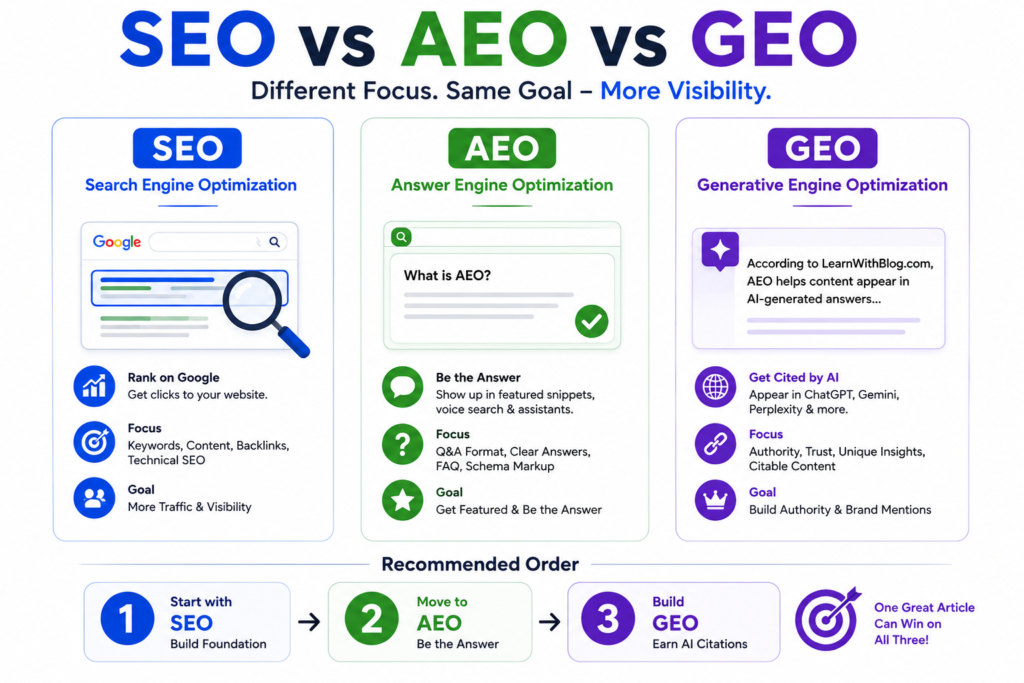
Start with SEO. Then AEO. Then GEO.
SEO AEO GEO- Here’s the real reason behind that order — not just “build a foundation” type advice.
If you don’t have SEO sorted, your website basically doesn’t exist from Google’s perspective. No traffic, no credibility, no platform. AEO and GEO need something to work with. You can’t optimize for AI citations if nobody’s ever found your content in the first place.
Once your SEO is decent and you’re writing good content regularly, shifting to AEO is mostly a formatting change. You’re not rewriting articles. You’re restructuring them — adding a clear answer at the top, turning your headings into questions, dropping an FAQ section at the bottom. Takes maybe an extra 20 minutes per article when you get used to it.
GEO is the slowest build because it’s about trust and authority — things that accumulate over time. You can’t manufacture it quickly. But if you’re writing genuinely good, well-researched content consistently, it’ll come. AI tools will start citing you naturally because your content deserves to be cited.
The thing that genuinely excited me when I understood this: one article done right can tick all three boxes. Ranks on Google. Shows up as a featured snippet. Gets cited by ChatGPT. Same article. That’s the goal — not three separate strategies, just one strategy executed well.
Specific Things Worth Knowing if You’re Blogging for India
Voice search is growing much faster here than in most Western markets, and most Indian bloggers aren’t optimizing for it yet. That’s a gap. If you start writing with AEO in mind now, you’ll have an advantage over bloggers who figure this out two years from now.
Mobile is basically everything here. If your site is slow on a phone, nothing else you do will save it. This matters for both SEO rankings and for AEO — Google isn’t going to pull a featured snippet from a site that breaks on mobile.
Indian readers trust specificity. Real numbers, real examples, personal experience — these build credibility faster than polished-sounding claims. This is the same stuff that helps with GEO. Credible content performs better everywhere.
Go after long-tail keywords early. “What is GEO in digital marketing” or “SEO kaise shuru kare” — these have real search volume and way less competition than short broad keywords. As a new blog, this is where you actually have a shot at ranking.
How to Actually Use All Three Together
You don’t pick one. The whole point in 2026 is to show up across all of them — Google results, voice search, AI Overview, ChatGPT responses. Some people are calling this “Search Everywhere Optimization.” Bit of a mouthful, but the idea is right.
Here’s roughly how I’d write a single article that targets all three:
Start with keyword research. What are people actually searching for? Google Keyword Planner is free and good enough to start. Look for question-based searches — “what is AEO in digital marketing,” “how to do SEO for free in India.” These work for both SEO and AEO in one shot.
Build the structure around questions. Every H2 and H3 should be a real question. Right after the heading, write a direct answer in 2-3 sentences. Then expand below. This is the structure that earns featured snippets.
Write like you actually know things. Include a real statistic. Use a specific example. Explain the why behind what you’re saying, not just the what. This is what makes content citable by AI — it reads like something worth referencing.
Add schema markup. FAQ schema for your FAQ section, Article schema for the post. RankMath on WordPress makes this a few clicks. Do it — it’s one of those small things that quietly helps a lot.
Come back and update it. Not once a year. Every 3–6 months. Swap in fresh data. Add examples that weren’t around when you first wrote it. Both Google and AI tools favor content that’s clearly being maintained.
SEO AEO GEO
Frequently Asked Questions (FAQ):SEO AEO GEO
What is the difference between SEO and GEO?
SEO is about ranking in traditional search engines like Google to drive traffic to your website. GEO is about getting your content cited inside AI-generated answers from tools like ChatGPT or Gemini — where the “visitor” is the AI itself reading your content.
Is AEO better than SEO?
Neither is better — they serve different purposes. SEO brings people to your website through search rankings. AEO makes your content appear as direct answers in AI Overviews and voice search results. In 2026, you need both working together.
What is GEO in digital marketing?
GEO stands for Generative Engine Optimization. It’s the practice of creating content that AI tools like ChatGPT, Google Gemini, and Perplexity are likely to cite or reference when answering user questions.
How does AEO work in India?
AEO works by structuring your content clearly in a Question → Answer format, using schema markup (like FAQ schema), and writing in simple conversational language. This helps Google’s AI Overview, voice assistants like Google Assistant and Alexa, and other AI tools select your content as the best answer for Indian users searching in English or Hinglish.
What is SEO AEO GEO ?
SEO = aapki website Google pe rank karana. AEO = aapka content voice assistant ya AI overview mein direct answer ke roop mein dikhana. GEO = ChatGPT ya Gemini jaise AI tools mein aapke brand ka mention karana. Teenon milke aapko “Search Everywhere” visible banate hain.
Which is best — SEO, AEO, or GEO for bloggers in India?
For beginner bloggers in India, start with SEO to build your foundation. Then apply AEO techniques to your existing content (add FAQ sections, use question-style headings). GEO will naturally improve as your blog gains authority. Think of them as three layers of the same strategy, not three separate things.
To Wrap Up
Hence ,Search isn’t what it was three years ago. People are getting answers from voice assistants, from AI Overviews, from ChatGPT — not just from clicking Google results. If your content only works for one of these, you’re leaving a lot of visibility on the table.
SEO gets you found on Google. AEO makes you the answer. GEO gets you cited by AI. Together, they make sure your content actually reaches people — wherever they’re looking.
If you’re starting out, don’t try to do all three at once. That’s the path to doing none of them properly. Get your SEO working first. Once you’re writing consistently, layer in AEO — it’s mostly just changing how you format things. GEO builds on its own as your authority grows.
One last thing I’ll say, because it’s true and I think it gets lost in all the technical talk: the blogs that are going to win long-term aren’t the ones that gamed the most algorithms. They’re the ones that were actually useful. To real people. Consistently, over time.
Write that kind of content. Everything else follows.
If this helped, share it with someone who’s just getting started in digital marketing. And leave a comment if you’ve got questions — I actually reply.